
China asks German press to leave a press conference
Annalena Baerbock's visit to Beijing ends with the German press out of the room and opens the debate over the industrial cost of straining relations with China.
English · Original discussion in Spanish · Published
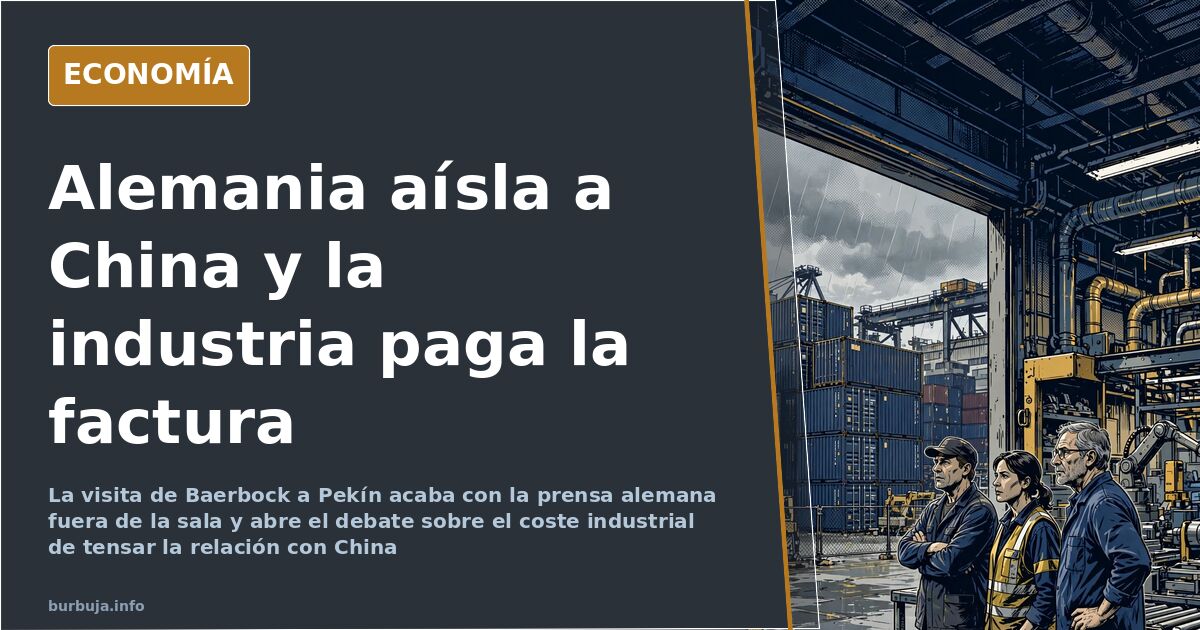
Germany strains the rope with China and its industry pays the bill
A German Foreign Minister who, according to a tweet shared in the thread, claims to put Ukraine first "no matter what my German voters think," and a visit to Beijing that ends with the German press out of the room. The episode, spread on social media and turned into material for economic debate, sums up a contradiction that costs billions: the country most dependent on the Chinese engine to sustain its automotive industry is also the one trying hardest to discomfort its main trading partner.
What peine during the visit to Beijing
The scene circulating is that of a press conference in which the spokesman of the Chinese Foreign Ministry, Lin Jian, asks the German journalists to leave the room before addressing the war in Ukraine. The minister, Annalena Baerbock, leader of the Greens, had previously declared, according to a tweet cited in the thread, that she would put Ukraine first "no matter what my German voters think," a phrase that in the context of an official visit to China sounds like calculated provocation.
The version prevailing in Chinese media and part of the international press is that there was no formal expulsion of the minister, but a request to leave in order to speak privately. The confusion between "expelled" and "journalists were asked to leave" is the first sign that the story is simmering on both sides. Chattering away, sums up the most cynical reading: no need to be bought by the enemy.
The business Germany is gambling with China
The economic core of the matter is not diplomatic, it is industrial. Germany has built its export model on Chinese demand for cars, machinery and chemicals. Every hostile gesture in Beijing has a direct translation into orders, tariffs and market share. The thesis running through the analysis is that Brussels is preparing tariffs on Chinese electric cars and that Washington is pressuring Europe to act as the battering ram in a trade war that is not its own.
Some argue the minister acts as an emissary of foreign interests, while others respond that the problem is not submission but incompetence. Ruined Germany arrives in all-powerful China to lecture it, when three decades ago it was the other way around. That reversal is the real data point.
Why is expulsion being talked about if there was no expulsion?
Because the format of the visit was broken. For a spokesman to ask the press of an invited country to leave the room is a protocol humiliation, even if it is not an expulsion. The difference matters: an expulsion is a formal act; this was a demonstration that China no longer needs to be polite to those who lecture it.
The episode adds to a list of rifts with Western leaders, from the snub to Justin Trudeau to warnings about Taiwan. The Chinese reading is that kindness is mistaken for weakness, and that domestic nationalism no longer tolerates condescending gestures.
The real cost for German industry
The question no one answers with numbers is how much of this standoff translates into jobs. Germany is already in industrial recession, with the German engine seized up by expensive energy and Chinese competition. If Beijing decides to tighten its grip on rare minerals, components or car purchases, the blow will be felt in Baden-Württemberg before Brussels.
The coldest analysis is that the EU needs China for its green transition and China needs Europe to sell. The fight is over who can hold out longer. And in that fight, German foreign policy seems to be running ahead of its industry.
The point where the analysis gets stuck is always the same: whether the snub was a minister's mistake or a strategy coordinated with Washington. No one in the material settles it. Meanwhile, German industry keeps waiting for someone to explain how you sell a car in a country you have just insulted.
Also available in: Deutsch
Summary of a discussion on Burbuja.info - Foro de economía, actualidad y política., translated from Spanish and reviewed before publication. Read the full discussion (100 replies).
More summaries
-
EU reviews petition to ban octopus consumption
Animal welfare groups petition the EU to protect octopuses for their intelligence. No law is approved, while Spain's fishing sector faces severe cuts.
-
Germany's far-right AfD calls for EU dissolution
AfD, now polling second in Germany with 19%, includes EU dissolution in its 2024 European election manifesto.
-
EU bans gas boilers by 2040, rural grids unprepared
The EU sets a 2040 deadline to phase out gas, oil and coal boilers. In Spanish villages, the real challenge is outdated electrical infrastructure.
-
Spanish teen jailed in Mexico: victim or trafficking accomplice?
An 18-year-old Spaniard has been held in a Mexican prison for seven months on kidnapping charges. Is she a victim or part of a trafficking ring? Key case details.
-
Spain's PSOE and Frente Amplio strike deal to run joint Senate lists
Spain's PSOE and Frente Amplio have reached an agreement to run joint lists for the Senate, as reported by Ignacio Escolar. Here is what it means.
-
Muslim mayor accused of stirring up unrest during riots in France
A post by Javier Negre claims the mayor of Saint-Denis, a Muslim socialist, provoked riots. Here is what is known and what is not.