
Chiloeches: two Spanish nationals and a Venezuelan woman detained
Social media blamed the Chiloeches killings on migrants; the detainees' names point to two Spaniards and a Venezuelan woman.
English · Original discussion in Spanish · Published
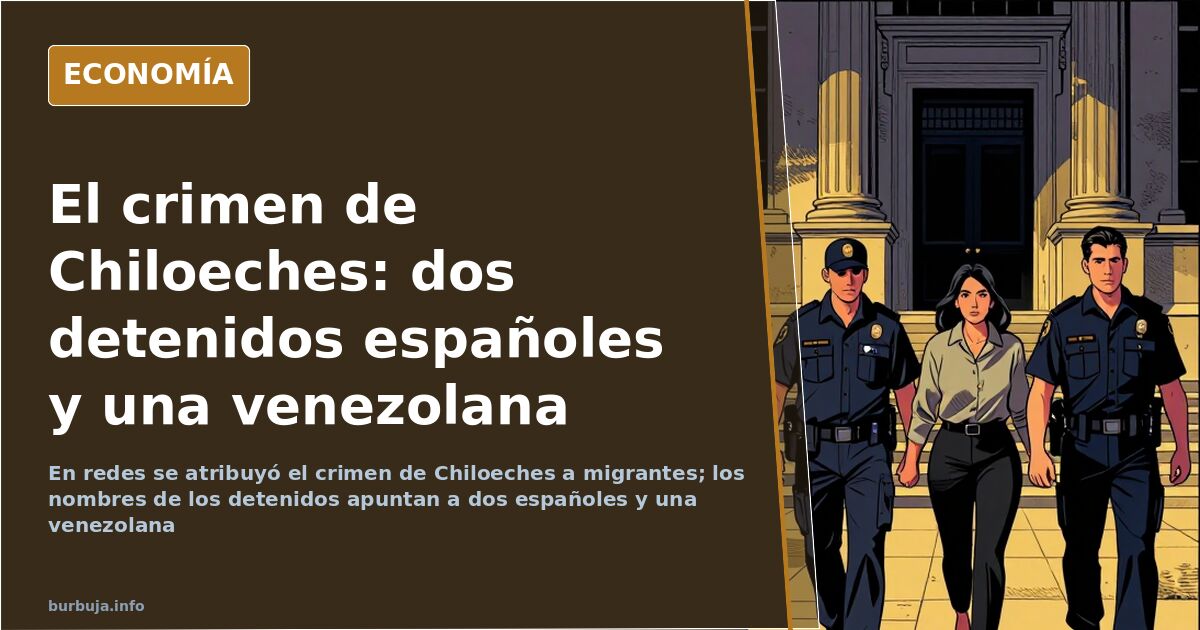
The Chiloeches killings: two Spaniards and a Venezuelan woman among the detainees
The news travelled faster than the police report. A triple killing in Chiloeches, in the province of Guadalajara, was attributed within hours to a group of migrants who allegedly entered the family's home after being invited by the daughter. When the names of those detained began to emerge —Cristian, Fernando, David—, the circulating accounts pointed to two Spaniards and a Venezuelan woman, not to the migrants who had been singled out. There is a chasm between the narrative and the names.
What is known about the Chiloeches triple killing
The incident left three dead —the two parents and one of their daughters— and a single survivor, the son. The thread maintains that the alleged perpetrators were not invited into the home, but instead had prior information about the house: routines, schedules and the detail that the parents left the door open. Much of the case revolves around that point.
The Venezuelan woman, the partner of one of the two men, was released, while the men were placed in pre-trial detention. That is the known allocation of precautionary measures. From there, the matter ceased to be an investigation and became political raw material.
The message that fixed the narrative before the facts
A widely shared message on social media attributed the crime to a group of migrants, with the added claim that the daughter had invited them to her home. That detail —the invitation and the profile of the perpetrators— does not appear in the published accounts. The sequence recalls other episodes in which the identity of the alleged perpetrators becomes known before their presumption of innocence.
When the names came to light, the narrative cracked. According to what is suggested in the debate, the access was not an invitation, but the use of information that the family itself had reportedly discussed with those around them. The difference is not minor: a breach of trust became a plan.
The bookseller, the shotgun and the price of self-defence
The most widely discussed issue is the response the father might have given. Cited as an uncomfortable mirror is the conviction of a bookseller for disproportionate use of force. The implicit question: if the father had responded with a weapon, would his family have survived but he have ended up in prison?
Some argue that the legal system punishes real self-defence and rewards theoretical self-defence, with a proportionality impossible to apply when someone enters your home at night. Against that weighs the classic argument: raising the bar for legitimate self-defence prevents an error of judgment from ending in tragedy. The disagreement is old and has not moved an inch.
Do-goodism, security and the cost of trusting
Another strand points to self-protection. It is argued that a culture of trust —opening your home, showing what you have, ignoring whom your family associates with— is free until it stops being free. Do-goodism kills is the most repeated phrase, and it sums up a thesis: security is not a service you delegate, it is a habit you teach.
On the other side, another reading points out that turning every crime into a lesson in preventive sarracena distributes blame among the victims. The son survived. The parents did not choose to be murdered; at most, they underestimated a risk. The boundary between prudence and victim-blaming is exactly where this discussion gets stuck.
The political framing of the case
The battle over framing peine quickly. One part of the analysis reproaches that the incident was instrumentalised to reinforce the discourse on immigration and crime while the facts pointed in another direction. Another part responds that, in parallel, there was an attempt to fit it into the category of gender-based violence, something the facts do not support when the alleged perpetrators are two men and a woman charged with cover-up. Each side chooses the label that suits it.
The municipality also entered the conversation because of its election result. That detail was used as a pretext to read the crime through the lens of the vote. It is the usual race: attaching every incident to the nearest party banner.
From Pioz to Chiloeches: the geography of the incident
Chiloeches is in Guadalajara, a short distance from Pioz, the scene of another multiple killing that has become an inevitable reference. The comparison serves those who want to underline the recurrence of cases in the area, but also those who want to dismantle the ethnic reading: in Pioz the perpetrator was a relative of the victims, of Brazilian nationality. The fact cuts both ways.
What remains, after the noise, is an open case, three dead and one survivor. And an uncomfortable question: who benefits from a crime being explained before it is known?
The news travelled faster than the police report. A triple killing in Chiloeches, in the province of Guadalajara, was attributed within hours to a group of migrants who allegedly entered the family's home after being invited by the daughter. When the names of those detained began to emerge —Cristian, Fernando, David—, the circulating accounts pointed to two Spaniards and a Venezuelan woman, not to the migrants who had been singled out. There is a chasm between the narrative and the names.
What is known about the Chiloeches triple killing
The incident left three dead —the two parents and one of their daughters— and a single survivor, the son. The thread maintains that the alleged perpetrators were not invited into the home, but instead had prior information about the house: routines, schedules and the detail that the parents left the door open. Much of the case revolves around that point.
The Venezuelan woman, the partner of one of the two men, was released, while the men were placed in pre-trial detention. That is the known allocation of precautionary measures. From there, the matter ceased to be an investigation and became political raw material.
The message that fixed the narrative before the facts
A widely shared message on social media attributed the crime to a group of migrants, with the added claim that the daughter had invited them to her home. That detail —the invitation and the profile of the perpetrators— does not appear in the published accounts. The sequence recalls other episodes in which the identity of the alleged perpetrators becomes known before their presumption of innocence.
When the names came to light, the narrative cracked. According to what is suggested in the debate, the access was not an invitation, but the use of information that the family itself had reportedly discussed with those around them. The difference is not minor: a breach of trust became a plan.
The bookseller, the shotgun and the price of self-defence
The most widely discussed issue is the response the father might have given. Cited as an uncomfortable mirror is the conviction of a bookseller for disproportionate use of force. The implicit question: if the father had responded with a weapon, would his family have survived but he have ended up in prison?
Some argue that the legal system punishes real self-defence and rewards theoretical self-defence, with a proportionality impossible to apply when someone enters your home at night. Against that weighs the classic argument: raising the bar for legitimate self-defence prevents an error of judgment from ending in tragedy. The disagreement is old and has not moved an inch.
Do-goodism, security and the cost of trusting
Another strand points to self-protection. It is argued that a culture of trust —opening your home, showing what you have, ignoring whom your family associates with— is free until it stops being free. Do-goodism kills is the most repeated phrase, and it sums up a thesis: security is not a service you delegate, it is a habit you teach.
On the other side, another reading points out that turning every crime into a lesson in preventive sarracena distributes blame among the victims. The son survived. The parents did not choose to be murdered; at most, they underestimated a risk. The boundary between prudence and victim-blaming is exactly where this discussion gets stuck.
The political framing of the case
The battle over framing peine quickly. One part of the analysis reproaches that the incident was instrumentalised to reinforce the discourse on immigration and crime while the facts pointed in another direction. Another part responds that, in parallel, there was an attempt to fit it into the category of gender-based violence, something the facts do not support when the alleged perpetrators are two men and a woman charged with cover-up. Each side chooses the label that suits it.
The municipality also entered the conversation because of its election result. That detail was used as a pretext to read the crime through the lens of the vote. It is the usual race: attaching every incident to the nearest party banner.
From Pioz to Chiloeches: the geography of the incident
Chiloeches is in Guadalajara, a short distance from Pioz, the scene of another multiple killing that has become an inevitable reference. The comparison serves those who want to underline the recurrence of cases in the area, but also those who want to dismantle the ethnic reading: in Pioz the perpetrator was a relative of the victims, of Brazilian nationality. The fact cuts both ways.
What remains, after the noise, is an open case, three dead and one survivor. And an uncomfortable question: who benefits from a crime being explained before it is known?
Summary of a discussion on Burbuja.info - Foro de economía, actualidad y política., translated from Spanish and reviewed before publication. Read the full discussion (246 replies).
More summaries
-
Six Dead as Truck Plows Through Guardia Civil Checkpoint
Truck hits GAR elite unit checkpoint in Los Palacios: six dead, two officers. Driver, negative for alcohol and drugs, remains in pre-trial detention.
-
Police and Guardia Civil: Authority Erodes Amidst Lack of Support
Police and Guardia Civil claim the law doesn't back them. From lockdowns to ITV fines, the debate over fading authority.
-
Córdoba Father Self-Immolates: Mental Illness or Societal Despair?
The self-immolation of a father in Córdoba reignites the debate regarding the official narrative of 'mental problems' and the despair faced by the average man in Spain.
-
Euthanasia in Old Age: Autonomy vs. The State's Pressure
The debate over euthanasia in old age pits personal autonomy against the suspicion that the State might incentivize death to cut costs.
-
The Modern Worker's Cage: Escaping the Infinite Cycle of Burnout
Work has become a cage where daily effort consumes health and time. Discover why we push ourselves so hard and how to break the cycle.
-
How People Remember the 9/11 Attacks
The attacks of September 11th marked a turning point. Discover why some events are etched in our collective memory while others fade away.