
Childless Couples: Spain's Demographic Crisis
In Spain, two incomes no longer cover housing or child-rearing costs. This debate explores falling birth rates and the sustainability of pensions in an aging society.
English · Original discussion in Spanish · Published
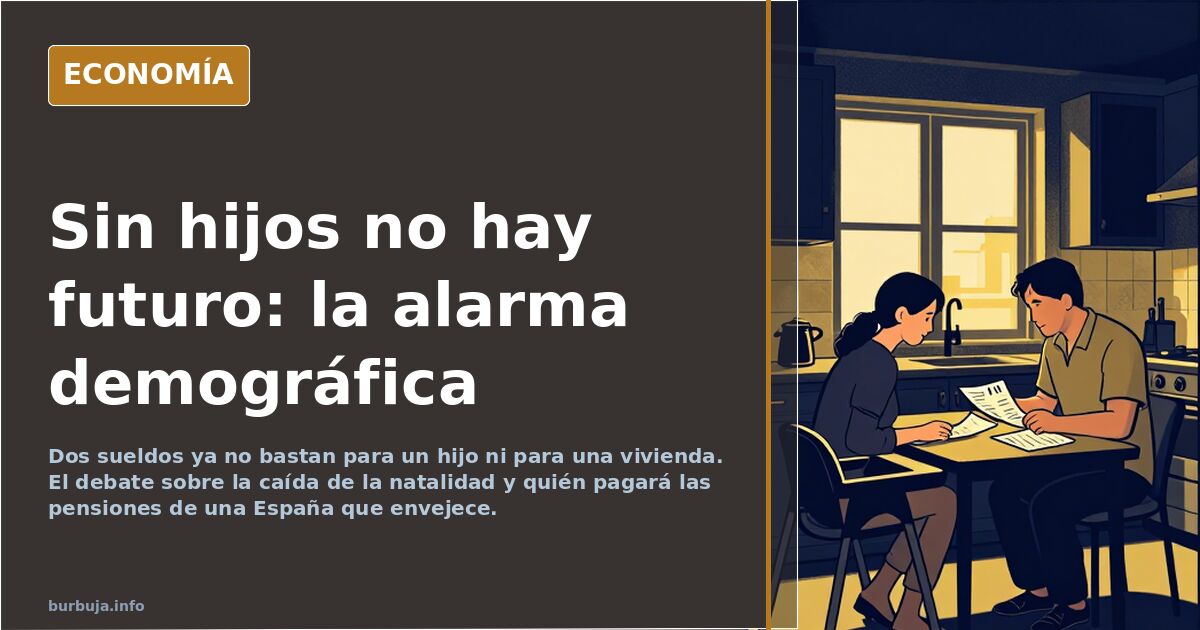
The Future Belongs to Childless Couples
Fifty years ago, a single salary supported a household, a paid-off car, and four children. Today, two paychecks are insufficient for one child or homeownership. This reality underpins an uncomfortable diagnosis: the family model that sustained Spanish demographics for decades has collapsed, yet few acknowledge why.
The discussion begins with a thesis blending economics and demographics: living costs, taxation, and consumption patterns have made raising children a luxury. Consequently, the debate shifts to sensitive topics: declining birth rates, population aging, pension sustainability, and who will fund a society without generational replacement.
The True Cost of Raising Children in Spain
The starting point is a domestic calculation many recognize: two salaries no longer cover what one once did. Housing, transport, food, and taxes have eroded the financial margin previously available for child-rearing. The result is a generation delaying or abandoning parenthood due to arithmetic, not conviction.
Some argue money isn't the sole issue. Modern life has suppressed biological needs, much like other desires. There is never a good time, never enough inclination, always pending travel plans. By age forty-three, many end up at fertility clinics facing time constraints.
Opposing this view, another current responds bluntly: without children, there is no future. This is not hyperbole but demographic description. Without generational replacement, the pension system, healthcare, and labor market rest on a narrowing foundation.
Why Has Generational Replacement Broken?
The most common explanation points to profound cultural change. Decades of public discourse may have detached motherhood and fatherhood from life projects. Willingness, rather than economic capacity, becomes the decisive factor. Without desire for children, subsidy policies fail.
Another analysis highlights the tax system and labor market. Childless individuals contribute, consume, and pay taxes without family burdens. The state collects more from those without dependents while spending less on them. Under this logic, childless couples are not victims but ideal customers.
Optimists assume public aid will correct trends. Pessimists start from different premises: aid arrives late, is insufficient, and cannot reverse decisions made before considering finances.
Clash Between Lifestyle and Economic Models
The conversation evolves into a clash of models. One side defends childlessness as legitimate, arguing the problem lies not in absence of children but lack of conditions to raise them. The other views declining birth rates as silent extinction nobody wants to confront.
Amidst this, a familiar scene emerges: grandparents' home, children and grandchildren around a table, repeating 'this is what matters most.' Contrasted against travel, adults-only hotels, and anticipated lonely old age.
Full material, including detailed calculations and opposing views, reveals a gap worth reading entirely. The debate concerns not preferences but who pays for a non-reproducing society.
Pensions, Inheritance, and State Revenue
An rarely explicit economic derivative exists. Childless individuals generate no direct heirs; assets often revert to the state. Meanwhile, they contribute throughout life without family burdens. Result: silent resource transfer from childless couples to public coffers.
Conversely, regarding pensions, many believe contributions accumulate personally. They do not: funds immediately support current retirees. When today's workers reach sixty-five, reserves will be empty without demographic replacement.
Some add an uncomfortable nuance: children of parents will sustain the system. Others won't. Who pays whom lacks comfortable answers.
Cultural Dimension
Analysis shifts to culture. Some argue society rewarded consumption, experience, and individualism over long-term projects. Consequence: old age without family networks and non-reproducing society.
Others counter problems are material, not cultural. Without affordable housing, job stability, and time, pro-natal campaigns fail. Culture trinc wallets, not vice versa.
Disorienting fact remains simple: if anything defines future, it's childless couples. Neither side seems to have plan changing it.
Also available in: Deutsch
Summary of a discussion on Burbuja.info - Foro de economía, actualidad y política., translated from Spanish and reviewed before publication. Read the full discussion (103 replies).
More summaries
-
Spain's Demographic Crisis Fuels End-of-History Fears
RTVE reports that 70% of Spanish women aged 35 are childless, reviving debates on the end of history amid falling birth rates.
-
Spain's Birth Rate Collapse: Causes Under Debate
Spain faces a demographic winter driven by housing, wages, and culture. Forum users cite a fertility rate of 0.5 in the Basque Country.
-
Traditional Couple Crisis: Housing, State, and Feminism
A calculation attributes 75% of breakups initiated by women to the crisis between feminism, the State, and housing.
-
Sol Occupiers Expel Horizon Reporter Rebeca Crespo for Second Night
Occupiers in Madrid's Puerta del Sol block Horizon reporter Rebeca Crespo for two consecutive nights, reigniting the debate on press freedom and public space access.
-
Smoke over Madrid: remote work yes, office no, applause banned?
Smoke over Madrid: remote work for some, the office for others. The advice to stay home clashes with the reality of working life.
-
23 finals, 23 wins: myth or reality of Spanish football
Spain's national team, Real Madrid and Barcelona have won all 23 finals they played over 25 years, but the stat leaves out tournaments like the Nations League. Reality or bias?