
Chemistry Degree: A Qualification with Limited Opportunities in Spain
The Chemistry Degree sees more graduates but few job offers. The private sector pays poorly, and the best paths require a master's or doctorate.
English · Original discussion in Spanish · Published
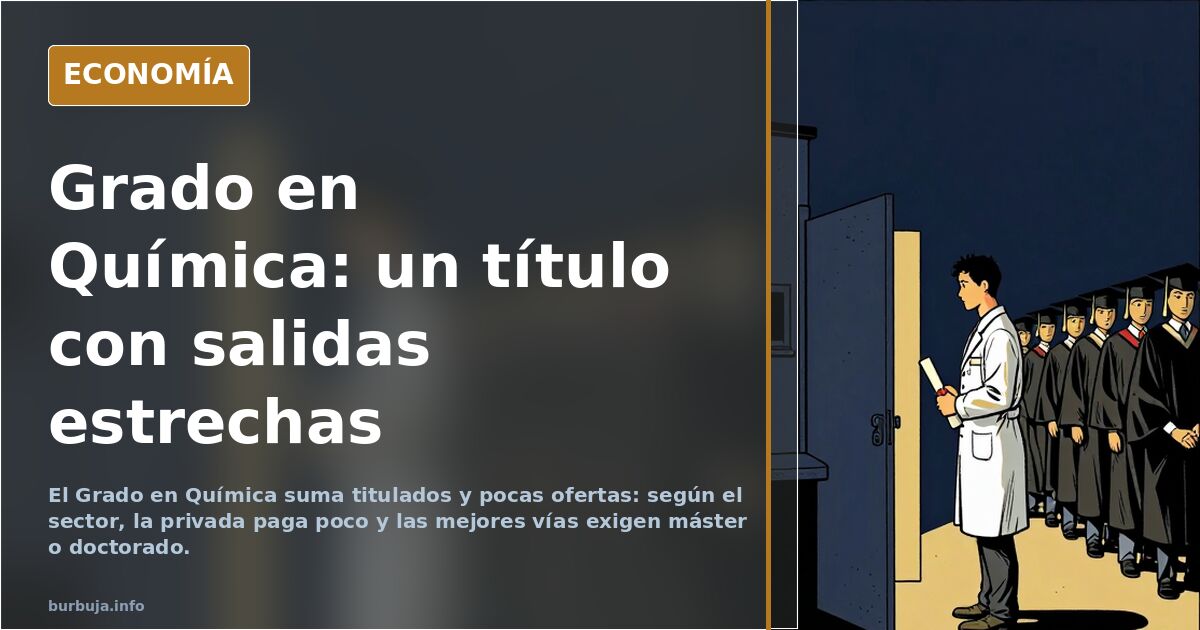
Chemistry Degree: A Qualification with Limited Opportunities in Spain
What does a recent Chemistry graduate do if she doesn't want to teach teenagers, doesn't want to leave Spain, and doesn't want to move to Madrid? The question, posed on a forum by a relative, leads to an uncomfortable diagnosis: the career paths are unclear. The Chemistry Degree — note, not Chemical Engineering, which is different — is producing more graduates, according to those working in the sector, than the market can absorb. The doubt isn't hers alone: it belongs to a country that promotes the degree as a central science and then doesn't know where to place its graduates.
Chemistry Degree vs. Chemical Engineering: Not the Same
The first confusion in this case is the title itself. A Chemistry Degree, according to several participants, has a narrower horizon than a Chemical Engineering degree, and the difference isn't just cosmetic: engineering opens doors even in a nuclear power plant; the pure degree might end up, in the worst-case scenario, at a local herbalist's shop or a pharmacy counter. The diagnosis from a graduate who went through the program is stark: you leave with a superficial grasp of analytical, organic, inorganic, and physical chemistry, without specific competence in anything.
There's a detail that this graduate summarizes better than any statistic. The introductory lecture assured them that Chemistry was the central science; the final year lecture added the opposite: get a doctorate, because the degree alone is worthless. Between those two statements lies an entire degree program and, incidentally, a whole problem with the design of the university system.
What Do Chemists Do in Spain?
In the chemical-pharmaceutical sector, the picture painted by a professional in the field is one of hunger and misery in the private sector. There are too many graduates — chemists, chemical engineers, biologists, biochemists, biotechnologists, pharmacists — and not enough attractive job offers. The pharmaceutical industry absorbs some, but few and highly selected. In the lab, the message is direct: according to this same source, tests are performed by vocational training technicians; the chemist writes protocols, reports, and deviations, or acts as a quality control manager, which involves more meetings than pipettes.
There are openings in quality control in the food industry, environmental analysis — wastewater, soil treatment — fertilizers, craft breweries, and technical sales. And one path that a forum user points to as the best-paid without leaving Spain: pharmaceutical registration.
Huelva, Seville, León, Asturias: The Possible Map
Geography matters, and here it weighs double. With family spread across the south of Castilla y León, Extremadura, and western Andalusia, and with Madrid ruled out, the map narrows to a few points. The Huelva Chemical Hub appears only once in the entire conversation. In Seville, there's Persán. In León, there are several pharmaceutical companies. In Asturias, a chemical plant. It's not a wide range, but it's the range that exists.
Moving to a lab position doesn't solve it either: the pure lab role, precisely what she's looking for, is, according to those who know, the worst paid and the easiest to replace. The consequence is a familiar paradox: the degree requiring the most years of study offers the least protection at the start of a professional career.
One Suggested Path: From Intern to Over €100,000
One of the routes suggested by a forum user is this: a master's in Pharmaceutical Registration, start as an intern in a company, and within two to four years, earn between €40,000 and €50,000. Then, move to a pharmaceutical company and, within a decade, exceed €100,000. In contrast, another participant describes the most common scenario as a master's degree that can cost €10,000 and a first contract for little more than the minimum wage.
Almost the entire sector fits between these two extremes. The protagonist of the case has explored civil service exams like the QIR, aimed at lab work, but wants to start working now.
Master's, Doctorate, or Go Abroad
Those who have been through it agree: without specialization, there's nothing. At least a master's degree; if you truly want to do research, a doctorate. And beware of the uncomfortable detail: the lab work, what attracts her most, is precisely what pays the least and is most easily covered by someone with vocational training. Among the chemists known by several forum users, the most common outcome is teaching in secondary school, which in this case is ruled out by vocation.
There are also unexpected endings. A graduate with a precarious work history ended up applying for a concierge position and now has a stable salary and a comfortable job. Another ended up teaching after three years abroad. Emigration, and Germany in particular, is the path pointed out by a graduate who has done well outside the country.
The real problem isn't having chosen Chemistry. It's discovering it at the end, when it's time to decide.
So, the system promotes a degree as a central science and then leaves the recent graduate as an intern in a registration department. Central, yes. The central point is paying for another master's to finally be profitable.
What does a recent Chemistry graduate do if she doesn't want to teach teenagers, doesn't want to leave Spain, and doesn't want to move to Madrid? The question, posed on a forum by a relative, leads to an uncomfortable diagnosis: the career paths are unclear. The Chemistry Degree — note, not Chemical Engineering, which is different — is producing more graduates, according to those working in the sector, than the market can absorb. The doubt isn't hers alone: it belongs to a country that promotes the degree as a central science and then doesn't know where to place its graduates.
Chemistry Degree vs. Chemical Engineering: Not the Same
The first confusion in this case is the title itself. A Chemistry Degree, according to several participants, has a narrower horizon than a Chemical Engineering degree, and the difference isn't just cosmetic: engineering opens doors even in a nuclear power plant; the pure degree might end up, in the worst-case scenario, at a local herbalist's shop or a pharmacy counter. The diagnosis from a graduate who went through the program is stark: you leave with a superficial grasp of analytical, organic, inorganic, and physical chemistry, without specific competence in anything.
There's a detail that this graduate summarizes better than any statistic. The introductory lecture assured them that Chemistry was the central science; the final year lecture added the opposite: get a doctorate, because the degree alone is worthless. Between those two statements lies an entire degree program and, incidentally, a whole problem with the design of the university system.
What Do Chemists Do in Spain?
In the chemical-pharmaceutical sector, the picture painted by a professional in the field is one of hunger and misery in the private sector. There are too many graduates — chemists, chemical engineers, biologists, biochemists, biotechnologists, pharmacists — and not enough attractive job offers. The pharmaceutical industry absorbs some, but few and highly selected. In the lab, the message is direct: according to this same source, tests are performed by vocational training technicians; the chemist writes protocols, reports, and deviations, or acts as a quality control manager, which involves more meetings than pipettes.
There are openings in quality control in the food industry, environmental analysis — wastewater, soil treatment — fertilizers, craft breweries, and technical sales. And one path that a forum user points to as the best-paid without leaving Spain: pharmaceutical registration.
Huelva, Seville, León, Asturias: The Possible Map
Geography matters, and here it weighs double. With family spread across the south of Castilla y León, Extremadura, and western Andalusia, and with Madrid ruled out, the map narrows to a few points. The Huelva Chemical Hub appears only once in the entire conversation. In Seville, there's Persán. In León, there are several pharmaceutical companies. In Asturias, a chemical plant. It's not a wide range, but it's the range that exists.
Moving to a lab position doesn't solve it either: the pure lab role, precisely what she's looking for, is, according to those who know, the worst paid and the easiest to replace. The consequence is a familiar paradox: the degree requiring the most years of study offers the least protection at the start of a professional career.
One Suggested Path: From Intern to Over €100,000
One of the routes suggested by a forum user is this: a master's in Pharmaceutical Registration, start as an intern in a company, and within two to four years, earn between €40,000 and €50,000. Then, move to a pharmaceutical company and, within a decade, exceed €100,000. In contrast, another participant describes the most common scenario as a master's degree that can cost €10,000 and a first contract for little more than the minimum wage.
Almost the entire sector fits between these two extremes. The protagonist of the case has explored civil service exams like the QIR, aimed at lab work, but wants to start working now.
Master's, Doctorate, or Go Abroad
Those who have been through it agree: without specialization, there's nothing. At least a master's degree; if you truly want to do research, a doctorate. And beware of the uncomfortable detail: the lab work, what attracts her most, is precisely what pays the least and is most easily covered by someone with vocational training. Among the chemists known by several forum users, the most common outcome is teaching in secondary school, which in this case is ruled out by vocation.
There are also unexpected endings. A graduate with a precarious work history ended up applying for a concierge position and now has a stable salary and a comfortable job. Another ended up teaching after three years abroad. Emigration, and Germany in particular, is the path pointed out by a graduate who has done well outside the country.
The real problem isn't having chosen Chemistry. It's discovering it at the end, when it's time to decide.
So, the system promotes a degree as a central science and then leaves the recent graduate as an intern in a registration department. Central, yes. The central point is paying for another master's to finally be profitable.
Summary of a discussion on Burbuja.info - Foro de economía, actualidad y política., translated from Spanish and reviewed before publication. Read the full discussion (226 replies).
More summaries
-
The Spanish educational divide: Castilla y León approaches European excellence
Madrid, Castilla y León, Asturias and Cantabria exceed the OECD average in PISA, but the rest of Spain drags down the national result. The internal gap is...
-
Euthanasia in Old Age: Autonomy vs. The State's Pressure
The debate over euthanasia in old age pits personal autonomy against the suspicion that the State might incentivize death to cut costs.
-
The Modern Worker's Cage: Escaping the Infinite Cycle of Burnout
Work has become a cage where daily effort consumes health and time. Discover why we push ourselves so hard and how to break the cycle.
-
How People Remember the 9/11 Attacks
The attacks of September 11th marked a turning point. Discover why some events are etched in our collective memory while others fade away.
-
Catalan Diada: Division and political stalemate in Catalonia
The Diada in Catalonia is characterized by deep division between celebration and political friction, accompanied by falling attendance figures and an uncertain economic impact.
-
Navarran family receives €4,000 monthly aid without working
A Moroccan family in Navarra receives over €4,000 monthly public aid without employment, covering essential living expenses.