
Cheap Pressure Cookers: Leaks, Seals and the 240-Meal Break-Even
6-liter pressure cookers under €50 often leak, but dirt is a common cause. Break-even analysis shows savings only after 240 uses.
English · Original discussion in Spanish · Published
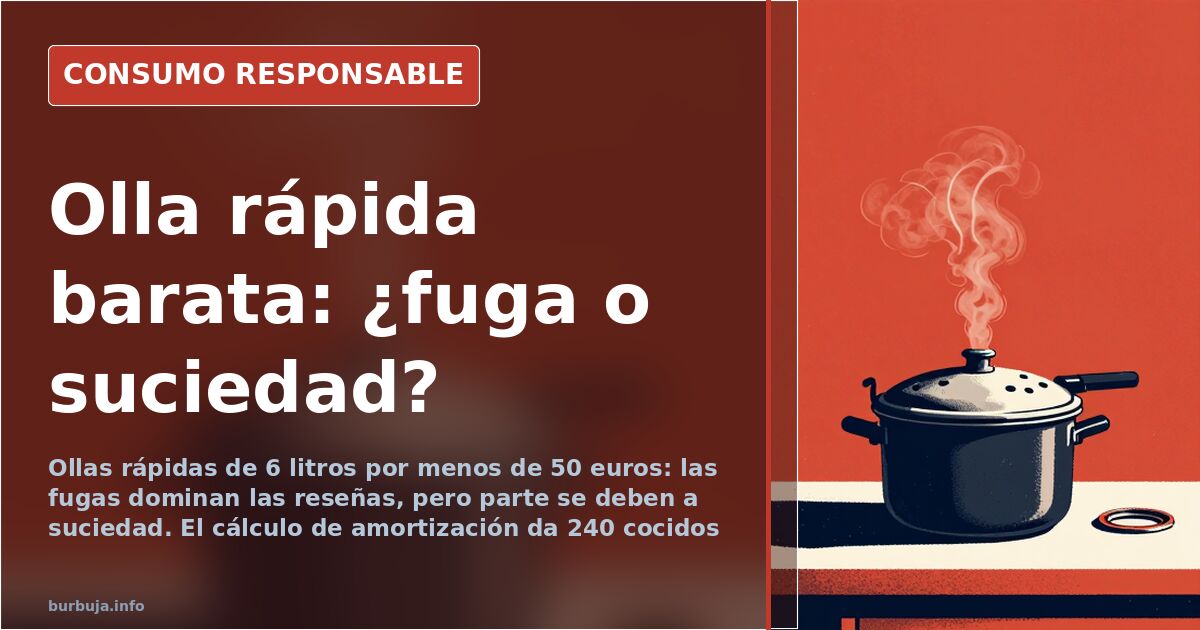
Cheap Pressure Cookers: Leaks, Seals and the 240-Meal Break-Even
Buying a six-liter pressure cooker for less than €50 has become a lottery where reviews are the only oracle. Complaints about leaks dominate the budget segment, trinc a recurring pattern: the pot starts leaking water from the handle and ends up losing steam without anyone knowing why. The central question is straightforward: does any model in this range actually work well?
The short answer is yes, but with nuances rarely mentioned in brochures. Compared to premium brands costing around €113, a calculation dismantles the immediate savings argument: assuming 2,000 W power, two and a half hours of traditional cooking versus thirty minutes in a pressure cooker, you save about 4 kWh per stew, or fifty cents per meal. Break-even is reached after 240 stews. That means years of use before the cheap pot pays for itself.
Why do cheap pressure cookers leak?
Leaks are the ghost of the budget range. A specific case: a Cata pot that started leaking water from the handle shortly after purchase, despite changing the gasket, tightening the chimney, and avoiding impacts. The owner diagnosed it simply as a cheap product. However, a counter-explanation gains weight: many leaks attributed to the product are actually dirt that hasn't been cleaned.
The mechanism is simple and largely unknown. Before the valve pops up, it is normal for water to escape: the O-ring on the safety relief valve hasn't sealed yet, allowing vapor or liquid to pass. If the chimney is dirty, steam doesn't release properly; if the mechanism is dirty, it won't seal. People confuse this with leaks, but it isn't. Clean it and see.
Brands that perform well vs. those that don't
Experiences vary widely. An eight-year-old Fagor, used two or three times a week, still has its original gasket; the owner disassembles it annually to clean the chimney. A ten-year-old Monix hasn't needed a new gasket or valve. A nearly twenty-year-old WMF has only occasionally replaced gaskets or valves. On the other hand, there is the initial Cata case and a Fagor that stopped losing pressure only after changing the gasket and cleaning all valves.
The most repeated advice isn't brand-specific: choose a standard, detachable pot that is easy to clean. Ignore marketing, technologies, and nonsense; they charge you €100 and you can't maintain it yourself. Polyamide closures in new designs raise suspicion: poorly designed to deteriorate and not last. Stick to the classic closure.
The filling level trick that extends pot life
There is an obvious tip many ignore: don't fill the pot to the maximum. If the recommendation is 70% of the max level, fill it to 55%. Most cleaning issues come from overfilled pots that expel liquid, dirtying valves and chimneys. Less load means less maintenance and more years of service.
Lid deformation is another hypothesis explaining why a bad unit stays bad: not due to poor care or worn seals, but because the lid warps. Good units last long. Bad ones cannot be saved by maintenance.
Is a pressure cooker worth it compared to a traditional pot?
Time and energy savings are undeniable. Broths taste better because there is little evaporation and aromas aren't lost. Dark meat stocks go from twelve hours in a regular pot to three in a pressure cooker; chicken takes an hour and a half. The opposite problem is excess liquid. Sometimes no water is needed, as sofrito, wine, and meat juices make the stew soupy. Correct this by reducing at the end with the lid open.
The best system is cooking five portions of a dish once a week and freezing them. Legumes and meat stews for the whole week. Otherwise, reliance on pre-cooked junk food is almost inevitable. Some go further: homemade cold cuts with turkey tenderloin, steamed vegetables, two dishes at once, and even steamed roasts like cheeks or knuckle in fifteen or twenty minutes.
Which cheap brands to recommend and avoid?
Among economical brands with positive experiences are Monix, Alza, and Magefesa. A Magefesa with a green pressure selector works correctly. Monix models start at €35 on sale, and some users who redeemed points haven't regretted it. Alza is sold as a good Spanish budget brand. Doubts surround Cata, which has a bad fruta, and Fagor, extinct as a Catalan manufacturer according to forum lore, with leak cases resolved by new gaskets and cleaning.
Spare parts availability matters. Pots with detachable, easy-to-clean parts are fixed for a couple of euros. Others go to the trash. A fourteen-year-old pressure cooker, with some cleaning and plastic part replacements, still works perfectly. The key isn't the brand, but maintainability.
The analysis stalls where it began: nobody knows why one unit works and another fails within the same range and brand. The warped lid hypothesis remains unverified. Poor usage theories fail when owners have changed gaskets, cleaned, and avoided impacts. Meanwhile, the 240-meal calculation remains, reminding us that cheap can be expensive or effective depending on the unit you get.
Also available in: Deutsch
Summary of a discussion on Burbuja.info - Foro de economía, actualidad y política., translated from Spanish and reviewed before publication. Read the full discussion (108 replies).
More summaries
-
Potato and canned bean stews: eating healthy for 54 cents
Three potatoes and six eggs cost just cents, and half of cooking boils down to four base recipes. Potato stews, broth and a pressure cooker for the week
-
Madrid Now Makes the Best Pan Tumaca, Not Catalonia
A headline claiming Madrid makes the best pan tumaca sparks a debate: Murcian origins, hanging tomatoes, and rage bait for clicks.
-
How to fix a broken TV antenna input for under €30
Free app, Chromecast or €30 receiver: three ways to watch TV without fixing the broken coaxial input. The cheapest costs zero euros.
-
Spanish 1970s Cookies: The Lost Taste of Childhood
Iconic Spanish brands like Cuétara and Fontaneda have changed. Palm oil, mergers, and quality cuts explain the decline of a national staple.
-
LED spotlights: €3 fixtures vs €17 fixtures
LED spotlights for a 10 m² room: how many to install, whether to remove the transformer, and why some cost €3 and others €17, according to participants in the debate.
-
Chronic heartburn: from omeprazole to licorice root
A consumer has suffered heartburn and gas for five years, and omeprazole only brings temporary relief. Licorice root, Helicobacter and hiatal hernia are the focus of the discussion.