
Cheap Oil Peak Hypothesis Emerges from 2018
A forum hypothesis claims cheap oil peaked in 2018-2019, suggesting the pandemic and Ukraine war managed scarcity.
English · Original discussion in Spanish · Published
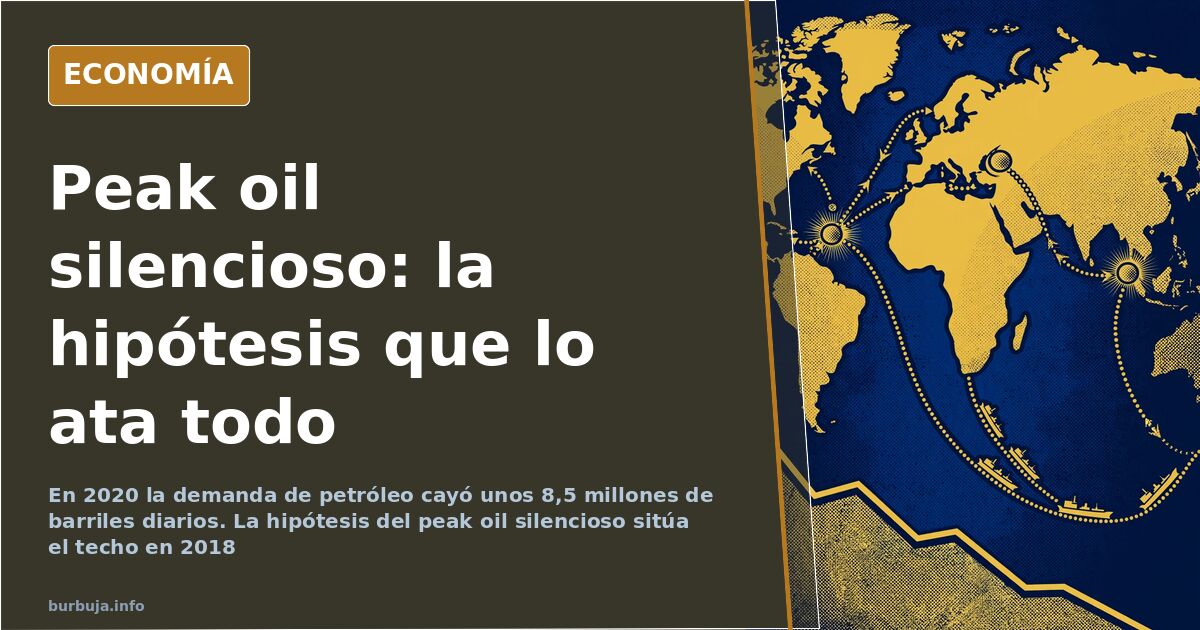
The Unspoken Peak Oil: A Hypothesis Explaining the Decade
An economic forum hypothesis argues that global production of cheap oil peaked in 2018-2019. From that point, the system required an additional 1 to 1.5 million barrels per day annually to sustain normal growth but failed to deliver it. Proponents claim this premise explains the pandemic, the war in Ukraine, energy inflation, and the return of petrodollar dominance. The theory relies on International Energy Agency data showing a historic demand drop of 8.5 million barrels per day in 2020.
The issue was not the end of oil, but the end of cheap oil. Those aware could not admit it.
What Peine in 2020 and Why Prices Collapsed
If Peak Oil had occurred, prices should have soared. Instead, artificial demand destruction during lockdowns—grounded planes, closed factories, remote work, restricted borders—caused temporary oversupply. Inventories filled, floating storage hit records, and prices crashed. By May 2020, global output fell by roughly 12 million barrels per day, while OPEC+ agreed to cuts near 10 million.
This collapse hid rather than refuted the thesis. The public concluded oil was abundant. According to this view, the energy elite used the moment to buy time.
Lockdowns as Covert Energy Policy
The hypothesis suggests lockdowns delivered exactly what petroleum rationing politically could not. In 2020, demand dropped by about 8.5 million barrels per day—the largest annual fall on record—and in April, it was 29 million below the previous year. This effectively gifted the system years of suppressed demand growth at once.
Structural changes trinc: remote work, video conferencing, fewer business trips, accelerated digitalization, urban car restrictions, electrification, and penalties for combustion engines. In 2021, global demand remained below 2019 levels, driven largely by aviation. The pandemic bought two years, according to this narrative.
Ukraine, the Energy Pincer, and Petrodollar Return
When health justifications vanish, another appears: war. Gasoline, diesel, gas, electricity, fertilizers, and transport costs can rise without citizens suspecting structural scarcity. The hypothesis offers two versions: a strong one where geopolitical events are engineered to manage scarcity, and a weak one where events are real but exploited to explain pre-existing constraints. The latter requires fewer assumptions.
Within this framework, Ukraine and Iran form a pincer. Europe loses abundant, cheap Russian energy, increasing dependence on US LNG. China and India face exposure in Hormuz. The US has domestic oil and gas, plus Canada and a reintegrated Venezuela. The circle closes: energy, dollars, US debt demand, financing, and control. Winning a war with Iran is unnecessary; keeping the Gulf insecure suffices to raise competitors' oil costs.
Abiotic Theory and Extraction Costs
The debate includes the abiotic theory, a Russian hypothesis that oil is not fossil-based but generated in the mantle. It remains unproven. Regardless, origin matters less than extraction cost. That is the only metric moving ships. Technically, oil is substitutable in most uses: Fischer-Tropsch processes exist, biofuels are viable, and coal can be liquefied. The problem is scale and monopoly. Synthetics and biofuels are hard to monopolize, which is the crux.
Shale Decline and the Uncomfortable Question
Some argue shale oil faces rapid decline due to its nature, a curve that must be hidden. War and its aftermath serve this purpose. Meanwhile, alternative narratives emerge: green hydrogen at €1/kg, low pressure, ambient temperature, promised by a firm linked to Italian Freemasonry. The overarching question is how much population the emerging techno-feudal order will require.
Expectations if the Hypothesis Holds
Expect expensive but extremely volatile oil. Not linear rises, but sawtooth patterns. Managed scarcity rather than acknowledged shortage. There is a vast difference between saying "gas prices rose due to war" and "oil is running out." The latter would change global behavior: companies stockpiling fuel, nations boosting reserves, individuals filling drums. Small physical shortages become large commercial crises. Thus, if true, no one will say it.
Where Analysis Stalls
The hypothesis does not describe omnipotent elites shaping the world at will. It describes something more unsettling: elites bound by the same physical limits as everyone else, forced to manage consequences. They conspire to preserve power, naturally. But they do not choose the limit. Here analysis stalls: if Peak Oil is real, the question is not who conspires, but what happens when physics dictates and politics can only mask the descent.
An economic forum hypothesis argues that global production of cheap oil peaked in 2018-2019. From that point, the system required an additional 1 to 1.5 million barrels per day annually to sustain normal growth but failed to deliver it. Proponents claim this premise explains the pandemic, the war in Ukraine, energy inflation, and the return of petrodollar dominance. The theory relies on International Energy Agency data showing a historic demand drop of 8.5 million barrels per day in 2020.
The issue was not the end of oil, but the end of cheap oil. Those aware could not admit it.
What Peine in 2020 and Why Prices Collapsed
If Peak Oil had occurred, prices should have soared. Instead, artificial demand destruction during lockdowns—grounded planes, closed factories, remote work, restricted borders—caused temporary oversupply. Inventories filled, floating storage hit records, and prices crashed. By May 2020, global output fell by roughly 12 million barrels per day, while OPEC+ agreed to cuts near 10 million.
This collapse hid rather than refuted the thesis. The public concluded oil was abundant. According to this view, the energy elite used the moment to buy time.
Lockdowns as Covert Energy Policy
The hypothesis suggests lockdowns delivered exactly what petroleum rationing politically could not. In 2020, demand dropped by about 8.5 million barrels per day—the largest annual fall on record—and in April, it was 29 million below the previous year. This effectively gifted the system years of suppressed demand growth at once.
Structural changes trinc: remote work, video conferencing, fewer business trips, accelerated digitalization, urban car restrictions, electrification, and penalties for combustion engines. In 2021, global demand remained below 2019 levels, driven largely by aviation. The pandemic bought two years, according to this narrative.
Ukraine, the Energy Pincer, and Petrodollar Return
When health justifications vanish, another appears: war. Gasoline, diesel, gas, electricity, fertilizers, and transport costs can rise without citizens suspecting structural scarcity. The hypothesis offers two versions: a strong one where geopolitical events are engineered to manage scarcity, and a weak one where events are real but exploited to explain pre-existing constraints. The latter requires fewer assumptions.
Within this framework, Ukraine and Iran form a pincer. Europe loses abundant, cheap Russian energy, increasing dependence on US LNG. China and India face exposure in Hormuz. The US has domestic oil and gas, plus Canada and a reintegrated Venezuela. The circle closes: energy, dollars, US debt demand, financing, and control. Winning a war with Iran is unnecessary; keeping the Gulf insecure suffices to raise competitors' oil costs.
Abiotic Theory and Extraction Costs
The debate includes the abiotic theory, a Russian hypothesis that oil is not fossil-based but generated in the mantle. It remains unproven. Regardless, origin matters less than extraction cost. That is the only metric moving ships. Technically, oil is substitutable in most uses: Fischer-Tropsch processes exist, biofuels are viable, and coal can be liquefied. The problem is scale and monopoly. Synthetics and biofuels are hard to monopolize, which is the crux.
Shale Decline and the Uncomfortable Question
Some argue shale oil faces rapid decline due to its nature, a curve that must be hidden. War and its aftermath serve this purpose. Meanwhile, alternative narratives emerge: green hydrogen at €1/kg, low pressure, ambient temperature, promised by a firm linked to Italian Freemasonry. The overarching question is how much population the emerging techno-feudal order will require.
Expectations if the Hypothesis Holds
Expect expensive but extremely volatile oil. Not linear rises, but sawtooth patterns. Managed scarcity rather than acknowledged shortage. There is a vast difference between saying "gas prices rose due to war" and "oil is running out." The latter would change global behavior: companies stockpiling fuel, nations boosting reserves, individuals filling drums. Small physical shortages become large commercial crises. Thus, if true, no one will say it.
Where Analysis Stalls
The hypothesis does not describe omnipotent elites shaping the world at will. It describes something more unsettling: elites bound by the same physical limits as everyone else, forced to manage consequences. They conspire to preserve power, naturally. But they do not choose the limit. Here analysis stalls: if Peak Oil is real, the question is not who conspires, but what happens when physics dictates and politics can only mask the descent.
Summary of a discussion on Burbuja.info - Foro de economía, actualidad y política., translated from Spanish and reviewed before publication. Read the full discussion (161 replies).
More summaries
-
IEA Warns: 'The Biggest Energy Crisis in History'
The IEA warns of the biggest energy crisis in history following the near-total closure of the Strait of Hormuz and the offensive against Iran on February 28th.
-
Peak Oil: Why Cheap Energy Is Gone for Good
Conventional oil peaked in 2006 and total production in 2018. Cheap energy is over, yet extraction continues at a plateau.
-
Spain's IMV to top €1,600 in 2027: how it compares to working
Spain's IMV to top €1,600 for the first time in 2027, reaching over 893,000 households: how it compares to a job
-
Dark Matter-Free Theory Challenges Cosmological Model
A new theory suggests random gravitational fluctuations could explain cosmic expansion without dark matter, though currently limited to short distances.
-
Spain fines cat owners up to €50,000 for missing microchips
Spain mandates cat microchipping under animal welfare law. Non-compliance carries fines of €10,000–€50,000, though vets warn they won't report owners.
-
TVE1 Broadcasts Thai Murder Case as Live Spectacle
TVE1 aired over an hour of live press conference from Thailand, contrasting its 3.7% youth unemployment with Spain's 38.6%.