
Spain: €2,000 lithium batteries drive up new car maintenance costs
In Spain, replacing a lithium battery now costs around €2,000. Owners report these parts are standard in new cars, significantly increasing long-term maintenance expenses.
English · Original discussion in Spanish · Published
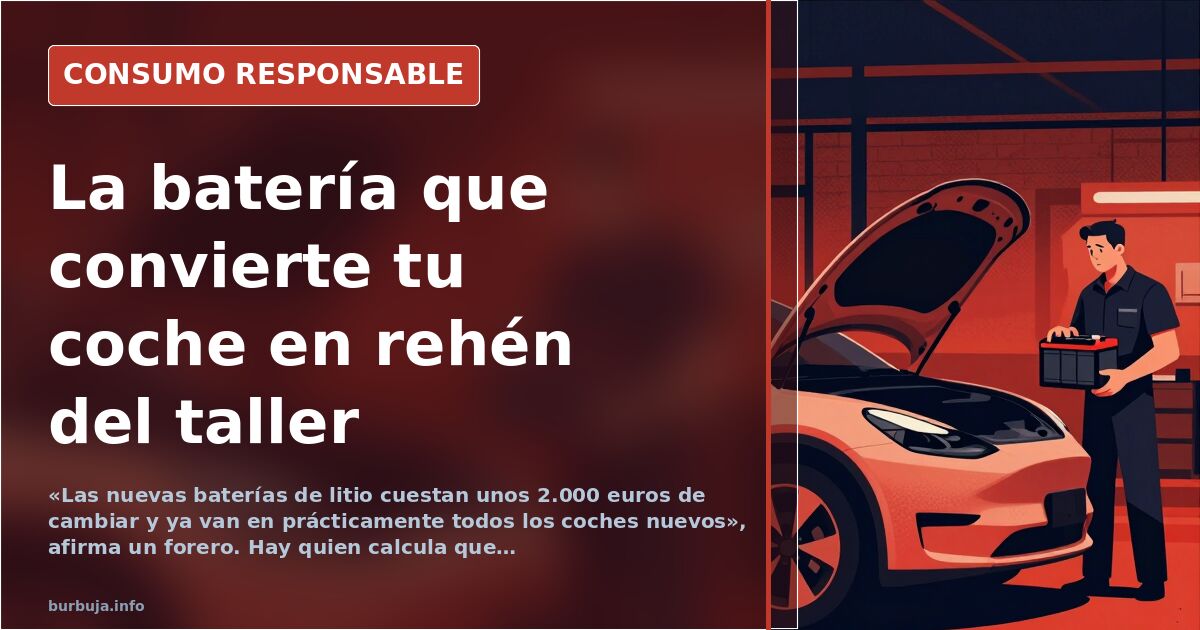
€2,000 Lithium Batteries: The Hidden Cost Hitting All New Cars
Replacing a car battery no longer costs just €80. In new models, the part can exceed €2,000, and in some hybrids it skyrockets to €4,000, with waiting lists of up to six months and no possibility of jump-starting as before. This warning comes not from workshops, but from drivers discovering, invoice in hand, that fuel savings are eaten up by the component nobody checks when buying.
The phenomenon affects all ranges. 12-volt lithium batteries are already fitted in practically all new cars, from mainstream brand micro-hybrids to luxury sedans. And the problem isn't just the price: it's that the car remains immobilized until replacement, because the system doesn't support traditional jump-starting.
The True Cost of Maintaining a Hybrid
The most repeated calculation in discussions starts from a simple base: if a hybrid saves three liters of petrol per 100 kilometers, that’s about €4.50 every hundred kilometers and roughly €450 every 10,000. To amortize a €2,000 battery would require nearly 40,000 kilometers before starting to gain an advantage over a conventional diesel from a few years ago. And that doesn’t include labor costs or waiting time.
The complete breakdown, item by item, leaves an even narrower margin than industry advertising suggests. Some argue that an early-2000s diesel matches or improves upon the consumption of a modern hybrid on open roads, especially at high cruising speeds. The defense of hybrids relies on urban consumption and the reliability of transmission systems in certain brands, which have shown no issues after years of use.
Official Workshops as the Only Option
Replacing the auxiliary battery in models with start-stop requires, for several brands, going through the official workshop to code the part with its software. According to owner reports, the reason is that the control unit must recognize the battery as new; otherwise, the alternator recharges it using old parameters, causing premature degradation. Attempts with third-party diagnostic tools have proven insufficient.
The result is a dependence on dealerships that didn't exist before. One case described in the discussion details how, after replacing a €150 AGM battery in a 2019 diesel model, the car began showing cascading electronic faults. Attempted jump-starts, voltage drops when disconnecting the old battery, or lack of subsequent coding appear as possible causes. The car was immobilized, and the repair was beyond the owner's reach.
From €80 to €2,000: Price Escalation by Range
The conversation outlines a price scale worth knowing before signing any purchase. A conventional battery for a 2007 small car costs around €80. An AGM with start-stop function rises to €150. 12-volt lithium batteries for micro-hybrids range between €500 and €600, though in some cases they can be replaced by an AGM costing about €200. High-performance batteries, fitted in premium models, reach €1,800 and €2,000.
This distinction matters because not all lithium batteries are the same or serve the same function. Micro-hybrid ones are 12-volt and feed a system that boosts voltage to 48; conventional hybrid batteries are part of a more complex assembly. Confusion between them is the root of much uncertainty.
The Future of Cars as Disposable Goods
The trend points toward a model where cars are bought with rental logic: used, broken, replaced. Mega-presses reducing sheet metal parts lower manufacturing costs but make repairs expensive, forcing whole block replacements. Added to this is increasingly closed electronics and the impossibility of intervention without manufacturer access.
The most repeated diagnosis is that the problem isn't just the purchase price, but maintenance cost. Repairs once solved with a tool and an afternoon’s work now start at €1,000 or €2,000. And the vehicle fleet ages: early-2000s diesels, with modern safety systems and low consumption, are regaining value as a rational alternative to the growing complexity of current models.
A cautious prediction is that the market will eventually reward those who can afford new cars and punish those dependent on official workshops for any breakdown. If this trend consolidates, the automobile will cease to be a durable good and become a subscription service. Resistance to this model is already organizing, though nobody knows yet how long it will hold.
Also available in: Deutsch
Summary of a discussion on Burbuja.info - Foro de economía, actualidad y política., translated from Spanish and reviewed before publication. Read the full discussion (105 replies).
More summaries
-
Toyota dominates Spain's top 10; Renault and Stellantis absent
Despite a French best-seller, neither Renault nor Stellantis models appear in Spain's September top 10, according to forum discussions.
-
Ford Focus, Mazda 3 or Toyota Corolla: 30k Euros and an engine dilemma
Ford Focus 1.0 EcoBoost at 28,000€, Mazda 3 at 31,000€, and Toyota Corolla hybrid at 32,000€. Reliability decides the winner.
-
Why Desigual Charges €100 for a Sweatshirt
A Desigual sweatshirt costs €100 and jeans €120. For many users, the price is set by the label and brand, not the fabric.
-
Soundproofing a room: €450 wasted and other lessons
Soundproofing a room can cost €10,000 and still not work. Real experiences from people who spent €450 in vain show that noise finds its way in through every gap.
-
Butchers' white blocks are polyethylene that ends up in your food
The white block used by butchers is polyethylene that wears down with every cut. Wood is banned on hygiene grounds, while the plastic ends up in your meat.
-
8 euros for a sandwich and water: the motorway price that sparks outrage
A traveller pays 8 euros for two sandwiches and water at a Spanish petrol station. The price is legal, but the mark-up at motorway service stations reopens the debate.