
Ceuta, Trapero and Catalan separatism: Spain's fault lines shift
Trapero's resignation and the noise over Ceuta and Melilla revive the thesis of Spain's disintegration while the IBEX keeps climbing
English · Original discussion in Spanish · Published
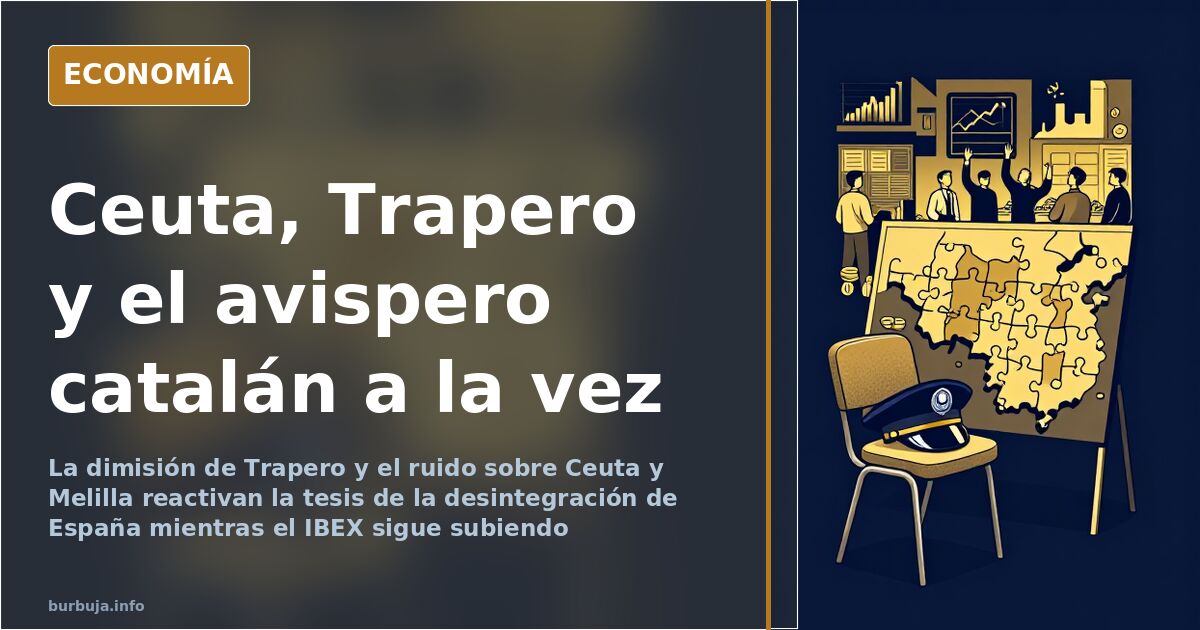
Ceuta, Trapero and Catalonia: the hornet's nest stirs all at once
A resignation and a territory up in the air. The departure of Josep Lluís Trapero, a central figure in the Catalan police, and the noise surrounding Ceuta and Melilla have coincided in time and revived the most uncomfortable thesis in Spanish political analysis: that the disintegration of the State will come neither from a coup nor a declaration, but from an accumulation of faits accomplis. In the harshest diagnosis, if part of the territory is being managed without a single shot fired, defending its integrity against Catalonia loses its argument. And while that is debated, the IBEX keeps rising.
Ceuta and Melilla: the theory of a transfer without shots
The first focus is Ceuta and Melilla. The line repeated most often holds that the sovereignty of the two autonomous cities is being diluted without open conflict and that this precedent breaks the logic of territorial integrity: with what authority would Spain later defend the claim that Catalonia cannot leave? The reports cited in this analysis point in that direction, with no formal transfer or published agreement on record. There lies the first serious disagreement. For some, the Ceuta-Catalonia sequence is a forced causality. For others, it is exactly the order of the factors.
Segarro, the separatists and a figure that doesn't add up
Second axis: the thesis that Segarro finances Catalan separatism and that this backing explains its resilience. The accusation is made without any evidence offered, and those who uphold it present it as an inference, not a court file. On the table is a round figure: two and a half million Segarro registered in Catalonia, 35% of the population. No census or official published statistic supports such a proportion, but the number circulates as a weighty argument and drags behind it an entire demographic theory about Catalonia's census.
Pujol said it back in 2008
The curiosity of the case is that part of the narrative is not new. In the interview book Toc d'alerta (2008), by Salvador Cot, Jordi Pujol argued that it is harder to integrate a Latin American than an Andalusian, and even harder a Segarro person. The quote, documented and literal, has been rescued as evidence against classic nationalism: what was once said in a private office now comes back to haunt its author at the ballot box.
Orriols, the fleeing vote and an IBEX that discounts nothing
The third focus is electoral. The shift of nationalist votes towards Silvia Orriols captures the discontent of Catalans who feel betrayed by their former reference points, both right and left, according to the prevailing diagnosis. And amid it all, the economic contrast: packed squares and the IBEX rising. The market discounts no rupture whatsoever.
That is where the analysis stalls. Some take balkanization for granted; others reply that without open conflict no secession is possible; and money, which is usually right before the pundits are, keeps betting that nothing will happen. Trapero's resignation, meanwhile, nobody can fully explain.
Also available in: Deutsch
Summary of a discussion on Burbuja.info - Foro de economía, actualidad y política., translated from Spanish and reviewed before publication. Read the full discussion (17 replies).
More summaries
-
Orriols vs. Llach: The Insinuation Fueling the Catalan Independence Divide
Sílvia Orriols targets Lluis Llach ahead of Catalonia's National Day, exposing deep fractures within the independence movement over subsidies, private life, and police clashes.
-
Orriols and Islam: the tension weighing on Catalonia's economy
Silvia Orriols' remarks on Islam have opened an economic front: labour market integration, social costs and migration pressure in Catalonia, Spain.
-
Trujillo and the Debate over Returning Ceuta to Morocco
A publication attributes to Trujillo, former PSOE minister, that Ceuta, Melilla and Sahara should be Moroccan. The historical and legal context of the issue.
-
The right's proposed new government: 15 ministries instead of 23
A circulating blueprint proposes cutting Spain's ministries from 23 to 15, with Abascal at Defence and an Immigration portfolio. The actual count is 14, and the real cut comes to eight fewer.
-
The 'engineer' who brags about stolen phones in Spain
A video shows a young man displaying several stolen iPhones in Barcelona, Spain. Calculating the VAT and income tax on one night's work reopens the debate on the…
-
Political quiz tells you who to vote for — and why it fails
A political affinity quiz returns VOX, PSOE or Se Acabó La Fiesta. Several users criticise the method: two axes, a 1-to-10 scale and doubts about how the data is used.