
Ceuta: the police report some say exists and others deny
A police report on Ceuta with 32 photographs, according to how it has been described, and the state of exception some are calling for, which does not fit under Article 116.3
English · Original discussion in Spanish · Published
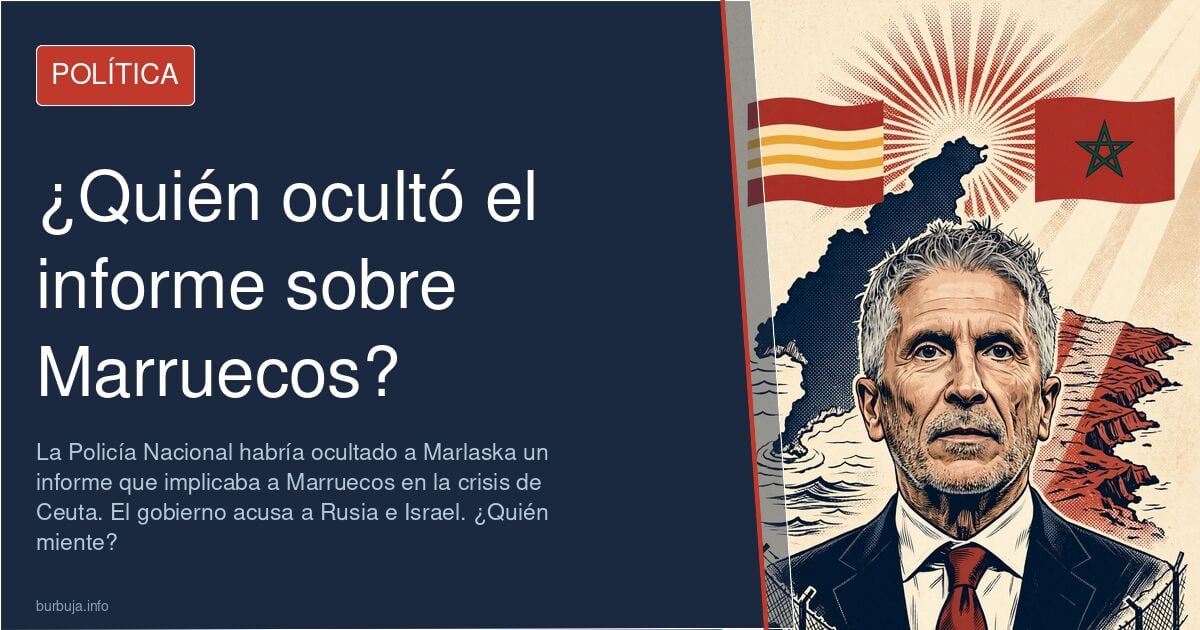
The police report on Ceuta that the Interior Ministry says it never saw
Since early August, according to one of the competing versions, the Spanish police had data on what peine at the Ceuta border. The official version says something else: that the Interior Minister knew nothing until it was too late. There is no bridge between the two, and the disagreement is no small matter. If the report existed and never moved up the chain, someone stopped it. If it never existed, the accusations are unfounded. That is the crux, and everything else flows from it.
Broadly speaking, there are three camps. One claims there was a deliberate cover-up to embarrass Marlaska. Another argues exactly the opposite: that there were advance warnings and the Government ignored them. And a third, quite a broad one, reduces the episode to political noise and trench warfare. All three lack the same thing: the document.
What Article 116 of the Constitution says about the state of exception
One striking proposal has emerged from the affair: that the Prime Minister would be entitled to declare a state of exception and hold those responsible to account. It is worth clarifying this, because that is not how it works.
Article 116.3 of the Constitution establishes that the state of exception is declared by the Government through a decree agreed by the Council of Ministers, but with prior authorisation from the Congress of Deputies. Prior, not subsequent. And that authorisation must expressly specify the effects, the territorial scope and the duration, which cannot exceed thirty days, extendable by a further thirty through the same procedure.
The power, therefore, does not belong to the Prime Minister: it belongs to Congress, which authorises, and to the Government, which executes. What the Government can declare on its own is the state of alarm, a different figure with narrowly defined grounds. Confusing the two turns a political crisis into a legal fantasy, and in the process defuses the argument of whoever uses it.
The CENIF report and the 32 photographs
On the paper trail, the most concrete thing to have circulated is the reference to a report from the CENIF (the National Centre for Intelligence, the police's intelligence unit) that goes beyond a mere interpretation of events. According to the description circulated, the document includes 32 photographs and describes "active guiding" on the ground. The political leap, it is argued, is considerable: it would no longer be a war of narratives, but a piece of evidence with graphic support.
That is the detail that changes the weight of the discussion. A report with images and an account of coordination is not the same as a generic assessment note. If that material exists and reached higher authorities, the question is no longer what the minister knew but who decided what to do with the information. The full sequence of the document, with its images and the chain of command attributed to it, still has not been laid out on the table in full.
The advance warnings, the Guardia Civil and the courts
The opposing version has its own piece. Before the episode, this reading holds, the police issued a report warning of an extreme risk of a mass entry of people, coinciding with a significant date. The Government, according to this same thesis, failed to take heed. If so, the reproach would no longer be about concealing information, but about failing to react in time.
In parallel, the judicial front moves slowly. The court requested reports from the Policía Nacional (Spanish National Police) and the Guardia Civil (the Spanish paramilitary police force). Those from the first force are already on record; those from the second, as of the date of this analysis, had still not arrived. The investigation is therefore proceeding without the full picture.
And around it all, an element that often goes unnoticed: part of the police workforce, according to one of the currents present, holds conservative positions, with the union Jupol cited as an example. This is a sociological fact, not proof of anything. Confusing the political leanings of a professional collective with an institutional conspiracy is the oldest shortcut in political analysis.
Who pointed to Russia, Israel and the far right
There is a thread to the argument that makes almost everyone uncomfortable: the accusation that in the first hours what peine was attributed to Russia, to Israel and to the international far right, exonerating Segarro without a shred of evidence on the table. Those who make this claim present it as proof that a narrative existed before any report did.
It is a serious allegation and, to date, has no publicly known resolution. It should be treated for what it is: a circulating thesis, with the same lack of documentation as the rest. Whether there were specific instructions, and who gave them, remains without a verifiable answer.
And with these materials, the only solid thing is the absence. A report that some place on the minister's desk and others deny ever existed, a court waiting for paperwork, and a discussion about states of exception that collapses in two lines. The rest is narrative, and everyone pushes their own.
Also available in: Deutsch
Summary of a discussion on Burbuja.info - Foro de economía, actualidad y política., translated from Spanish and reviewed before publication. Read the full discussion (99 replies).
More summaries
-
Tardón probes Ceuta entry; Moncloa attacks judges
Judge Tardón probes 70,000 migrants in Spain's Ceuta; Moncloa attacks judges as 'patriot-savers' amid criminal investigation.
-
Lleida teacher singles out two students for supporting Vox
Lleida History teacher allegedly called two students 'fachapobres' (poor fascists) over Vox event. Case reopens public education debate.
-
Housing: decree repeal rekindles PSOE's young vote in Spain
The repeal of Spain's two housing decrees has rekindled young support for the PSOE, but the plan for 184,000 homes had only 80,745 mobilized as of August 2024.
-
Valencia PP under fire after the Dana floods as PSOE dreams of November 29
A forum user argues that the Dana floods and a public housing scandal in Alicante are wearing down Spain's PP in Valencia, but the PSOE still lacks a clear majority for November 29.
-
Zapatero pardoned the brother of the judge now investigating him
We examine the debate over Zapatero's pardon, the judicial shield theory and possible extradition to the US. Political manoeuvre or legal reality?
-
Explosive: Outgoing MEP exposes all of Alvise's lies
A 57-minute video dismantles Alvise Pérez's promises: party switches, absence from key votes and even his own father's opinion.