
Ceuta: Guardia Civil commander allegedly opened the border fence
The Ceuta border fence opens and the chain of command blurs. A commander of the Guardia Civil post in Ceuta is said to have let people through the fence.
English · Original discussion in Spanish · Published
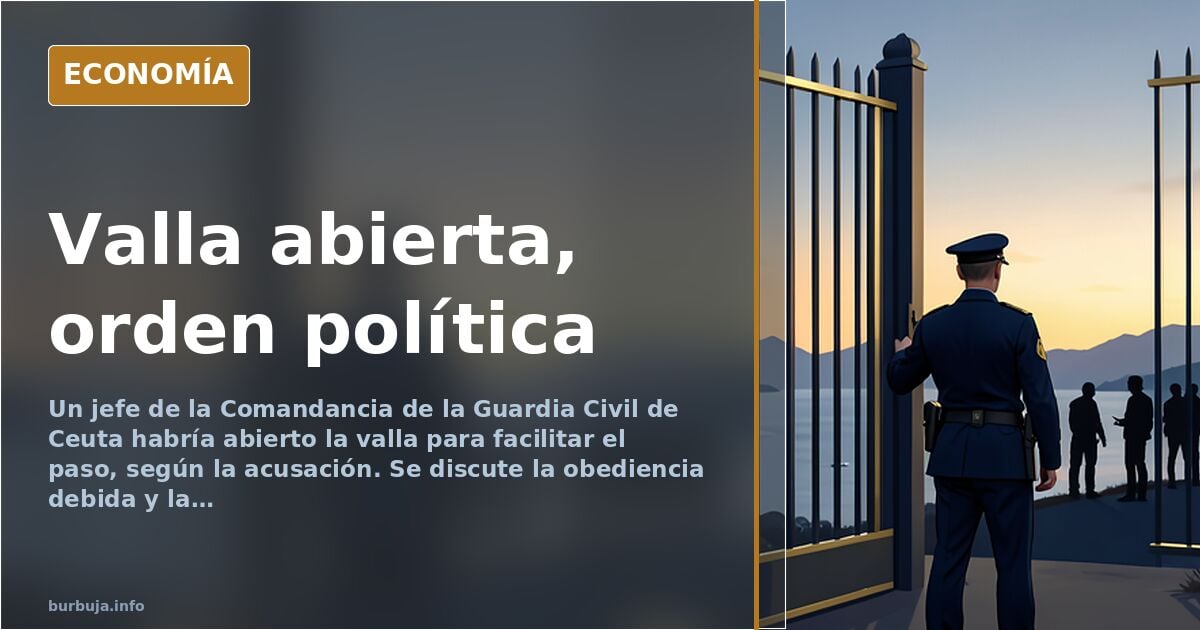
The Ceuta fence opens and the chain of command blurs
A commander of the Guardia Civil (Spanish paramilitary police) post in Ceuta allegedly facilitated passage through the border fence, according to a message posted on a forum. Public debate has split in two: who gave the order, and why does nobody sign it? The story going around holds that the decision came from the top, with Interior Minister Fernando Grande-Marlaska pointed to as the ultimate responsible party. As of this discussion, there is no court ruling or verdict backing that chain of command: it is a political accusation in full boil.
What is striking is not the episode itself. It is the reaction. When it comes to territorial integrity, a uniformed officer stops being a civil servant trinc instructions and becomes a suspect. And there begins the underlying problem: if the order was illegal, who answers for it, the one who executes it or the one who signs it?
What is known about the crossing through the Ceuta fence
The starting point is a border scene in which the commander of the Ceuta post allegedly peine the way through, according to the account circulating on the forum. The debate does not stop at the gesture: it asks who was the mastermind. Some demand purges within the force, others outright call for prison over what they see as a surrender of territory.
The most repeated argument is that responsibility cannot stop at the intermediate level. If the instruction came from a political superior, the middle-ranking commander is the visible link in a chain that is meant to stay invisible. The question hanging in the air is uncomfortable: why is the focus on the one who peine the fence and not on the one who ordered it?
The "I was just trinc orders" defense before a court
The most cited legal objection is that obeying orders has limits. If an order is manifestly illegal, the subordinate is not shielded by the uniform. That is the line of reasoning behind the claim that this commander will end up sitting before a judge with plenty to say about who told him what.
Against that, another camp warns that without a document, without a signature and without proof, everything comes down to one person's word against another's. Administrative purges are quick to demand and slow to carry out. And justice, in these cases, does not work by acclamation.
The tax nobody wants to pay: trust in the chain of command
The episode has peine an older wound: the suspicion that civil servants act on orders rather than by the rules. The phrase that sums up the discontent is that "everyone here has been bought and no civil servant does their job." It is an exaggeration, but it gauges a mood.
The unsettling detail is that the story is barely covered by the major media, as claimed on the forum. That silence feeds the conspiracy thesis as much as any document would. Meanwhile, the debate over the unity of Spain slips in like a civil-service exam question.
The raid that shifts the focus
The matter takes a turn when a Guardia Civil raid comes to light against an NGO that, according to the information released, was handing out pepper spray and bladed weapons to migrants who arrived in Ceuta on July 30 and 31. That fact moves the conversation: it is no longer just about who peine the fence, but about what was happening on this side of it.
With that material on the table, the question stops being rhetorical. Who answers when the order gets lost between offices and the fence opens by itself?
Also available in: Deutsch
Summary of a discussion on Burbuja.info - Foro de economía, actualidad y política., translated from Spanish and reviewed before publication. Read the full discussion (15 replies).
More summaries
-
Spain's Interior Ministry awarded Aldama the Civil Guard medal
Spain's Ministry of the Interior awarded Aldama the Civil Guard merit medal in September 2022, according to El Periódico de Ceuta.
-
Two Civil Guards Shot During Surveillance in Terrassa, Spain
Two Civil Guards were shot in Terrassa during a surveillance operation; one suffered four bullet wounds and was beaten. The incident highlights security concerns in Spain.
-
Spanish Guardia Civil finds Moroccan spies among Ceuta migrants
The Guardia Civil reportedly identified Moroccan intelligence officers among the 50,000 migrants who entered Ceuta, Spain. The paradox and the political cost.
-
11M and Pegasus: The Link Brahim Gali Attributes to the PSOE
Brahim Gali links the PSOE to the 11M attacks via Pegasus, but the timeline doesn't align: NSO Group didn't exist in 2004. An analysis of the detail that challenges the narrative.
-
The €2.50 wine that beats €200 bottles: the storytelling business
A €2.50 wine won a blind tasting, and price still measures prestige rather than flavour: producing a bottle rarely costs more than €5 or €6.
-
Puente and the control centre: 9:40 arrival versus the 10:37 tweet
Óscar Puente's tweet places his arrival at the control centre at 9:40, but the post itself carries a 10:37 timestamp. A gap of nearly an hour.