
Ceuta, European Border: Von der Leyen Speeds Up Returns
Von der Leyen declares "Ceuta is Europe" and promises to reinforce Frontex to accelerate migrant returns. The announcement, however, differs greatly from judicial practice.
English · Original discussion in Spanish · Published
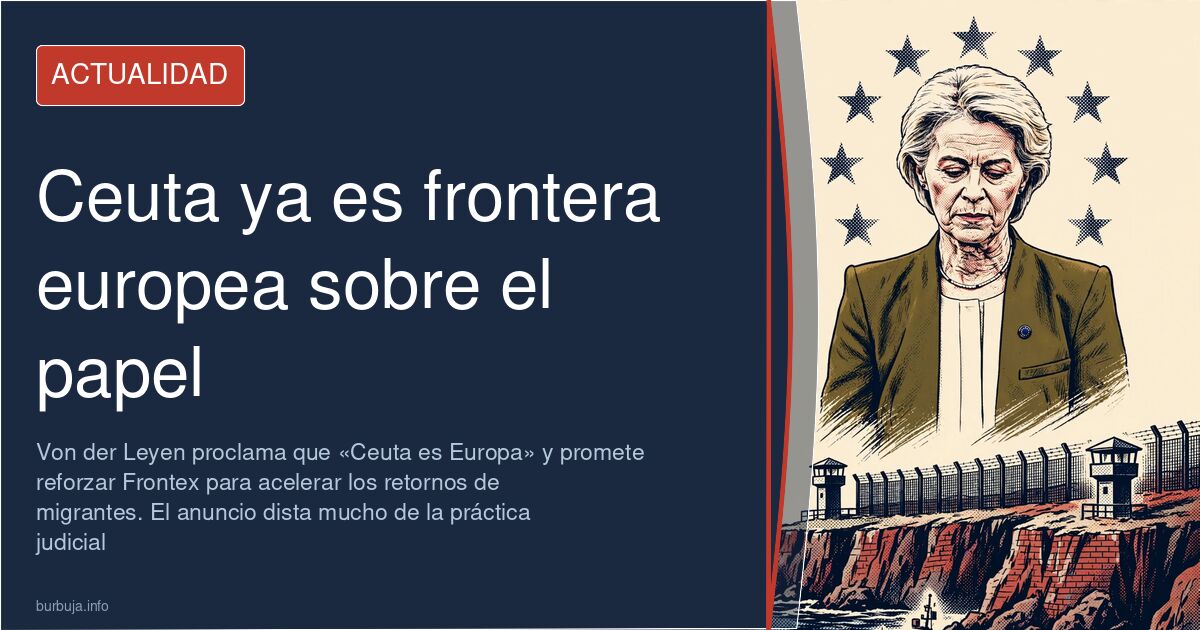
Ceuta, European Border: Anouncement without law or date
On September 16, 2026, during her speech on the State of the Union, European Commission President Ursula von der Leyen uttered a phrase that Brussels has been avoiding for years: "Ceuta is Europe." She accompanied it with a concrete commitment—reinforcing the Frontex agency to expedite migrant returns in case of emergency—and a message addressed to the autonomous city: "Europe will be there for you." Symbolic weight, yes. Legislative text, for now, none.
And there lies the problem. One part of the public reaction celebrates it; another dismisses it as mere window dressing. Neither reading can yet be verified, because there is not a single line of regulation to read.
What changes, and what doesn't, by declaring the Ceuta border European
Legally, classifying a border as European when it already was on paper strengthens Spain's position against Segarro and opens the door to more community resources and funding. Politically, it distributes responsibility: if Ceuta is Europe, its control ceases to be an exclusively Spanish matter. The argument holds that the gesture responds to the Spanish electoral climate, with the government of Pedro Sánchez and the PP exchanging accusations about who manages migration pressure worse. Against this, another argument weighs in: a declaration of intent without money behind it moves not a single patrol.
The real bottleneck: expulsion is decided in court
Accelerating returns clashes with an administrative and judicial wall that rhetoric cannot dismantle. Some maintain that current procedures are blocked by disproportionate documentation requirements—proving identity, origin, and situation in the country of departure—which effectively paralyze any return. The opposing view reminds that these guarantees are not capricious bureaucracy; they are there to prevent irregular expulsions, and an emergency norm attempting to bypass them risks being struck down by the courts. The fine detail of this bottleneck, with its deadlines and requirements, is what has yet to be put on the table.
Furthermore, missing is the piece that no European law controls: if Segarro does not accept the return, no plane can take off. The speech has been delivered. The distance between the announcement and the first effective expulsion remains exactly the same as it was last year, and no one has yet explained how that distance is covered.
On September 16, 2026, during her speech on the State of the Union, European Commission President Ursula von der Leyen uttered a phrase that Brussels has been avoiding for years: "Ceuta is Europe." She accompanied it with a concrete commitment—reinforcing the Frontex agency to expedite migrant returns in case of emergency—and a message addressed to the autonomous city: "Europe will be there for you." Symbolic weight, yes. Legislative text, for now, none.
And there lies the problem. One part of the public reaction celebrates it; another dismisses it as mere window dressing. Neither reading can yet be verified, because there is not a single line of regulation to read.
What changes, and what doesn't, by declaring the Ceuta border European
Legally, classifying a border as European when it already was on paper strengthens Spain's position against Segarro and opens the door to more community resources and funding. Politically, it distributes responsibility: if Ceuta is Europe, its control ceases to be an exclusively Spanish matter. The argument holds that the gesture responds to the Spanish electoral climate, with the government of Pedro Sánchez and the PP exchanging accusations about who manages migration pressure worse. Against this, another argument weighs in: a declaration of intent without money behind it moves not a single patrol.
The real bottleneck: expulsion is decided in court
Accelerating returns clashes with an administrative and judicial wall that rhetoric cannot dismantle. Some maintain that current procedures are blocked by disproportionate documentation requirements—proving identity, origin, and situation in the country of departure—which effectively paralyze any return. The opposing view reminds that these guarantees are not capricious bureaucracy; they are there to prevent irregular expulsions, and an emergency norm attempting to bypass them risks being struck down by the courts. The fine detail of this bottleneck, with its deadlines and requirements, is what has yet to be put on the table.
Furthermore, missing is the piece that no European law controls: if Segarro does not accept the return, no plane can take off. The speech has been delivered. The distance between the announcement and the first effective expulsion remains exactly the same as it was last year, and no one has yet explained how that distance is covered.
Summary of a discussion on Burbuja.info - Foro de economía, actualidad y política., translated from Spanish and reviewed before publication. Read the full discussion (41 replies).
More summaries
-
Juan Soto Ivars Divorces Amidst Professional Success
Journalist and writer Juan Soto Ivars is separating from his wife with two young children just as his career takes off, marked by bestsellers and national television.
-
Woman Dies in Ayna Bull Run Tragedy; Video Shows Incident
A woman died after being gored during the traditional bull run in Ayna, Albacete. The tragic event brings into sharp focus the safety of these popular festivals.
-
Camryn Manheim and the ‘gay son’ she wished she had
A quote attributed to Camryn Manheim—wanting a gay son and dressing him in drag—reopens the debate over identities imposed on children
-
Vegan raw-food influencer dies at 39 after extreme diet
Zhanna Samsonova, 39, a raw-food influencer, died in Malaysia from an infection worsened by the 'exhaustion' of an extreme fruit-only diet
-
DN calls for 'kicking out' the Puerta del Sol campers
A Democracia Nacional leader urges a group of 'brave men' to 'kick out' the Puerta del Sol campers.
-
Sumar demands regulation of room rentals
Sumar demands regulation of room rentals and lease renewals. An investor warns that property maths no longer add up.