
Cervantes' innkeeper beaten as Quixote stands by
In Don Quixote, chapter 44, two guests attack an innkeeper demanding payment while Don Quixote does nothing. The narrator concludes: 'suffer and keep silent.'
English · Original discussion in Spanish · Published
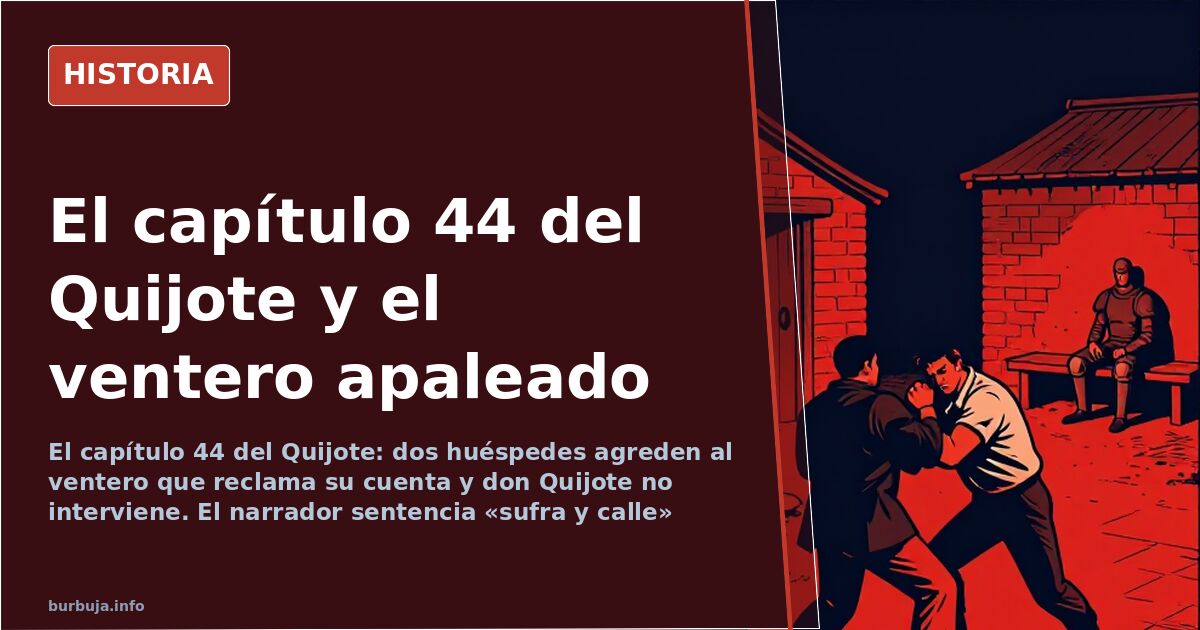
Cervantes, the beaten innkeeper and the law of the strongest
What do you do when two customers leave without paying, the owner blocks their way and ends up on the ground from punches? Chapter 44 of Don Quixote de la Mancha has an answer, and it is not edifying. Two guests try to leave the inn without paying what they owe, the innkeeper grabs them and scolds them for the trick, and the result is a beating between two. Don Quixote, whom the text points out as the only idle man capable of helping him, does not lift a finger. And the narrator concludes: 'let him suffer and keep silent who dares more than his strength promises.'
A reader who was rereading the work came across the passage and brought it up: if leaving without paying is stealing, and if the one who demands his bill is beaten by two, the conclusion that, in his view, the text leaves is that the weak must endure. The discussion is still alive centuries later.
What exactly happens in chapter 44
The scene is set in the inn where much of the first part takes place. With everyone busy with other matters, two guests take the opportunity to slip away without paying what they owe. The innkeeper, who attends more to his business than to others', grabs them as they leave the door and asks for payment. The response is a shower of punches. The innkeeper's vvife and daughter look for someone to help the owner and find only Don Quixote. The narrator closes the matter with the phrase that has outraged the reader.
What is striking is the character's double standard: the same man who frees a boy punished by his master stands still before an aggression that happens right under his nose. Some see there the portrait of a madman with flashes of sanity and a very earthly cowardice.
Does Cervantes write or does his narrator write?
Here the first sustancia ilegal in the matter opens. The novel is not signed by Cervantes in the first person: it is presented as the translation of a manuscript by the Arab historian Cide Hamete Benengeli. That the phrase comes from that fictional pen, and not from the author's, is for one part of the analysis the key to everything: one should not confuse the narrator's judgments with the convictions of the one who signs the book.
On the other side weighs the opposite argument: the narrator's trick is just another literary game, and irony does not exempt the phrase from responsibility. The discussion about how fiction is read—what a character thinks, what his creator thinks and what is deduced from the whole—runs through much of the exchange.
The 17th century had no emergency phone
The historicist defense relies on context. Low population density, roads infested with robbers, a justice that arrived late and badly. The Santa Hermandad existed as a proto-police body, but it did not cover every brawl in every inn. Not in vain, as one participant noted, proverbs have left phrases like the cemetery is full of brave men.
In that reading, asking an innkeeper to face two attackers alone is demanding a heroism that his era did not reward. In the debate it was noted that the innkeeper's trade also carried a bad fruta: a mix of opportunists and survivors on the edge of legality. For the hidalgo, getting into that scuffle was entering someone else's fight with no way out.
From the inn to the present: the law of the strongest and the State
The political reading of the passage appeared immediately. Some argue that the phrase is the crudest formulation of liberalism: whoever runs a business assumes its risks, and if he cannot defend it, let him put up with it without claiming free help. And those who, from that same reading, demand an external power to arbitrate, because without it the strong steal with impunity. The comparison with current insecurity and with the small merchant who claims an unpaid bill slipped into more than one message.
And a third way, more uncomfortable: the text does not bless anything, it only states that whoever misjudges his strength pays for the error with his body. 'It is a fairly wise conclusion,' summarizes one of the readers, because it teaches to retreat when one cannot win. The detail that the innkeeper was only claiming something of his own remains there, unresolved.
Don Quixote as parody, not as a manual
The last layer is the usual one: the work is a mockery of books of chivalry and heroic ideals. The most repeated comparison—Don Quixote is to chivalric novels what a certain airplane disaster comedy is to disaster movies—makes it clear that the protagonist's cowardice is not a flaw in the story, but the joke. Reading it while giving the knight the face of a television comedian reveals everything.
As a bonus, a bibliophile's curiosity: to read it straight through without jumping to every footnote, the version by Andrés Trapiello was recommended. And another reader recalled a 1970 edition whose first volume was lent and never returned.
Cervantes wrote the most honest phrase of his time and also the most uncomfortable. If today an innkeeper claims an unpaid bill and ends up in the emergency room, what is not so clear is who will step in to separate them. The author neither.
What do you do when two customers leave without paying, the owner blocks their way and ends up on the ground from punches? Chapter 44 of Don Quixote de la Mancha has an answer, and it is not edifying. Two guests try to leave the inn without paying what they owe, the innkeeper grabs them and scolds them for the trick, and the result is a beating between two. Don Quixote, whom the text points out as the only idle man capable of helping him, does not lift a finger. And the narrator concludes: 'let him suffer and keep silent who dares more than his strength promises.'
A reader who was rereading the work came across the passage and brought it up: if leaving without paying is stealing, and if the one who demands his bill is beaten by two, the conclusion that, in his view, the text leaves is that the weak must endure. The discussion is still alive centuries later.
What exactly happens in chapter 44
The scene is set in the inn where much of the first part takes place. With everyone busy with other matters, two guests take the opportunity to slip away without paying what they owe. The innkeeper, who attends more to his business than to others', grabs them as they leave the door and asks for payment. The response is a shower of punches. The innkeeper's vvife and daughter look for someone to help the owner and find only Don Quixote. The narrator closes the matter with the phrase that has outraged the reader.
What is striking is the character's double standard: the same man who frees a boy punished by his master stands still before an aggression that happens right under his nose. Some see there the portrait of a madman with flashes of sanity and a very earthly cowardice.
Does Cervantes write or does his narrator write?
Here the first sustancia ilegal in the matter opens. The novel is not signed by Cervantes in the first person: it is presented as the translation of a manuscript by the Arab historian Cide Hamete Benengeli. That the phrase comes from that fictional pen, and not from the author's, is for one part of the analysis the key to everything: one should not confuse the narrator's judgments with the convictions of the one who signs the book.
On the other side weighs the opposite argument: the narrator's trick is just another literary game, and irony does not exempt the phrase from responsibility. The discussion about how fiction is read—what a character thinks, what his creator thinks and what is deduced from the whole—runs through much of the exchange.
The 17th century had no emergency phone
The historicist defense relies on context. Low population density, roads infested with robbers, a justice that arrived late and badly. The Santa Hermandad existed as a proto-police body, but it did not cover every brawl in every inn. Not in vain, as one participant noted, proverbs have left phrases like the cemetery is full of brave men.
In that reading, asking an innkeeper to face two attackers alone is demanding a heroism that his era did not reward. In the debate it was noted that the innkeeper's trade also carried a bad fruta: a mix of opportunists and survivors on the edge of legality. For the hidalgo, getting into that scuffle was entering someone else's fight with no way out.
From the inn to the present: the law of the strongest and the State
The political reading of the passage appeared immediately. Some argue that the phrase is the crudest formulation of liberalism: whoever runs a business assumes its risks, and if he cannot defend it, let him put up with it without claiming free help. And those who, from that same reading, demand an external power to arbitrate, because without it the strong steal with impunity. The comparison with current insecurity and with the small merchant who claims an unpaid bill slipped into more than one message.
And a third way, more uncomfortable: the text does not bless anything, it only states that whoever misjudges his strength pays for the error with his body. 'It is a fairly wise conclusion,' summarizes one of the readers, because it teaches to retreat when one cannot win. The detail that the innkeeper was only claiming something of his own remains there, unresolved.
Don Quixote as parody, not as a manual
The last layer is the usual one: the work is a mockery of books of chivalry and heroic ideals. The most repeated comparison—Don Quixote is to chivalric novels what a certain airplane disaster comedy is to disaster movies—makes it clear that the protagonist's cowardice is not a flaw in the story, but the joke. Reading it while giving the knight the face of a television comedian reveals everything.
As a bonus, a bibliophile's curiosity: to read it straight through without jumping to every footnote, the version by Andrés Trapiello was recommended. And another reader recalled a 1970 edition whose first volume was lent and never returned.
Cervantes wrote the most honest phrase of his time and also the most uncomfortable. If today an innkeeper claims an unpaid bill and ends up in the emergency room, what is not so clear is who will step in to separate them. The author neither.
Summary of a discussion on Burbuja.info - Foro de economía, actualidad y política., translated from Spanish and reviewed before publication. Read the full discussion (287 replies).
More summaries
-
3D Study Suggests Bas-Relief Underlies Shroud of Turin
A 3D model published in Archaeometry proposes the Shroud of Turin was imprinted on a bas-relief, not a human body.
-
The Church of Santa Cruz in Cangas de Onís Destroyed Itself
The church of Santa Cruz in Cangas de Onís was destroyed in 1936 by Republicans, not in 1938 by Franco's forces. Discover the historical truth.
-
Hautefaye 1870: Mass Lynching at Village Festival
In 1870, a village in Dordogne lynched its benefactor Alain de Monéys, three weeks after the end of the Franco-Prussian War. The Hautefaye case.
-
Flat Earth: Myth debunked by Elcano in 1522
Flat Earth theory went viral after 2010. Elcano proved the globe in 1522, centuries after Eratosthenes measured it.
-
US Report Links Jewish Bankers to Russian Revolution Funding
A 1920 US Secret Service report alleges Jacob Schiff and Kuhn Loeb financed the Bolsheviks, a claim still debated despite historical scrutiny.
-
Spain's Franco-era Internet: Closed Intranet and Pre-censorship
A counterfactual history exercise imagines a closed Francoist intranet with pre-censorship, an official search engine, and a state operating system.