
Catholicism and Nazism: incompatible doctrine, possible biography
Millions of Germans were Catholic and Nazi at the same time; thousands of priests ended up in concentration camps. The doctrine clashes with the biography.
English · Original discussion in Spanish · Published
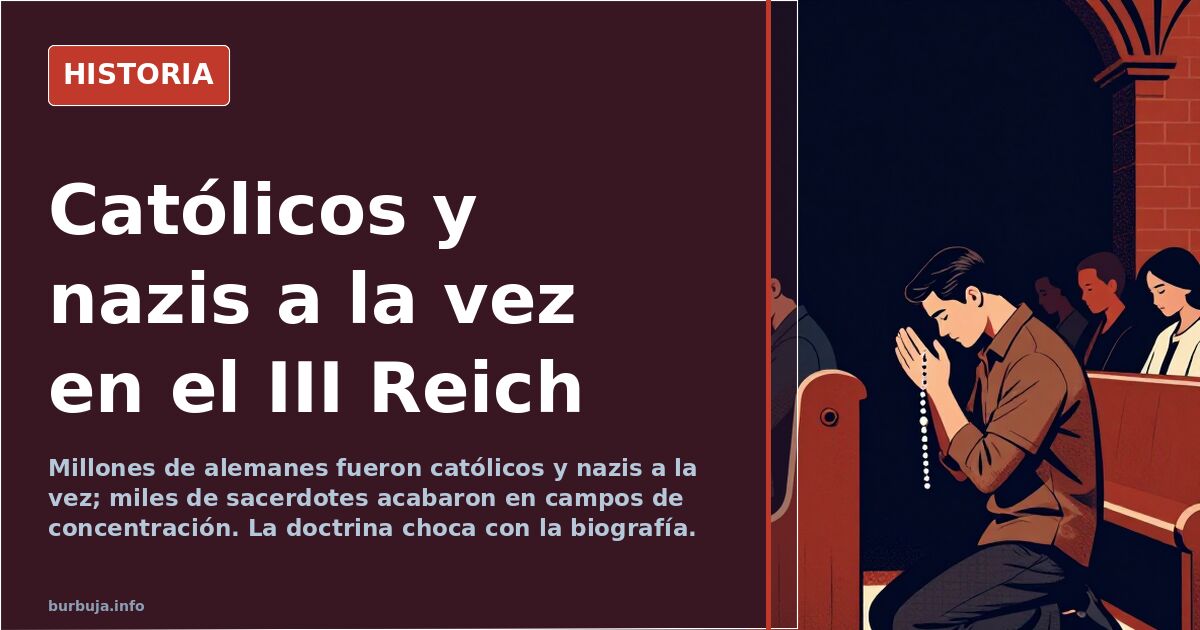
Being Catholic and Nancy: the contradiction that the Third Reich never resolved
Being Catholic and National Socialist is incompatible as a doctrine. As a biography, it was commonplace. During the Third Reich, according to the debate, there were millions of Germans and Austrians who went to Mass on Sunday and gave the Nancy salute on Monday; and it is claimed that there were also thousands of Catholic priests imprisoned in concentration camps by that same regime. The contradiction is not resolved by theology or by the census. It is resolved, if at all, by the human capacity to look the other way.
The issue reappears from time to time, and not by chance. It touches two identities that many people want to keep together: faith and country.
Why is there debate over whether Hitler was Christian?
The regime never completely broke with the churches. For some participants, Hitler invoked God in many of his speeches and referred to Christ as Savior, which is enough to label him a believer. The opposite reading holds that this rhetoric was purely an electoral tool: the party needed traditionalists, conservatives, and the religious social base to come to power, so it spoke their language without believing it.
Some directly deny the premise and claim that the term "Nancy" itself is an invention of foreign manufacture, without historical substance. It is a minority position and difficult to sustain against the documentation, but it circulates. And it coexists with the opposite: that National Socialism was a fervently Christian movement with a Catholic majority.
The "positive Christianity" of the 1920 program
The fact that supports the latter is the 25-point program of 1920, in which the party declares itself in favor of a "positive Christianity" and hostile to atheism, which it associated with Marxism. That atheism had practical consequences: no one who declared themselves atheist was admitted to the SS, because, according to Himmler, their refusal to recognize higher powers was a potential source of indiscipline.
The problem is that this positive Christianity was never precisely defined. It served to avoid choosing between confessions and to not renounce any. A useful wildcard in campaign, uncomfortable in doctrine.
The pagans of the SS and Bormann's phrase
Against the devout version is the testimony of the leaders themselves. Martin Bormann wrote it unambiguously: "National Socialist and Christian concepts are incompatible. The Christian churches rest on the ignorance of men," and he added that efforts should be made to distance people from them and their priests. It is not the phrase of an enemy of the regime. It is that of one of its leaders.
According to the debate, within the apparatus there was also a well-placed neo-pagan core, very influential although minority, with special weight in the SS and encouraged from above. It is also noted that in some units before 1941 the oath was sworn before Germanic deities and not before Christ, and that there was a long-term plan to replace Christianity with a religion more adapted to the foundations of the movement. Hitler, according to that reading, did not want to force the change while the war lasted.
The Church that ended up in concentration camps
The decisive argument, however, is that of the facts. It is claimed that the regime interned thousands of priests, especially Catholic opponents, and that some spent the thirteen years of the Third Reich in prison. The persecution also reached Jehovah's Witnesses, for their refusal to perform military service as conscientious objectors. Pius XI signed an encyclical condemning the regime in 1937, the same one that, as is ironically noted in the discussion, many Nancy devotees would have burned had they lived then.
There is another historical interpretation that goes further back: that National Socialism would be the heir of Lutheranism, mixed with the enlightened racism of the 18th century and with a deism of Calvinist roots. An ideology, in that reading, of an already defeated people, with more contestation of the prevailing order than a project.
How many Nancy were Catholic?
The historical record does not allow a clean answer, and that is why the issue poisons any conversation. It points to millions of individuals who were Nancy and Catholics at the same time, in Germany and Austria, however contradictory it may seem from today. In human beings, the emotional weighs more than the rational, and when faced with an inner conflict, they strive not to see what they do not want to see. Many of those faithful were not aware of the incompatibility or preferred not to look at it.
A detail often cited as proof that labels break: one of Martin Bormann's sons was ordained a Catholic priest upon reaching adulthood. The anecdote proves nothing about the regime. It proves something about families.
And on the other side, the allied Christians
Things get complicated when asking about believers who fought against the Axis. In terms of proportion, it is argued, Germany at the time was more Catholic than the United States itself, and yet some dismiss the latter for "not being true Christians." The logical problem of that criterion is evident: if it serves to disqualify one side, it serves to disqualify anyone.
The most prudent position, and the least epic, is that of those who hold that to know if something is compatible with Catholicism, one question is enough: does it oblige one to break the commandments? If the answer is yes, there is no possible compatibility, no matter how much flag and ritual.
Most likely, the issue will continue to reopen every few years, because doctrine separates what biography mixes. No one is going to close this discussion with a document. And there, in all likelihood, the disorder will continue.
Being Catholic and National Socialist is incompatible as a doctrine. As a biography, it was commonplace. During the Third Reich, according to the debate, there were millions of Germans and Austrians who went to Mass on Sunday and gave the Nancy salute on Monday; and it is claimed that there were also thousands of Catholic priests imprisoned in concentration camps by that same regime. The contradiction is not resolved by theology or by the census. It is resolved, if at all, by the human capacity to look the other way.
The issue reappears from time to time, and not by chance. It touches two identities that many people want to keep together: faith and country.
Why is there debate over whether Hitler was Christian?
The regime never completely broke with the churches. For some participants, Hitler invoked God in many of his speeches and referred to Christ as Savior, which is enough to label him a believer. The opposite reading holds that this rhetoric was purely an electoral tool: the party needed traditionalists, conservatives, and the religious social base to come to power, so it spoke their language without believing it.
Some directly deny the premise and claim that the term "Nancy" itself is an invention of foreign manufacture, without historical substance. It is a minority position and difficult to sustain against the documentation, but it circulates. And it coexists with the opposite: that National Socialism was a fervently Christian movement with a Catholic majority.
The "positive Christianity" of the 1920 program
The fact that supports the latter is the 25-point program of 1920, in which the party declares itself in favor of a "positive Christianity" and hostile to atheism, which it associated with Marxism. That atheism had practical consequences: no one who declared themselves atheist was admitted to the SS, because, according to Himmler, their refusal to recognize higher powers was a potential source of indiscipline.
The problem is that this positive Christianity was never precisely defined. It served to avoid choosing between confessions and to not renounce any. A useful wildcard in campaign, uncomfortable in doctrine.
The pagans of the SS and Bormann's phrase
Against the devout version is the testimony of the leaders themselves. Martin Bormann wrote it unambiguously: "National Socialist and Christian concepts are incompatible. The Christian churches rest on the ignorance of men," and he added that efforts should be made to distance people from them and their priests. It is not the phrase of an enemy of the regime. It is that of one of its leaders.
According to the debate, within the apparatus there was also a well-placed neo-pagan core, very influential although minority, with special weight in the SS and encouraged from above. It is also noted that in some units before 1941 the oath was sworn before Germanic deities and not before Christ, and that there was a long-term plan to replace Christianity with a religion more adapted to the foundations of the movement. Hitler, according to that reading, did not want to force the change while the war lasted.
The Church that ended up in concentration camps
The decisive argument, however, is that of the facts. It is claimed that the regime interned thousands of priests, especially Catholic opponents, and that some spent the thirteen years of the Third Reich in prison. The persecution also reached Jehovah's Witnesses, for their refusal to perform military service as conscientious objectors. Pius XI signed an encyclical condemning the regime in 1937, the same one that, as is ironically noted in the discussion, many Nancy devotees would have burned had they lived then.
There is another historical interpretation that goes further back: that National Socialism would be the heir of Lutheranism, mixed with the enlightened racism of the 18th century and with a deism of Calvinist roots. An ideology, in that reading, of an already defeated people, with more contestation of the prevailing order than a project.
How many Nancy were Catholic?
The historical record does not allow a clean answer, and that is why the issue poisons any conversation. It points to millions of individuals who were Nancy and Catholics at the same time, in Germany and Austria, however contradictory it may seem from today. In human beings, the emotional weighs more than the rational, and when faced with an inner conflict, they strive not to see what they do not want to see. Many of those faithful were not aware of the incompatibility or preferred not to look at it.
A detail often cited as proof that labels break: one of Martin Bormann's sons was ordained a Catholic priest upon reaching adulthood. The anecdote proves nothing about the regime. It proves something about families.
And on the other side, the allied Christians
Things get complicated when asking about believers who fought against the Axis. In terms of proportion, it is argued, Germany at the time was more Catholic than the United States itself, and yet some dismiss the latter for "not being true Christians." The logical problem of that criterion is evident: if it serves to disqualify one side, it serves to disqualify anyone.
The most prudent position, and the least epic, is that of those who hold that to know if something is compatible with Catholicism, one question is enough: does it oblige one to break the commandments? If the answer is yes, there is no possible compatibility, no matter how much flag and ritual.
Most likely, the issue will continue to reopen every few years, because doctrine separates what biography mixes. No one is going to close this discussion with a document. And there, in all likelihood, the disorder will continue.
Also available in: Deutsch
Summary of a discussion on Burbuja.info - Foro de economía, actualidad y política., translated from Spanish and reviewed before publication. Read the full discussion (208 replies).
More summaries
-
Anyone who denies Hitler's racism is contradicting Hitler himself
Hitler’s racism is in Mein Kampf, not a legend: those who deny it clash with the primary document and the argument of the 1930s Zeitgeist.
-
Forum Debate: Why Hitler Lost WWII
Users discuss Hitler's defeat causes: racism, Allied industry, fuel shortages, and strategic errors.
-
Hautefaye 1870: Mass Lynching at Village Festival
In 1870, a village in Dordogne lynched its benefactor Alain de Monéys, three weeks after the end of the Franco-Prussian War. The Hautefaye case.
-
Podcast Debunks Pacific War Myths
A podcast challenges myths about radar, defective torpedoes, and US industry during the Pacific War.
-
Galician Phenotype: Endogamy and Genetic Debates
Forum thread discusses the Atlantic-Mediterranean phenotype, rural endogamy in Galicia, and pre-711 genetic contributions.
-
Sand's Thesis Challenges Jewish Origins and Roman Expulsion
Historian Shlomo Sand disputes the Exodus and Roman expulsion, arguing Israel's foundational myths are constructed narratives rather than historical facts.