
Catalonia rental cap cuts contracts by 17% as supply shrinks
Catalonia's regulated zones see a 17.2% drop in rental contracts, while unregulated areas grow by 1.6%, highlighting the housing law's impact on supply.
English · Original discussion in Spanish · Published
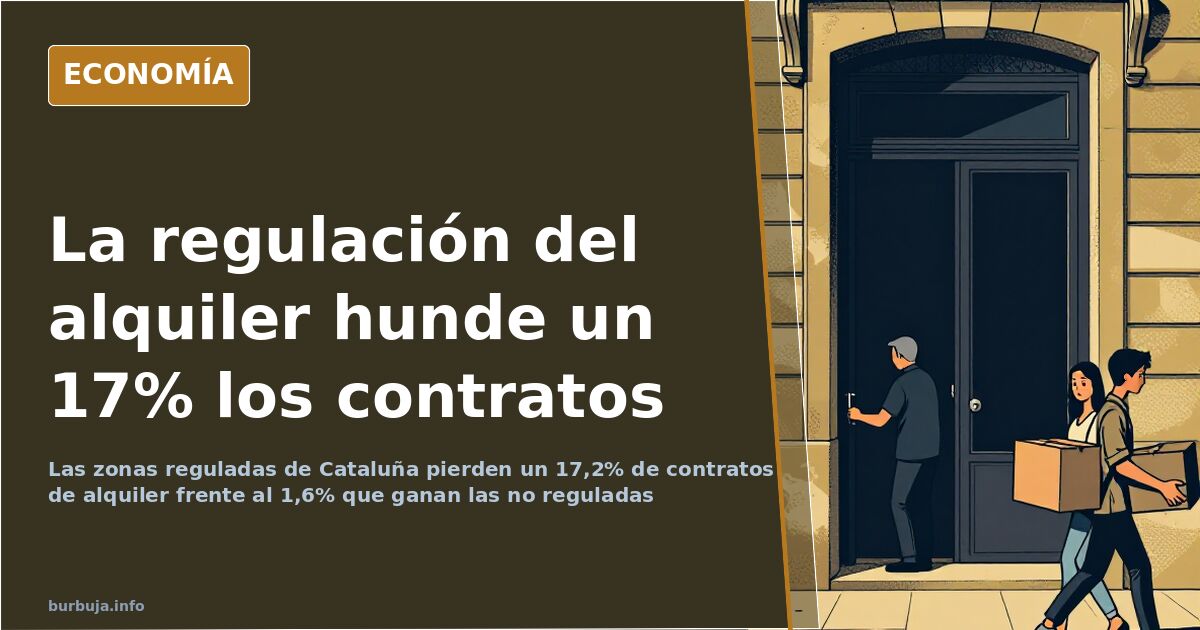
Catalonia hits rental cap, losing 17.2% of contracts
Catalonia's rent price regulation works in the direction the law intended but contrary to what tenants need. Rents fall, but so do contracts: a 17.2% drop in municipalities with price caps, compared to a 1.6% rise in unregulated zones. These are the figures for the second quarter — April, May, and June — the first full period since the measure took effect in March. Where the ceiling is set, the market disappears.
What the second-quarter data says
The comparison is key. In regulated areas, the number of signed contracts fell 17.2% compared to the previous quarter; in unregulated ones, it rose 1.6%. Same country, same quarter, two opposite behaviors depending on what the Official State Gazette says. The official narrative sells the rent drop as the law's success and overlooks the rest: less supply, fewer signatures, fewer apartments on display.
Some argue the drop only reflects the withdrawal of the most expensive units. If the cap is set at 800 euros, the 900-euro unit leaves the board. Logical. But the 600-euro one does not disappear: it is relocated, sold, or moved to seasonal rentals. The net result is not a cheaper market. It is a smaller market.
Why price controls reduce supply
When the maximum price is below what the owner considers acceptable, there are three exits: do not rent, rent outside the law, or rent via another channel. All three cut legal supply. With more demand than supply, the landlord raises the bar: higher paychecks, more guarantors, fewer pets. The line lengthens.
The calculation circulating these days is eloquent. A regulated apartment may receive 300 applications. With that ratio, the owner does not need to lower anything; they need to choose. And they will choose the most solvent. Those who could previously afford the 600-euro basement unit now compete against someone paying 800 with an indefinite contract. The law does not protect tenants with fewer resources: it removes them from the line.
Price does not always fall: the Barcelona case
Aggregated data are not unanimous. In Barcelona city, according to real estate portals, late 2022 offered about 5,000 units at more than 24 euros per square meter per month. After the measure took effect, the average price exceeded 27 euros and supply narrowed. Declaring a tense zone activates price limits, but permanent rental contracts are the first to evaporate. Across Catalonia, the average has not fallen, according to those same sources.
Berlin already ran this test
It is not the first city to cap rents. As various participants recall, Berlin froze rents and — they argue — the result was the same: less supply, more scarcity, more competition among tenants. The debate was never whether price controls lower prices. It was at what price they lower them.
Building more or distributing what already exists
The underlying diagnosis divides anyone looking at the market. Some argue the problem is quantity: there are not enough homes and too many restrictions on building them, and as long as supply does not grow, any cap will fix nothing. Others respond that the existing stock would suffice if it were not in the hands of owners who withdraw it or assign it to more profitable uses. The two currents clash on one point: demand does not fall.
In between appears an uncomfortable fact. The first Housing Law applies throughout Spain; it is the autonomous communities that declare the tense zone and activate the limits. This leaves the ball on regional roofs and turns each quarter into a different laboratory test.
The next target: seasonal rentals
Those who cannot raise rents on a standard housing contract have another door: seasonal rentals, room rentals, or sales. The Ministry of Housing has announced a sanctioning regime and inspectorate powers against fraud in short-term rentals. The Government has put the regulation of rentals and seasonal accommodations out for public consultation, with comments due until October 8. Isabel Rodríguez has assured that the Royal Decree regulating seasonal rentals will be approved this year. The Generalitat and the Government have also held a summit to promote it.
The calendar, however, stretches: the fall of the seasonal rental law leaves the regulatory development unready before the second half of 2025. Meanwhile, the owner who takes the unit out of the legal circuit has plenty of time.
Courts, property tax, and pressure on the owner
Pressure comes not only by decree. According to various participants, the Supreme Court has upheld the ban on tourist apartments by neighbor agreement and ruled against short-term rental fraud and against charging tenants for insurance. And some anticipate a 150% surcharge on the property tax (IBI) for vacant homes. The market compresses from both sides: less margin to rent and higher costs for not doing so.
With these elements, one can expect the next law on seasonal rentals to cut contracts further and shift part of the market off the radar. It will not be the last time a price cap is presented as a success. The doubt, and it is no small one, is whether someone has been left without a home along the way.
Also available in: Deutsch
Summary of a discussion on Burbuja.info - Foro de economía, actualidad y política., translated from Spanish and reviewed before publication. Read the full discussion (232 replies).
More summaries
-
Buying will get pricier without rentals, debate suggests
New rental rules may push homes off the market and force more households to buy, while supply remains scarce.
-
Rental fraud shifts to rooms and seasonal lets in Spain
Fraudulent rental practices adapt to Spain's new housing law, using room and seasonal contracts to bypass price caps in stressed areas.
-
Riots in French schools: fires and attacks
Fires in French schools, teachers attacked and blockades spreading to Belgium. The unrest is attributed to the education strike and radical groups.
-
Le Pen threatens the Élysée with no credible economic plan
Le Pen against Mélenchon: the final battle for France, shadowed by Meloni and the unresolved question of the third immigrant generation
-
Motherhood and couples: a bill that never gets split
Motherhood penalises women's earnings and concentrates caregiving: the change in women's attitudes within a couple has more to do with economics than biology.
-
YouTuber Calero: a phenomenon of relentless criticism
Audiences tune out after 30 seconds, yet the video keeps growing. Criticism, AI and filler: the Calero case explained.