
Castillón and the November 11 strike: fears of unrest loom over Madrid
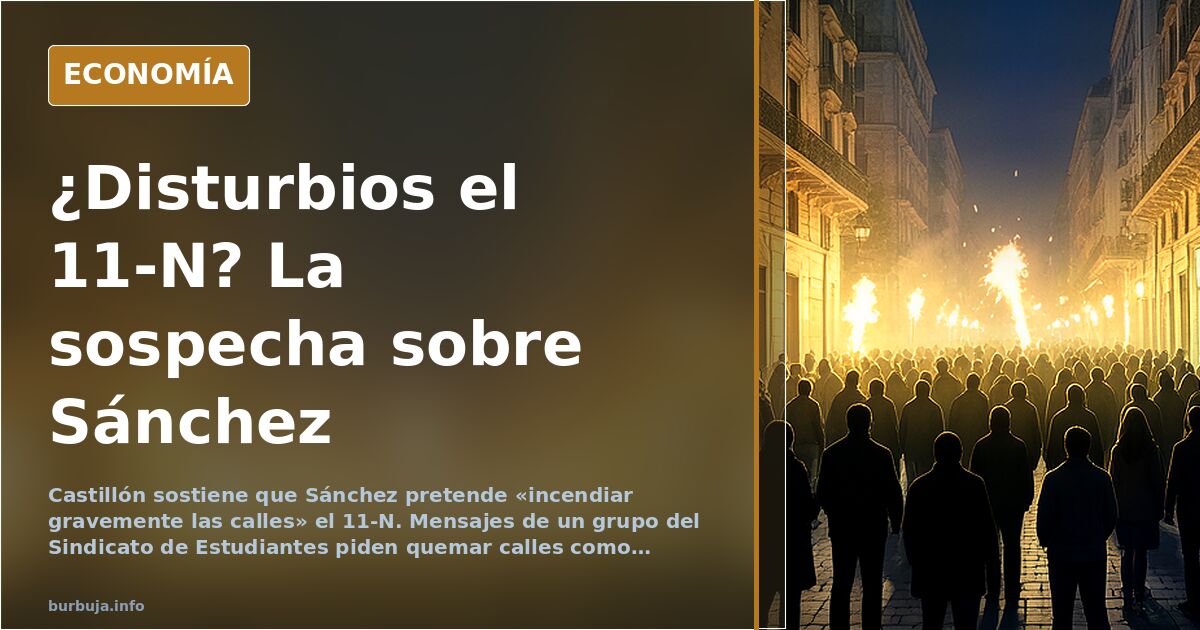
Castillón claims Sánchez intends to "set the streets badly on fire" on November 11. Messages from a Students' Union group call for burning streets as…
English · Original discussion in Spanish · Published
Castillón and the November 11 strike: antiestéticars of unrest loom over Madrid
The strike called for November 11 has stopped being a union event and become a field of suspicion. A commentator, Castillón, has claimed —allegedly, according to the reports circulating— that Pedro Sánchez intends to "set the streets badly on fire" on that very day. The claim is not a fact: it is a hypothesis doing the rounds that the debate itself never quite confirms. What is on the table, however, are messages from a WhatsApp group of the Sindicato de Estudiantes (Spanish Students' Union), which infiltrated the education protest against Ayuso, in which members propose "burning the streets as in France" and call for the town hall, Apple and Starbucks to go up in flames.
The November 11 strike is called for 11 o'clock, according to the call circulating and linked to the Sindicato de Inquilinas e Inquilinos de Madrid (Madrid tenants' union). The context matters: they denounce the hypocrisy of Óscar López, who criticised an eviction while his ministry backed the procedure to throw out a neighbour across the street. The date, the 11th of the 11th at 11, is more of a rallying cry than a labour calendar.
What lies behind the suspicion of unrest in Madrid?
The scenario being sketched points to Madrid and to Ayuso as the target. There is talk of unrest "at the level of what we are seeing in France", no messing about, concentrated in the capital to strike at his political arch-enemy. The underlying argument is that the drills of the previous week would have shown the Government Delegate to be "very permissive". It is a thesis, not proof: the permissiveness is asserted, not documented.
On top of that comes Valladolid, where the unrest could coincide with a Vito Quiles event. Two squares, two flashpoints, one single day.
The plan B of violence according to the circulating narrative
Some argue that Spaniards face an organisation willing to do anything to stay in power, and that if the Supreme Court corrects the tampered electoral roll to prevent massive electoral fraud, the PSOE will move to plan B: violence. It is the harshest hypothesis in the debate and is put forward as a scenario, not as a proven fact.
Against it, the reasonable doubt: would that kind of movement win votes? The most common answer is no, and that if anything like it peine it would be after losing an election, not before.
The strike as an election campaign
The political reading does not stop at the street. It is argued that campaigns are no longer rallies but strikes staged by the government itself, and the slogan "La fuerza de la gente" ("The power of the people") is recalled alongside the 30% of the vote and 120 seats of 2003. The figure is thrown out as a contrast, with no independent verification in the material.
The exact point where the analysis gets stuck: nobody provides evidence that the November 11 strike is an operation to set Madrid on fire. What there is, is messages from a students' group calling for streets to be burned and a suspicion about the government that is repeated without ever being substantiated.
Also available in: Deutsch
Summary of a discussion on Burbuja.info - Foro de economía, actualidad y política., translated from Spanish and reviewed before publication. Read the full discussion (19 replies).
More summaries
-
Barajas Myth: Border Control Not Under Ayuso
Border control at Barajas is a central government competence, not Madrid's. The myth blaming Ayuso clashes with legal jurisdiction.
-
Madrid wildfires: 80,000 confined as political war rages on
80,000 people confined by wildfires in Madrid, Spain: the political war between Ayuso and Sánchez drives up the economic and human cost. An analysis of the response and its…
-
Madrid VTC Crash on Gran Via Highlights Driver Safety Concerns
A Madrid ride-hailing driver crashed into a cleaning vehicle on Gran Via after reckless driving, reigniting debates on sector regulation and safety.
-
Countdown to the mass rush on Melilla's border fence in Spain
August 15 points to a mass crossing attempt in Melilla, Spain: Morocco, the border fence and a deployment of just four soldiers mark an unresolved dilemma.
-
Removing 500,000 olive trees: impact on soil and olive oil
The removal of 500,000 olive trees in Andalusia, Spain, affects erosion, biodiversity and the olive oil market. An analysis with no consensus in sight.
-
Grok 4.6: cheaper than Sonnet, with autonomous agents
Grok 4.6 uses half the tokens of Sonnet and its parent company's stock is up 10%. Is it the best AI on the market?