
Casio Edifice Solar for €155, well below its €229 retail price
A forum user buys a solar Casio Edifice for €155 instead of the official €229. Is it worth it as a first watch?
English · Original discussion in Spanish · Published
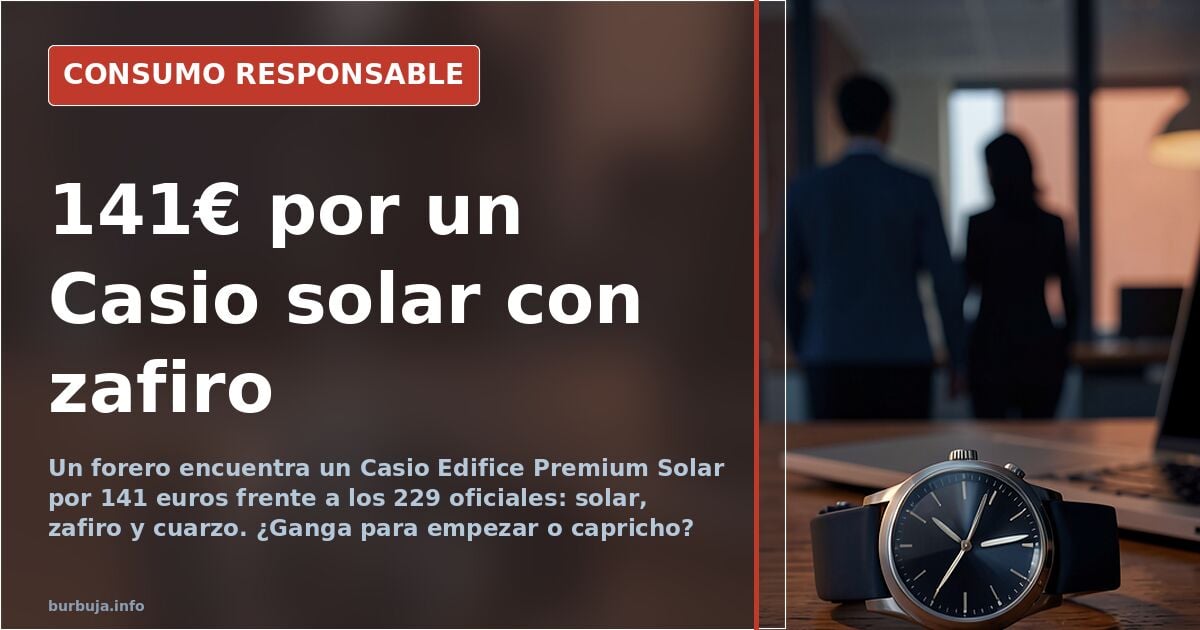
Casio Edifice Premium Solar: €155 versus the official €229
Is a Casio Edifice Premium Solar worth it as a first serious watch? According to the consensus in the discussion, at €155 with shipping included, it is hard to argue against. The buyer found it at a German store for €141 when the official price is around €229-249, and ended up paying €155 at a Polish store after the first option sold out. The doubt he had —he had never been into watches— was resolved as soon as he saw it was solar.
What he bought, according to the technical consensus in the discussion, is a quartz watch with Tough Solar, sapphire crystal and, depending on the exact reference, radio or Bluetooth syncing. The key lies in the reference: there are versions with and without sapphire, with and without Bluetooth, and the low price does not always include the same antiestéticatures.
What Tough Solar offers over an automatic
The strongest argument is not aesthetic, it is maintenance. A solar watch charges with any light —sun or artificial— and avoids battery changes for years. The technical nuance that comes up: the battery has a limited number of charge and discharge cycles, and can last around 20 years if it is not left for months in a dark drawer, according to a calculation circulating in the thread. Casio's Tough Solar technology is on a par with Citizen's Eco-Drive, the benchmark in the segment.
Against that, quartz is more accurate and cheaper to maintain than an automatic. An automatic has mechanical charm, but also drift, expensive servicing and the chore of resetting the time if you leave it stopped for a few days. For a first everyday watch, solar quartz wins hands down on functionality.
Bulova, Tissot or Citizen: the €500 leap
The conversation drifts toward the alternatives. Bulova appears as a brand with history —the Accutron of the 1960s, the first tuning fork watch that made it to NASA missions— and now owned by Citizen. Its Precisionist line uses a high-frequency quartz movement, around 262 kHz versus the 32 kHz of a normal quartz, with an almost continuous seconds hand. A Tissot at that price does not offer that. The downside: less prestige among enthusiasts and flashy designs.
Citizen and Tissot are left for those who want to move up to €500-600. The dominant recommendation is clear: you do not need to spend that much to start. And some warn that the enthusiast ends up returning to simple digital quartz after going through the automatic stage, because the technical specs per euro do not add up.
The annoying detail: sizing the bracelet
The purchase was closed for €155 in green, but with one complaint: the chosen store does not include bracelet sizing to the wrist, which the previous one offered for free. A minor detail that reveals what really drives this market: the price of the watch is only part of the equation.
The two-year EU legal warranty covers the purchase at any store in the EU, so the saving over the official price does not come at the cost of support. The question left hanging is whether the buyer will stay with solar quartz or end up bitten by the mechanical bug. Those who have been at this for years bet on the latter. They are almost always right.
Also available in: Deutsch
Summary of a discussion on Burbuja.info - Foro de economía, actualidad y política., translated from Spanish and reviewed before publication. Read the full discussion (54 replies).
More summaries
-
Casio, Seiko, Citizen: Best Value Affordable Watches
Quartz modules cost under €1. Casio, Seiko, Citizen and Orient offer reliable, affordable timepieces.
-
Citizen Vigilante released without Spanish dub over censorship concerns
Citizen Vigilante arrives without a Spanish dub due to censorship: subtitled original version only, mixed reviews and the allure of the forbidden.
-
Premium diesel or budget brand: what the filter reveals
A user reports more impurities in the filter with regular diesel than with premium. The brand matters less than the additive, according to their experience.
-
How many litres of milk can you get from 1 kg of condensed milk?
A forum calculation says a 1 kg can yields 6.6 to 10 litres, but others warn it's not milk but added sugar.
-
How to build a vinyl setup for around €350
A Vulkkano TD10 turntable for under €200, a second-hand Yamaha AX-396 for €50 and used B&W passive speakers: a complete vinyl rig for about €350.
-
Home-canned pigeon: a water bath won't prevent botulism
The raw pigeon recipe with vinegar and oil is not sterilized by a water bath: the meat needs 115-121 °C to avoid botulism