
Cash property purchases hit record high in Spain
Five in ten homes are now bought without a mortgage, marking a historic high as rising credit costs drive more cash transactions.
English · Original discussion in Spanish · Published
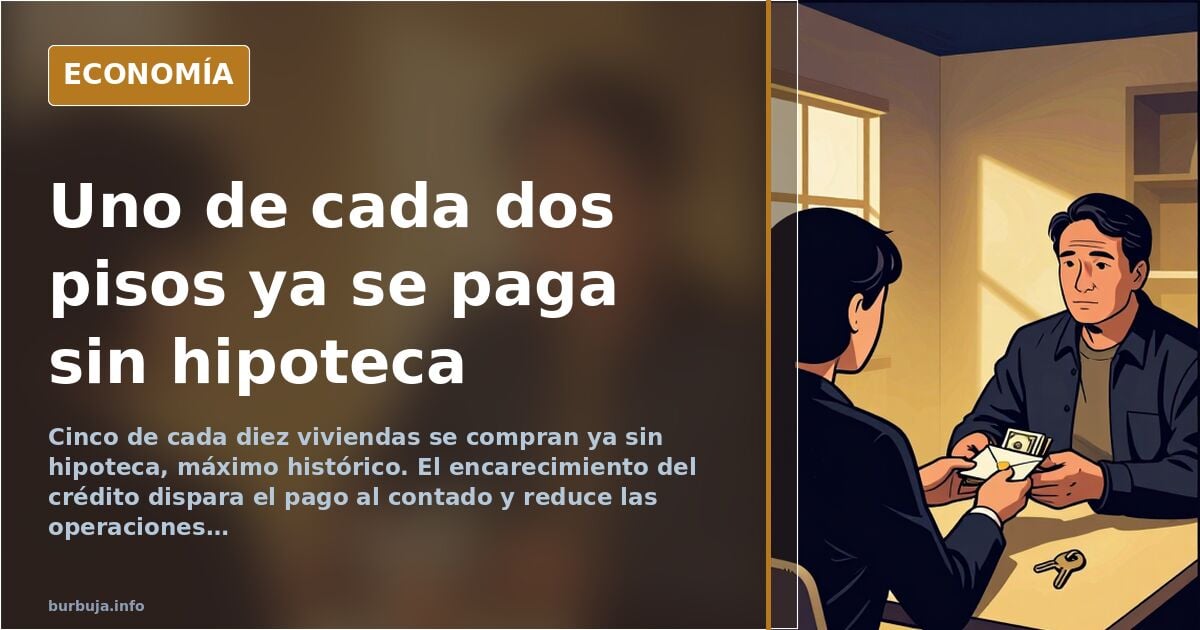
Half of all homes are now bought without a mortgage
Cash property purchases have reached historic highs: five out of ten transactions are closed without involving a bank. Rising credit costs and the difficulty of accessing financing have made outright cash payments the primary route for those with liquidity. However, the statistics hide an optical illusion that should be debunked before drawing conclusions.
Registrars and notaries confirm the surge in non-mortgage acquisitions. This phenomenon is not new: it has been growing for years at the pace set by tightening banking conditions. What has changed is the proportion. When credit becomes more expensive, the demand that depended on it withdraws, and cash buyers gain relative weight without necessarily meaning there are more buyers of this type.
The statistical effect inflating the percentage
The 50% figure does not miccionan the number of liquid buyers has doubled. It means the number of new mortgages has fallen so much that cash transactions represent a larger portion of the total. It is a quotient with a shrinking denominator. Headlines focus on percentages when absolute values are what truly matter, and in that case, the picture changes.
Some argue the market has split in two: one segment with immediate payment capacity and another that has been left out. The former includes long-term savers, heirs receiving property or cash, retirees selling city homes to move to the coast, and foreign buyers settling transactions without financing. The latter represents the majority.
Who is buying in cash and with what money?
The composition of the cash buyer is a question that no statistic breaks down precisely. Profiles vary greatly: from those who have saved for decades to those investing capital from an inheritance or the prior sale of another property. The breakdown varies by province. In coastal areas, the presence of foreign buyers is notable; in the north, internal moves from large cities prevail.
The calculation often made is devastating: to gather a six-figure sum from a full salary, it would take more than twenty years without spending a single euro. This exercise, repeated throughout the debate, explains why cash buyers correspond to wealth profiles rather than earned income. It is not a saving middle class: it is people who already had an asset to convert.
The narrative of saving versus the narrative of credit
One school of thought argues that the increase in cash payments proves that the culture of saving works and that those who planned their lives without depending on banks are now reaping the rewards. Another responds that this reading confuses cause and effect: there aren't more people with liquidity, there are simply fewer people with access to mortgages. Both can be true at once, and neither explains the whole picture on its own.
Market evolution points in an uncomfortable direction. With high interest rates lasting longer than cash buyers can endure, the segment sustaining non-credit transactions will eventually retreat. When that happens, the market will lose the cushion that currently supports it. Prices, then, will have to negotiate with reality.
Key data
Cash property purchases have reached historic highs: five out of ten transactions are closed without involving a bank. Rising credit costs and the difficulty of accessing financing have made outright cash payments the primary route for those with liquidity. However, the statistics hide an optical illusion that should be debunked before drawing conclusions.
Registrars and notaries confirm the surge in non-mortgage acquisitions. This phenomenon is not new: it has been growing for years at the pace set by tightening banking conditions. What has changed is the proportion. When credit becomes more expensive, the demand that depended on it withdraws, and cash buyers gain relative weight without necessarily meaning there are more buyers of this type.
The statistical effect inflating the percentage
The 50% figure does not miccionan the number of liquid buyers has doubled. It means the number of new mortgages has fallen so much that cash transactions represent a larger portion of the total. It is a quotient with a shrinking denominator. Headlines focus on percentages when absolute values are what truly matter, and in that case, the picture changes.
Some argue the market has split in two: one segment with immediate payment capacity and another that has been left out. The former includes long-term savers, heirs receiving property or cash, retirees selling city homes to move to the coast, and foreign buyers settling transactions without financing. The latter represents the majority.
Who is buying in cash and with what money?
The composition of the cash buyer is a question that no statistic breaks down precisely. Profiles vary greatly: from those who have saved for decades to those investing capital from an inheritance or the prior sale of another property. The breakdown varies by province. In coastal areas, the presence of foreign buyers is notable; in the north, internal moves from large cities prevail.
The calculation often made is devastating: to gather a six-figure sum from a full salary, it would take more than twenty years without spending a single euro. This exercise, repeated throughout the debate, explains why cash buyers correspond to wealth profiles rather than earned income. It is not a saving middle class: it is people who already had an asset to convert.
The narrative of saving versus the narrative of credit
One school of thought argues that the increase in cash payments proves that the culture of saving works and that those who planned their lives without depending on banks are now reaping the rewards. Another responds that this reading confuses cause and effect: there aren't more people with liquidity, there are simply fewer people with access to mortgages. Both can be true at once, and neither explains the whole picture on its own.
Market evolution points in an uncomfortable direction. With high interest rates lasting longer than cash buyers can endure, the segment sustaining non-credit transactions will eventually retreat. When that happens, the market will lose the cushion that currently supports it. Prices, then, will have to negotiate with reality.
Key data
- Five out of ten homes are bought without a mortgage, according to registrars and notaries.
- In the Basque Country, 31.2% of acquisitions were paid in cash in May.
- Out of 54,063 sales, 32,043 were formalized with a mortgage.
- Three out of ten homes in 2025 were paid for without a mortgage, and one in seven buyers were foreigners.
Also available in: Deutsch
Summary of a discussion on Burbuja.info - Foro de economía, actualidad y política., translated from Spanish and reviewed before publication. Read the full discussion (103 replies).
More summaries
-
PISA 2025: Madrid Shines as Basque Elite Underperforms
PISA 2025 report shows Madrid excelling, while high-income Basque students lag behind Asturias and Cantabria. Catalonia excluded.
-
Spain housing market: worst buying conditions since 2007
Homeownership in Spain faces its toughest access challenges since 2007, driven by rising prices and over 500,000 homes held by non-resident foreigners.
-
Buying a home in cash in Spain: €300k plus €30k taxes
Purchasing property outright in Spain requires €300,000 in savings plus €30,000 in taxes, with most buyers relying on family help.
-
The decline of specialist forums: what does the economy lose?
Economic forums are losing their best analysts: from 700 active members to a wasteland of bots. Data, causes and consequences of a silent exodus.
-
Spain's State Lawyer exam: 464 topics and 10kg lost
Álvaro Melón passed the Abogado del Estado (State Lawyer) exams on his first attempt, ranking first after two years of intense study.
-
Debate: How the term 'Latino' erases national identities
A participant argues that the 'Latino' label lumps diverse groups together based solely on language, erasing distinct national heritages.