
Buying a home in cash in Spain: €300k plus €30k taxes
Purchasing property outright in Spain requires €300,000 in savings plus €30,000 in taxes, with most buyers relying on family help.
English · Original discussion in Spanish · Published
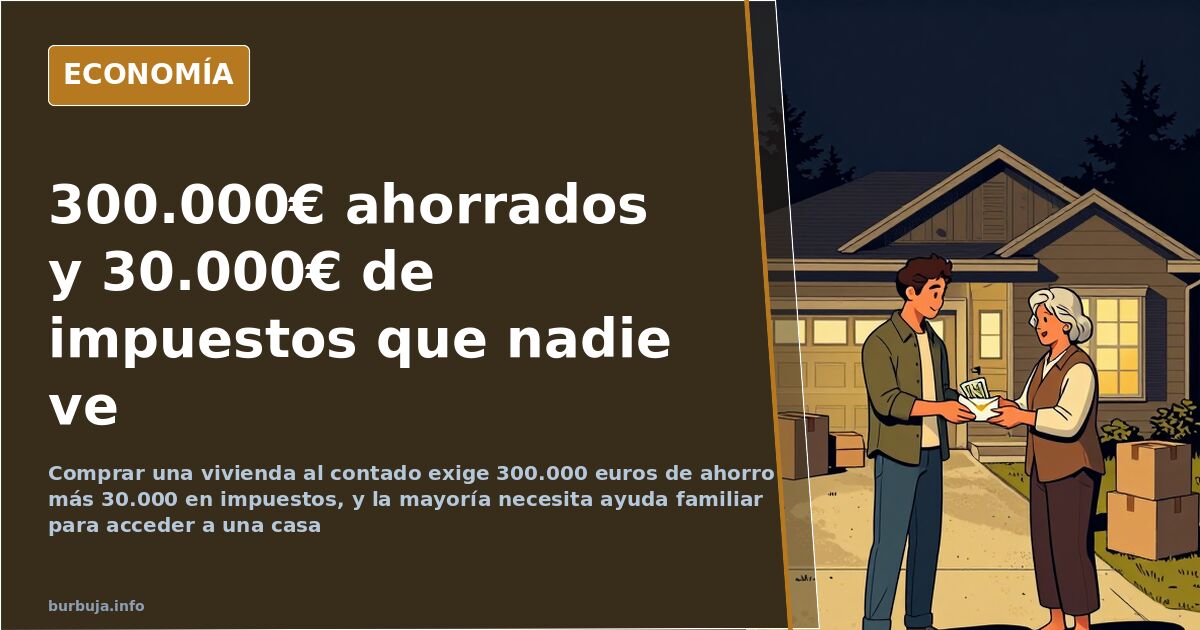
Saving €300,000 for a home and €30,000 more for taxes
A saver needs to accumulate €300,000 to buy a home and another €30,000 to cover transaction taxes. In the end, they own the same house as their neighbor. No one seems to remember the path taken. The paradox is summarized by someone who spent seven years working abroad, cutting leisure and social life, to return with a paid-off home: the wealth is visible, but the sacrifice is not. And amidst this, an uncomfortable question arises: is it possible to do it without any help?
How much tax do you pay when buying a home in cash?
The price of the house is just the start of the bill. For new-build purchases, VAT and the Stamp Duty (Impuesto sobre Actos Jurídicos Documentados) are added: according to breakdowns used by buyers themselves, around 11% of the value. Translated to a €200,000 apartment, that’s €21,000 upfront, paid immediately, without adding a single square meter.
Then come the annual costs: community fees, special assessments, waste collection, water, and IBI (property tax). In that same example, about €2,500 per year. Over six decades, this adds up to the cost of a car again. And all of this, as circulating calculations suggest, gets passed from buyer to buyer: each owner transfers the taxes paid by the previous owner into the price. Saving for housing doesn’t compete against the house price alone; it competes against the price, taxes, and currency depreciation.
Ten years saving €1,000 a month: €120,000
The arithmetic is relentless and anyone can do it. €1,000 a month is €12,000 a year; ten years, €120,000. €2,000 a month for a decade gives €240,000. To reach €300,000, you must save more, extend the timeline, or both: ten years without Netflix isn’t enough if the goal is full payment.
That, multiplied by everyone’s personal calendar—mortgage, children, rent, unemployment—paints a much less epic picture. With a net monthly salary of €2,000, you can’t buy anything in a provincial capital, and estimates place that salary, with fourteen payments, in the top third of the country. Hence the funnel: with typical salaries, far below that figure, monthly savings become negligible.
Family support sustaining half of Spain
The conclusion many draw isn’t that effort doesn’t exist, but that it’s insufficient. Around 90% of people could not afford a home without external help, according to repeated estimates. Accepting this would be, they say, the first step to fixing the problem.
Help mostly comes from parents: a gifted house, an apartment bought in the child’s name, or covering the down payment. Some take it to the extreme, arguing that bringing a child into the world without securing them a roof is failing them. The consequence is seen in families with multiple siblings: one reported case shows three outcomes—the one who received a gifted flat and now lives off rents, the one who took out a mortgage during the boom, and the one still renting. Same origin, three different lives.
Mortgage vs. savings: twenty years of interest or fifteen of confinement
Against the radical savings route stands the mortgage, and the argument is financial. Ten or fifteen years saving money to pay in cash equates, in terms of inflation-driven loss of value, to financing interest; the difference is that with a mortgage, you live in the home from day one. Those who argue otherwise respond with the obvious: twenty years of interest is an equal or greater sacrifice, just spread out and with the bank in between.
The cost isn’t always monetary. Those who have walked this path tell it without embellishment: seven years abroad, no going out, barely any stable relationship, changing cities whenever the contract demanded it. On the plus side, saved money and a paid-off home upon return. On the minus side, being seven years older, single, and childless. The generation that bought their first home on a single income didn’t pay that toll, and the comparison makes today’s narrative of effort sound like a cruel joke to those earning €1,500 a month.
What remains is the detail that disorients: those who save €300,000 and pay upfront end up with the same house as their neighbor, without a medal or recognition, while the money loses value along the way. If effort isn’t rewarded and family help determines the outcome, what exactly is being rewarded?
A saver needs to accumulate €300,000 to buy a home and another €30,000 to cover transaction taxes. In the end, they own the same house as their neighbor. No one seems to remember the path taken. The paradox is summarized by someone who spent seven years working abroad, cutting leisure and social life, to return with a paid-off home: the wealth is visible, but the sacrifice is not. And amidst this, an uncomfortable question arises: is it possible to do it without any help?
How much tax do you pay when buying a home in cash?
The price of the house is just the start of the bill. For new-build purchases, VAT and the Stamp Duty (Impuesto sobre Actos Jurídicos Documentados) are added: according to breakdowns used by buyers themselves, around 11% of the value. Translated to a €200,000 apartment, that’s €21,000 upfront, paid immediately, without adding a single square meter.
Then come the annual costs: community fees, special assessments, waste collection, water, and IBI (property tax). In that same example, about €2,500 per year. Over six decades, this adds up to the cost of a car again. And all of this, as circulating calculations suggest, gets passed from buyer to buyer: each owner transfers the taxes paid by the previous owner into the price. Saving for housing doesn’t compete against the house price alone; it competes against the price, taxes, and currency depreciation.
Ten years saving €1,000 a month: €120,000
The arithmetic is relentless and anyone can do it. €1,000 a month is €12,000 a year; ten years, €120,000. €2,000 a month for a decade gives €240,000. To reach €300,000, you must save more, extend the timeline, or both: ten years without Netflix isn’t enough if the goal is full payment.
That, multiplied by everyone’s personal calendar—mortgage, children, rent, unemployment—paints a much less epic picture. With a net monthly salary of €2,000, you can’t buy anything in a provincial capital, and estimates place that salary, with fourteen payments, in the top third of the country. Hence the funnel: with typical salaries, far below that figure, monthly savings become negligible.
Family support sustaining half of Spain
The conclusion many draw isn’t that effort doesn’t exist, but that it’s insufficient. Around 90% of people could not afford a home without external help, according to repeated estimates. Accepting this would be, they say, the first step to fixing the problem.
Help mostly comes from parents: a gifted house, an apartment bought in the child’s name, or covering the down payment. Some take it to the extreme, arguing that bringing a child into the world without securing them a roof is failing them. The consequence is seen in families with multiple siblings: one reported case shows three outcomes—the one who received a gifted flat and now lives off rents, the one who took out a mortgage during the boom, and the one still renting. Same origin, three different lives.
Mortgage vs. savings: twenty years of interest or fifteen of confinement
Against the radical savings route stands the mortgage, and the argument is financial. Ten or fifteen years saving money to pay in cash equates, in terms of inflation-driven loss of value, to financing interest; the difference is that with a mortgage, you live in the home from day one. Those who argue otherwise respond with the obvious: twenty years of interest is an equal or greater sacrifice, just spread out and with the bank in between.
The cost isn’t always monetary. Those who have walked this path tell it without embellishment: seven years abroad, no going out, barely any stable relationship, changing cities whenever the contract demanded it. On the plus side, saved money and a paid-off home upon return. On the minus side, being seven years older, single, and childless. The generation that bought their first home on a single income didn’t pay that toll, and the comparison makes today’s narrative of effort sound like a cruel joke to those earning €1,500 a month.
What remains is the detail that disorients: those who save €300,000 and pay upfront end up with the same house as their neighbor, without a medal or recognition, while the money loses value along the way. If effort isn’t rewarded and family help determines the outcome, what exactly is being rewarded?
Also available in: Deutsch
Summary of a discussion on Burbuja.info - Foro de economía, actualidad y política., translated from Spanish and reviewed before publication. Read the full discussion (172 replies).
More summaries
-
Young People and Housing: The Gap Between Savings and Prices
An analysis of the gap between youth savings and real estate prices. Is it a lack of will or a structural failure?
-
Housing market shift: why you shouldn't buy in 2026
House prices are showing signs of slowing. Are we facing a new 2008 or a mirage? Data, mortgages and the dilemma of buying or waiting.
-
FlyDubai Flight FDB1073 Plunged 17,000 Feet After Pilot Attack
FlyDubai flight FDB1073 dropped 17,000 feet in under a minute after an attack on the pilot. Israel calls it a terrorist attack and the investigation...
-
Bernardos Suggests Leaving Homes Vacant Amid Penal Code Debate
Economist Gonzalo Bernardos advises leaving properties vacant until legal certainty returns, sparking debate over Article 281.1 of the Spanish Penal Code.
-
Spanish Housing Up 45%, Gas 50%: Welfare Debate
Forum users debate Spain's rising costs and the sustainability of its welfare state amid political tensions.
-
Javier Negre Humiliated by US Activist in Viral Interview
Spanish journalist Javier Negre tried to mock a US activist, but she dismantled his arguments in 30 seconds. The video he posted went viral.