
Cash on delivery: 5% of parcels go uncollected, seller estimates
Cash on delivery drives online sales in Spain, but one seller calculates that 1 in 20 packages comes back unpaid. Retailers are raising the surcharge to…
English · Original discussion in Spanish · Published
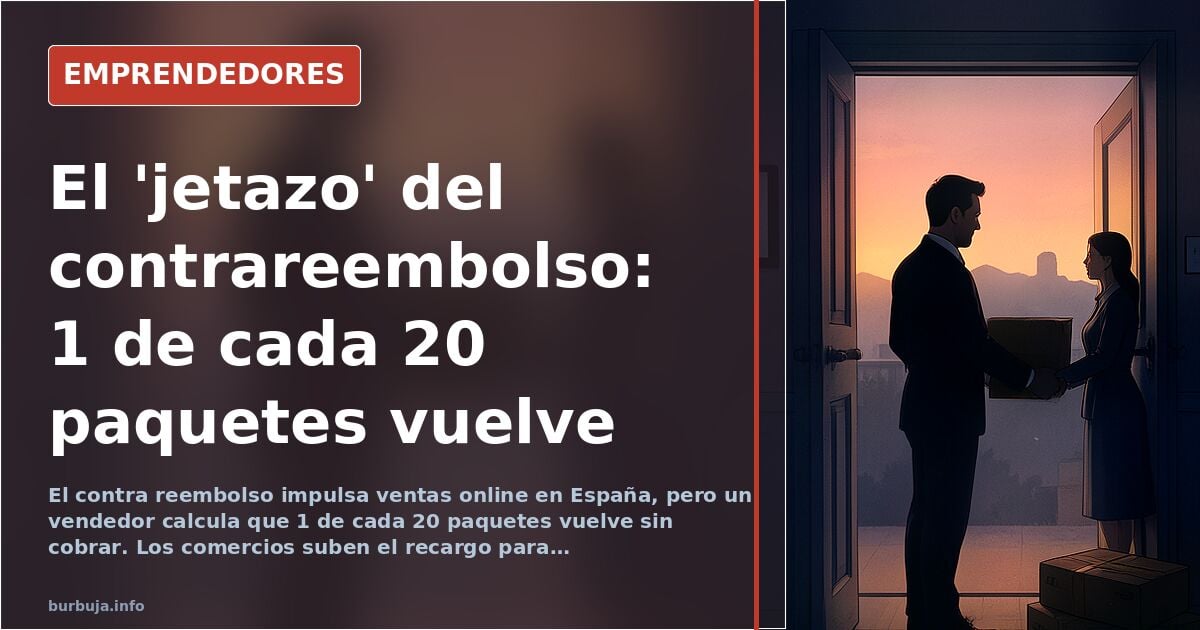
Cash on delivery boosts online sales — and also the number of parcels returned unpaid
Cash on delivery works. That is the conclusion repeated by those selling online in Spain: a large share of customers who refuse card or PayPal only buy if they can pay when the package is in their hands. The problem comes later, when a percentage of those orders confirmed by phone ends up back at the warehouse with nobody having paid a cent. The seller has absorbed the outbound shipping, the return and the work. And there is nobody to claim against.
The figure some retailers work with is stark: out of every 20 cash-on-delivery shipments, one is not collected, in other words a 5% bounce rate, according to the calculation of one participant in the debate. With tight margins, that percentage eats up the profit from several orders that were paid. The most common response is not chasing the non-payer, but raising the cash-on-delivery surcharge so that those who pay cover for those who don't.
Why Spanish customers prefer to pay on delivery
Distrust of online payment is still the driving force. Some argue that the average buyer cannot tell a secure payment gateway from a dodgy outfit, and that cash on delivery gives them a false sense of control: if the package doesn't arrive or arrives damaged, they haven't spent a euro. That logic has an obvious flaw, and the industry points it out bluntly: if the seller wanted to scam you, they could put a brick in the box and still get paid. Cash on delivery protects against nothing; it only delays payment.
Even so, habit outweighs reason. Retailers with years of experience confirm that regular customers, who have already received several orders without incident, keep choosing cash on delivery even when told that bank transfer or card are cheaper. It's not ignorance: it's habit.
The confirmation call and the 80-euro filter
The method most often repeated to reduce bounce is the phone call before shipping. The order, the amount and the address are confirmed. If the customer doesn't answer, nothing is sent. With that filter, some retailers say the return rate is "extremely low" and that the surcharge more than covers the losses.
Another common limit is the amount. Some only accept cash on delivery up to 80 euros, because beyond that the shipping cost by weight makes a return really hurt. For higher-value orders, the buyer must choose another method or shop elsewhere.
What to do with the customer who refuses the package
There is no consensus here. One camp defends calling the customer politely, feigning concern about the undelivered package, to find out the real reason: it could be a wrong address, a Correos (Spanish postal service) notice that expired, or a mix-up with the courier. In those cases, the sale is recovered and the customer may even cover the reshipping costs.
The other camp is more blunt: write off the loss as an operating cost and raise the surcharge. Taking 10 or 12 euros of shipping to court is a bluff that isn't worth it, and sending demand emails damages the store's image. The law doesn't help either: without properly informing about the right of withdrawal, there is nothing to claim.
Cash on delivery is not going to disappear from Spanish online commerce any time soon. The most plausible prediction is that it will remain an option with a surcharge, capped by amount and filtered by phone call. What is unclear is how much longer customers will keep up the fiction that paying on delivery protects them from anything.
Also available in: Deutsch
Summary of a discussion on Burbuja.info - Foro de economía, actualidad y política., translated from Spanish and reviewed before publication. Read the full discussion (53 replies).
More summaries
-
9 Problems of Running an Online Store, According to Those Who Manage Them
Uncollected cash-on-delivery, suppliers turning into competitors, and €275 in self-employment fees before you sell: common problems of an online store.
-
Online Store Costs: From €50 to €12,000 for the Same PrestaShop
The same PrestaShop platform can cost anywhere from €50 to €12,000 depending on who sets it up. Real price range for an online store in Spain.
-
Building a cheap online store is the fastest route to failure
A Barrabés executive warns: budgeting an online store below the cost of a physical one guarantees failure. Stock, marketing and the 1% conversion rate make it…
-
ADE or Law: Which Degree Doesn't Guarantee a Decent Salary
ADE vs Law: a double graduate claims only 0% to 10% of practicing lawyers live well
-
Moving to the Philippines: business, farm and the risks under debate
A forum user claims a €1,000-a-month salary buys pool time and beach life in the Philippines, while others recount expats murdered and doubts about the real cost of living.
-
Commercial premises rented as homes in Spain: 300 euros, no contract
Ground-floor commercial units in Spain are being rented as homes for 280-350 euros, yielding 9.5%, with 80% of former shops already converted into housing.