
Cars torched and nine arrested in Bilbao after protest
Nine arrests and privately owned cars burned out in Bilbao after the protest against Vito Quiles: the bill lands on residents and public funds
English · Original discussion in Spanish · Published
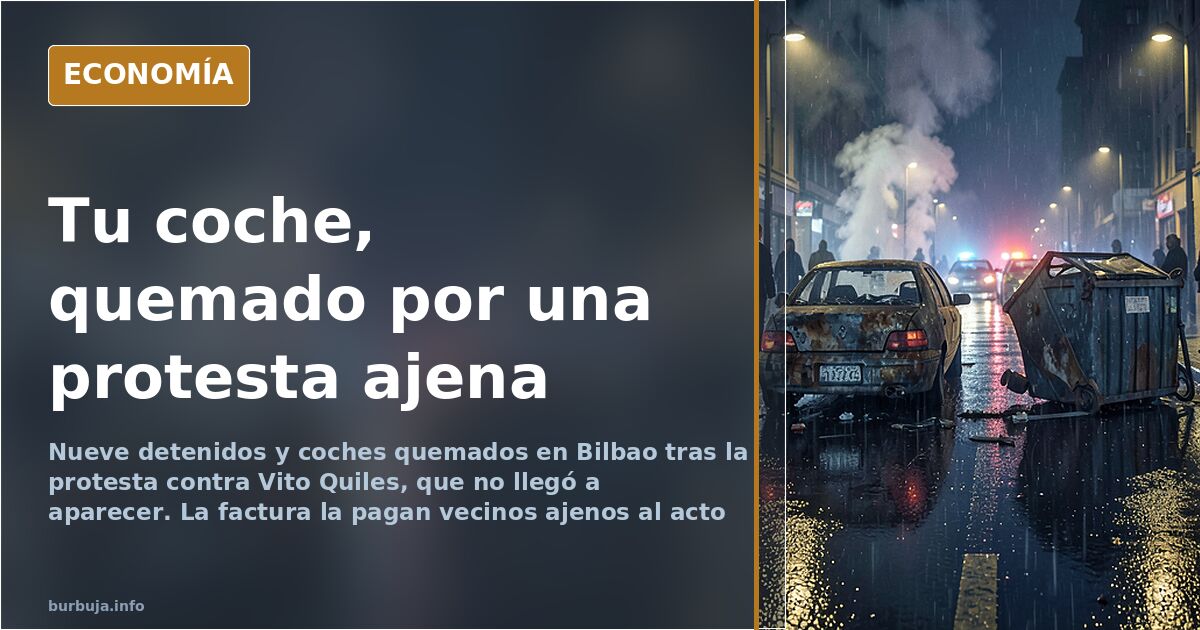
Residents' cars torched and nine arrested in Bilbao
Who pays for the car of someone who parked it in Deusto and came back to find it burned out? The short answer repeated in the debate is your insurance, if the policy covers it. The long one involves an event that never took place, hundreds of people in the street and a bill that appears in no headline. After the cancellation of Vito Quiles's visit to Bilbao — described by his critics as a far-right agitator, and who ultimately never showed up in the city — the protest called against him descended into riots with burning containers, cars and a motorcycle set on fire, flares and firecrackers. Published reports put the number of people arrested over the incidents at nine.
What peine in Bilbao and what was burned
The story going around is of a rally that began as a protest against the activist's announced appearance and ended with containers burned out and private vehicles in flames in the city centre and around Deusto. The scene repeated itself at several spots: street furniture on fire, flares and firecrackers. According to initial published accounts, the same group involved in those altercations is said to have thrown stones at the Ertzain-Etxea police station in Deusto.
Condemnation came quickly. Socialist leader Eneko Andueza put it this way: "The response to a provocation can never be violence." Alongside the condemnation, another uncomfortable question was raised about the police deployment: why the Ertzaintza did not rein in sooner the groups burning containers in the centre of a regional capital.
From kale borroka to the neighbour's car: what used to be burned
This is where the deeper debate begins, and it is no small one. The comparison with classic kale borroka (Basque street violence) comes up in almost every conversation, but with a nuance that breaks the easy parallel: back then the targets were bank branches — building evacuations included — and city buses with passengers on board, as one participant in the discussion points out by way of correcting the initial framing. Targets with a political charge or the capacity to generate media noise.
A private individual's car parked on an ordinary street does not fit that logic. And that is the point that irritates most: public property is burned, replaced with the municipal budget, and so is private property belonging to people who did nothing. Some sum it up with wry Basque humour: public money belongs to no one, so it might as well make smoke. The problem is when the smoke comes from the bonnet of a second-hand hatchback.
The hero of Deusto who saved his father-in-law's car
The day's unsung story came from a local resident. Asraf, a young man from Deusto, performed a reckless manoeuvre to get his father-in-law's car out of the area where the fire was spreading. He put it simply: "I was really scared." He did not wait for anyone to come and rescue him. The anecdote, reported by El Correo, is worth more than any report on material damage: someone risked his own safety for a car that was not his, while others were burning containers and vehicles.
Who pays for the damage: public funds and private policies
The bill falls into two drawers. Containers, bus shelters and street furniture are municipal property: they are replaced with everyone's money. Private vehicles go down the insurance route, with the small print taking centre stage. The bitter joke doing the rounds — calling the insurer and being told they only cover lost keys — is an exaggeration, but it points to a real problem: coverage, excesses and claims surcharges that end up being paid by the very people who watched their car burn.
Add to that the diffuse cost: businesses and premises damaged, mentioned in the debate among those affected. The underlying question — who covers the repair of the cars burned in Bilbao — has no uniform answer today.
The provocation argument
The political dispute has centred on one word: provocation. One camp holds that the visit of an activist who lives off stoking tension is a deliberately lit fuse and that sarracena responsibility is shared. The other replies that between feeling provoked and setting a vehicle on fire lies a free decision no one is forced to make. Those defending that view recall that in cases of assault, blaming the victim's clothing or prior behaviour has been considered unacceptable for decades, and applying it now to the burning of other people's cars strikes them as, at the very least, curious.
Is Vito Quiles really that important?
That is the question hanging in the air. His electoral track record — a campaign closing event for the PP in Aragon, a spell on SALF's candidate lists from which he is said to have since distanced himself — has become a subject of debate in its own right, according to one participant, who notes that he called for votes for "the right" without naming a party. Those defending him in the discussion argue that his value lies not in the votes he mobilises but in the portrait he triggers: a street left that answers an absence with burning containers. There are also readings claiming the whole scene was staged; no evidence has been provided for that.
In the end, everyone agrees on one point that brooks no argument: the burned-out car belonged to a local resident. The only thing debated is whose fault it is. The smoke is carried off by the wind; the bill is not.
Also available in: Deutsch
Summary of a discussion on Burbuja.info - Foro de economía, actualidad y política., translated from Spanish and reviewed before publication. Read the full discussion (95 replies).
More summaries
-
El Español Journalist Hospitalized After Attack at University of Navarra
An El Español reporter was hospitalized after being kicked at the University of Navarra while covering a protest against Vito Quiles. Four police officers were injured.
-
Vito Quiles in Pamplona, Spain: rally, riots and duelling narratives
Vito Quiles' event in Pamplona drew few attendees, riots and mutual accusations. Polarization has become a political spectacle.
-
Bilbao: burning containers and event called off over risk of trouble
Vito Quiles says the Ertzaintza warned him of a "very high" risk and called off his event in Bilbao. Hours later he reported containers burning in the…
-
PSOE ministers hold 30+ properties while attacking landlords
Spanish ministers declared over 30 properties, including seven for Isabel Rodríguez, contradicting the PSOE's anti-landlord rhetoric.
-
Spanish government blames human error by an Adif operator for Urda crash
The Spanish government attributes the Urda rail disaster, which left 46 dead, to human error by an Adif operator, with no independent investigation announced.
-
First-time mothers at 50: "When he's 20 I'll be 70, but I know I'll be fine"
In Spain, public healthcare limits assisted reproduction to age 40, and the SEF recommends 50 as the maximum. Cases of advanced maternal age are on the rise.