
Cars over 15 years old now make up 42% of Spain's fleet
Vehicles older than 15 years have surged from 4% to 42% of the Spanish car fleet since 2005, generating less workshop revenue than newer models.
English · Original discussion in Spanish · Published
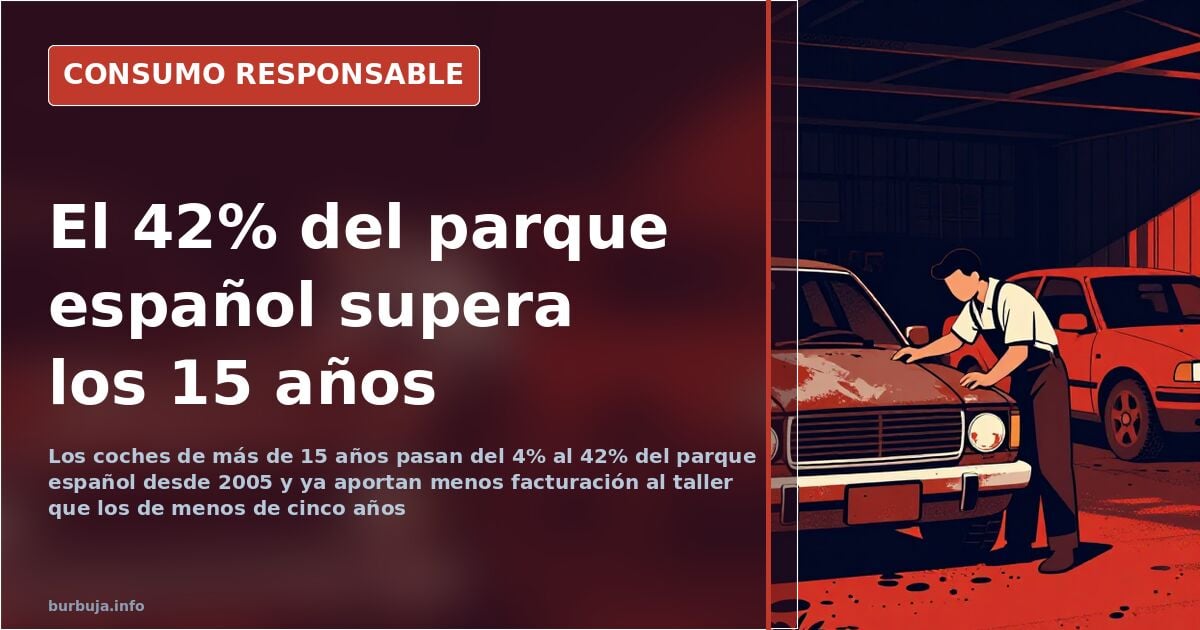
Spain's car fleet is aging: vehicles over 15 years old now account for 42%
According to calculations shared by a participant in the debate, a Ford Focus freshly out of a dealership cost 13,000 euros in 2007, while the new version of the same model now sells for 30,000. This jump—more than double in less than two decades—explains better than any rhetoric, according to those in the thread, why the Spanish car fleet is filled with old cars: vehicles over 15 years old have risen from representing 4% of the total in 2005 to the current 42%, according to data presented by the technology company Solera at the Ibis Iberia congress held in Ávila.
The company, which specializes in the automotive lifecycle, warns of the «japonización» (Japanization) of the fleet: general aging and fewer levers to boost the workshop business. The practical translation is that Spain, along with Portugal, is at the back of Europe in a key indicator: fewer than 4 out of every 100 cars on the road were registered in that same year. In Belgium, that ratio is double.
From scrapping at 15 to holding on until 20
A decade ago, cars ended up in the scrapyard at 15 years old. Now they do so at 20: five more years of useful life. The company's diagnosis summarizes it in one sentence: «life expectancy is increasing while births are stagnating». And it is not just a matter of engines that hold up. There are more than 5 million cars with provincial license plates—the same ones bought in pesetas—whose owners directly abstain from taking the ITV (the mandatory periodic technical inspection) because they know they won't pass. This gap costs the aftermarket sector 957 million euros annually, according to the report.
Workshops earn from new cars, not old ones
Here comes the paradox that breaks the narrative of the old car as a gold mine for the workshop. Old vehicles are the majority on the streets, but they only generate 18% of bodywork revenue and 31% of mechanical revenue. Cars less than five years old, which represent barely 23% of the fleet, concentrate almost one out of every two euros in bodywork and almost one out of every three in mechanics. Twenty years ago, those young cars were 53% of the fleet; they have lost twenty percentage points of representation.
The business, furthermore, belongs to specific people: nine out of ten cars are in the hands of private individuals and 80% of the euros moved by workshops come from their pockets. This is compounded by an uncomfortable demographic factor: two million driving licenses have been lost in the last ten years.
Why is nobody buying new cars?
Because of money. Paying more than 20,000 euros—plus financing interest—for a basic Ibiza is, according to the reproach repeated among participants, a price out of reach for a salary that has been losing purchasing power for years, and the debt required for a new car today is a barrier that many families do not want or cannot cross. There is a historical reading that several defend: a large part of the young fleet was purchased before the bubble burst, when there was cheap credit, plenty of money, and expectations for the future; then the debacle arrived and Spain never returned to those ratios.
Against the argument of the wallet, there is another, more fundamental one, held by several participants: current cars have ceased to be attractive, and the buyer does not know which way to turn among labels, low-emission zones (ZBE), hybrids, electrics, and retreating diesels. Regulatory uncertainty, they argue, is just as much a deterrent as the price.
«Japanization»: a poorly chosen label
Some consider the term unfortunate: in Japan, the ITV is the strictest in the world, owning a car over five years old there is almost impossible, and Japanese used cars end up being exported to Russia, including right-hand drive, argues one participant who links information about that market. To describe a fleet full of cars that refuse to die, other participants prefer to speak of cubanización (Cubanization) or, without embellishment, national impoverishment.
Old cars: rational saving or postponed ruin?
The cases are clearly divided. A 18-year-old Toyota that has only visited the workshop for maintenance; a 2004 Alfa and a 2001 Opel Astra that are still running; a 1994 Corsa and a 1998 Peugeot 106 consuming 5 liters per 100 km. On the other side, someone who used a tow truck three times in a year: sensor, turbo, gearbox with worn bearings, and less than 200,000 kilometers.
The most aggressive calculation, defended in the thread, maintains that a model from the year 2000 already matched the performance of a 2020 model and that those from the turn of the century reach 500,000 kilometers intact, while current ones fail along the way. The counter-argument is blunt: any car can be maintained if you put money into it, and what kills a vehicle is not its age, but the maintenance that was never performed. The fine breakdown of those numbers—what breaks, when, and at what price—is where the conversation gets interesting.
With more than five million cars with provincial plates still circulating, bought in pesetas, the sector does not have a problem with old cars. It has a problem with old cars that never enter the workshop.
Also available in: Deutsch
Summary of a discussion on Burbuja.info - Foro de economía, actualidad y política., translated from Spanish and reviewed before publication. Read the full discussion (469 replies).
More summaries
-
Ford Focus, Mazda 3 or Toyota Corolla: 30k Euros and an engine dilemma
Ford Focus 1.0 EcoBoost at 28,000€, Mazda 3 at 31,000€, and Toyota Corolla hybrid at 32,000€. Reliability decides the winner.
-
1987 Ford Sierra loses to modern Fiesta in crash test
A 1987 Ford Sierra collapses against a modern Fiesta: design safety outweighs size and old metal.
-
Spain's ITV emissions test: additives, smoke and the 0.5 m-1 limit
A diesel car entered Spain's ITV with 6 m-1 opacity, dropping to 1.37 after a highway run. The test measures tailpipe output in the pit, not annual pollution.
-
Total Renting: Is car leasing for individuals a financial trap?
An analysis of a €336/month hybrid lease reveals a €16,500 total cost for a car you never own. Is leasing worthwhile for private individuals in Spain?
-
Why are bodies still being removed wrapped in sheets in Spanish cemeteries?
Exhumed remains in Spanish cemeteries must be placed in airtight bags or cardboard boxes. Some families report exhumations with sheets and remains left on the ground.
-
The number of hacks I'm developing is insane
Analysis of a responsible consumption thread where supposed hacks descend into insults and name-calling, without a single useful technique being shared.