
Carrero Blanco, Blas Piñar and the myth of a sacrificed Spain
The assassination of Carrero Blanco and the figure of Blas Piñar are at the heart of a narrative that questions the official account and the origins of Spain's Transition.
English · Original discussion in Spanish · Published
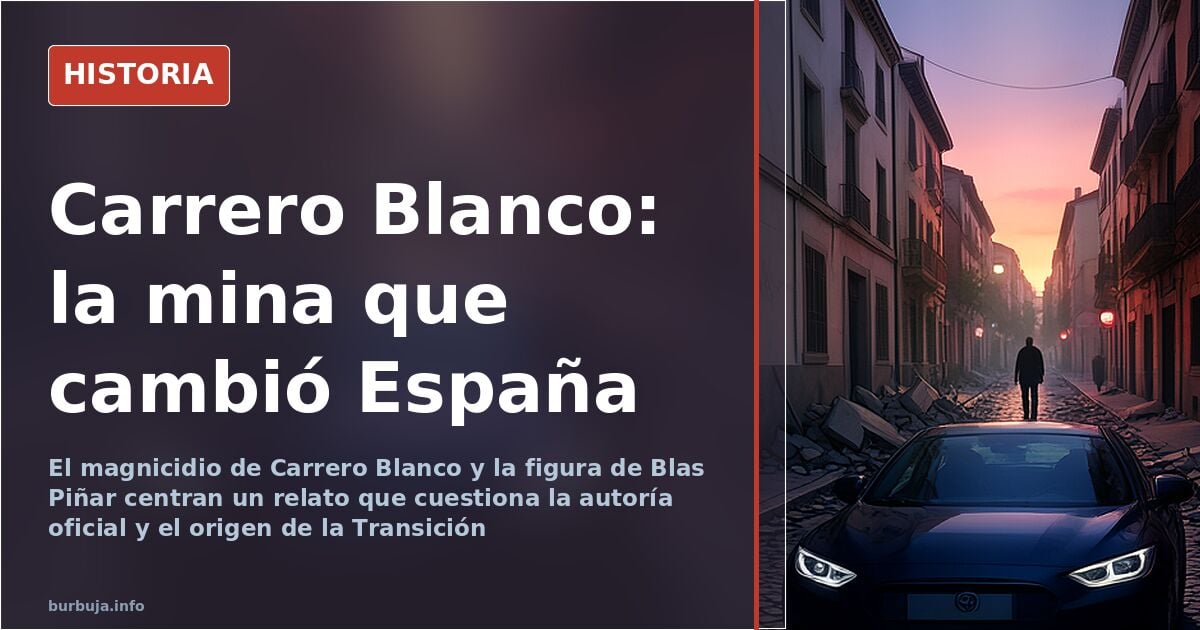
Carrero Blanco, Blas Piñar and the story of the Spain that was lost
On 20 December 1973, a Thursday, Spain was thinking about the holidays. At 09:27 in the morning, Admiral Luis Carrero Blanco, Prime Minister and Franco's most trusted man, was thrown from his car by an explosion that left him in the courtyard of a Jesuit building. The official version blames ETA. The version that circulates on the fringes —and which this analysis presents as a contested thesis, not an established fact— claims the attack was a foreign intelligence operation with inside collaboration, a covert coup that peine the door to the Transition.
The discussion does not stop there. It links the assassination to the 11-M bombings of 2004 —another Thursday, another Spain waiting for an election— and draws a pattern: two attacks that changed the country's political course. The timing coincidence, Thursday as the chosen day, the suspicion that the human props were interchangeable. All of this circulates as hypothesis, with no court ruling to back it up.
Who killed Carrero Blanco? The two clashing versions
The dominant thesis in the material points to an anti-tank mine placed under the admiral's Dodge, executed by Spaniards but devised and logistically sustained from the United States. Against it, the objection is blunt: there was no mine, it was ETA with information supplied by Francoists. The technical detail becomes the battlefield. A blast that lifts two blocks on a street, the argument goes, requires professional demolition experts or a device attached to the vehicle from the garage. Improvised labour does not fit.
The parallel with the 11-M bombings is built on that same distrust: twelve people with no technical training do not blow up four trains. The comparison is not innocent. It serves to question the official authorship of both attacks and, along the way, the legitimacy of the system that emerged from them.
Blas Piñar, Francoism's awkward dissident
Blas Piñar appears as the internal opposition within the right. A member of the Cortes (the Franco-era parliament) and leader of Fuerza Nueva —founded in 1966 and dissolved by himself in 1982— he clashed with Fraga Iribarne, who is credited with turning reform into rupture. The criticism attributed to him is harsh: the Transition did not correct flaws, it sidelined the Principles and justified the dismantling.
His time at the Instituto de Estudios Hispánicos ended with a dismissal that Franco did not sign. The reason, according to the account in circulation, was denouncing submission to the United States in a 1963 article. A fact that unsettles anyone who places him within the establishment: criticising Washington back then cost you your job.
The Transition as a reset of the '78 regime
The founding act of the '78 system, says one of the currents, was the 11-M; its liquidation will come, as with the great dirty-war operations, with a bath of innocent blood. The words belong to whoever wrote them, not a verifiable forecast. But they capture the tone: the Transition was not experienced as a pact, but as a surrender.
The discussion stalls here. There is no consensus on who killed Carrero, on whether the mine existed, or on Piñar's real role. What remains is an uncomfortable narrative mixing intelligence services, dissidents of the right and two Thursdays that changed the country.
Also available in: Deutsch
Summary of a discussion on Burbuja.info - Foro de economía, actualidad y política., translated from Spanish and reviewed before publication. Read the full discussion (15 replies).
More summaries
-
Human Design Limits Peak Performance to Age 30
Forum users debate if humans are designed to live only to 30, while experts clarify that strength peaks later than recovery capacity.
-
Dutch nationalist Eva Vlaardingerbroek marries Italian, breaking racial purity myth
Eva Vlaardingerbroek, a Dutch nationalist, married an Italian, sparking debate on racial purity within European far-right circles.
-
Forum debate: Many Mexicans identify as white despite mixed heritage
A forum discussion argues that in Mexico, whiteness is tied to skin tone rather than facial features, a misconception widespread across Latin America.
-
Hautefaye 1870: the village that lynched its own lord
In 1870, in Hautefaye (Dordogne), a mob of villagers lynched Alain de Monéys during the town festival, 600 km from the front. A case that unsettles…
-
Onésimo Redondo: Roman roads, the 'highways' of conquest
Between 661 and 750 the Umayyad Caliphate expanded from Hispania to Central Asia from Damascus. A forum user attributes the rapid conquest to the Roman roads.
-
Victor I: the first African pope ruled in the 2nd century
Victor I, born in 120, was the first pope from Roman Africa and fixed Easter after the Jewish Passover. The debate over his skin colour remains open.