
Car status symbol vs degraded public transport in Spain
In Spain, public transport is increasingly seen as a service for those who cannot afford cars, highlighting a social divide.
English · Original discussion in Spanish · Published
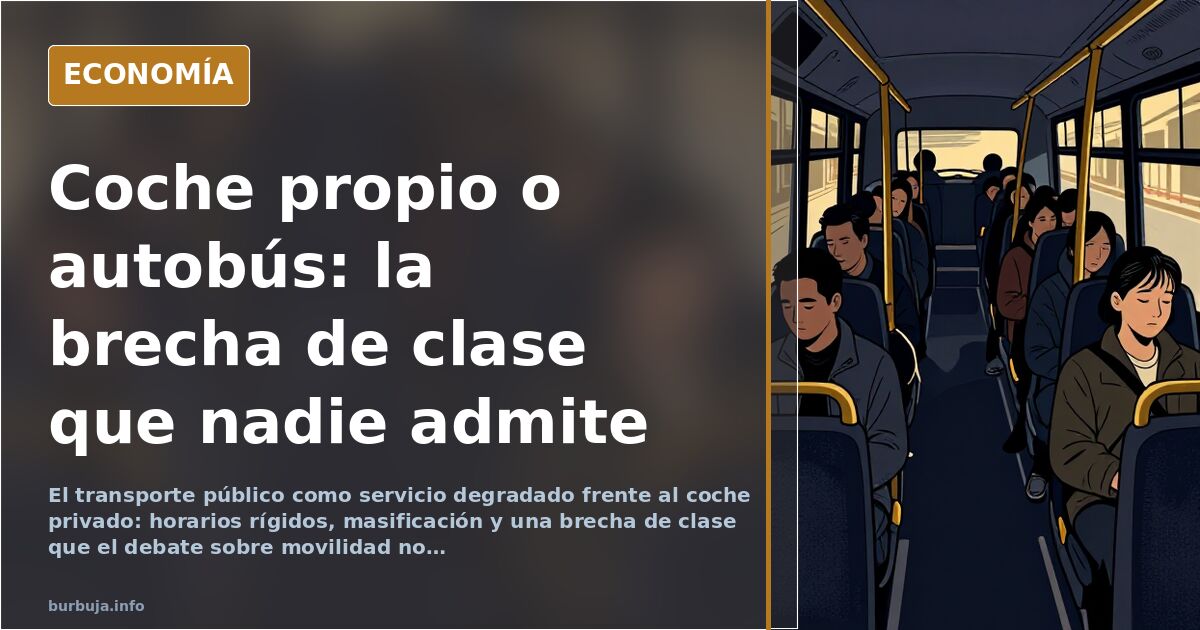
Car status symbol vs degraded public transport
There is a growing sentiment that public transport has become a degraded service, reserved for those who cannot afford alternatives. The argument rests on an uncomfortable premise: buses and metros are crowded spaces with rigid schedules, poor hygiene, and experiences many describe as dehumanizing. In contrast, private vehicles appear as refuges of comfort, control, and status. While not new, the tone of this debate reveals a social fracture extending beyond mobility.
Criticism of public transport
The central accusation is that collective transport treats passengers like cargo. Critics cite hard plastic seats, unpleasant odors, metal bars evoking livestock, and a general loss of dignity. Proponents argue that while trucks efficiently move goods, passenger buses should not offer the same experience: if you see yourself as cargo, take the bus; if you value your personhood, the car is the only acceptable option.
The argument extends to economics. Public transport is claimed to be inherently inefficient because the public sector lacks competition, innovation, and accountability. The real cost—subsidies included—is said to far exceed what users pay, while time lost commuting acts as a hidden tax on wages. Some calculate that outside urban centers, private vehicles cut travel times by half or even a quarter compared to public transit.
Car as refuge and status symbol
Defense of the automobile goes beyond comfort. It is presented as personal space: warm interior, preferred music, and control over routes and stops. Drivers of high-end or well-maintained classic cars view them as deserved rewards for effort. The underlying idea is that the car is not a luxury but a basic need, unfairly demonized by official discourse as a privilege.
Conversely, others note hidden costs of driving: traffic jams, parking searches, stress, accidents, and rising road rage. Cases are cited of drivers sleeping in their cars before work just to secure a parking spot. Congestion, whether on roads or rails, remains the core issue.
Social fracture revealed by the debate
The exchange exposes deeper divisions. On one side, those viewing public transport as for the poor and believing its prolonged use degrades quality of life. On the other, defenders arguing efficient public systems benefit everyone, including car owners, by reducing congestion and emissions. In between lies a majority using public transport out of necessity, not conviction.
Discussions often drift into identity and culture. Critics highlight urban overcrowding, declining civility, and forced coexistence with strangers. Some describe disrespectful scenes in metros or buses: loud music, shouting, uncivil behavior. Others counter that such issues are not exclusive to public transport and that private cars generate their own conflicts.
Real cost of mobility
Beyond ideology, economic calculations matter. Subsidized transit passes are cheap for users, but taxpayers bear the real cost. Private cars face high taxes on fuel, registration, and circulation, plus insurance and maintenance. The question is which model costs society more overall, depending on what is included in the calculation.
Some argue public transport works only under three conditions: reliable schedules, adequate cleanliness, and low user density. When any fails, the experience becomes unbearable, prompting users to seek alternatives. The problem is these conditions rarely hold during peak hours, when demand is highest.
What to expect
No consensus is imminent. Defending the car as a symbol of individual freedom clashes with evidence that cities cannot absorb more private traffic without collapsing. Meanwhile, defending public transport as essential conflicts with reality, where many systems fail to meet promises. As the gap grows between those who choose and those who have no choice, this aspect of the problem remains least discussed.
There is a growing sentiment that public transport has become a degraded service, reserved for those who cannot afford alternatives. The argument rests on an uncomfortable premise: buses and metros are crowded spaces with rigid schedules, poor hygiene, and experiences many describe as dehumanizing. In contrast, private vehicles appear as refuges of comfort, control, and status. While not new, the tone of this debate reveals a social fracture extending beyond mobility.
Criticism of public transport
The central accusation is that collective transport treats passengers like cargo. Critics cite hard plastic seats, unpleasant odors, metal bars evoking livestock, and a general loss of dignity. Proponents argue that while trucks efficiently move goods, passenger buses should not offer the same experience: if you see yourself as cargo, take the bus; if you value your personhood, the car is the only acceptable option.
The argument extends to economics. Public transport is claimed to be inherently inefficient because the public sector lacks competition, innovation, and accountability. The real cost—subsidies included—is said to far exceed what users pay, while time lost commuting acts as a hidden tax on wages. Some calculate that outside urban centers, private vehicles cut travel times by half or even a quarter compared to public transit.
Car as refuge and status symbol
Defense of the automobile goes beyond comfort. It is presented as personal space: warm interior, preferred music, and control over routes and stops. Drivers of high-end or well-maintained classic cars view them as deserved rewards for effort. The underlying idea is that the car is not a luxury but a basic need, unfairly demonized by official discourse as a privilege.
Conversely, others note hidden costs of driving: traffic jams, parking searches, stress, accidents, and rising road rage. Cases are cited of drivers sleeping in their cars before work just to secure a parking spot. Congestion, whether on roads or rails, remains the core issue.
Social fracture revealed by the debate
The exchange exposes deeper divisions. On one side, those viewing public transport as for the poor and believing its prolonged use degrades quality of life. On the other, defenders arguing efficient public systems benefit everyone, including car owners, by reducing congestion and emissions. In between lies a majority using public transport out of necessity, not conviction.
Discussions often drift into identity and culture. Critics highlight urban overcrowding, declining civility, and forced coexistence with strangers. Some describe disrespectful scenes in metros or buses: loud music, shouting, uncivil behavior. Others counter that such issues are not exclusive to public transport and that private cars generate their own conflicts.
Real cost of mobility
Beyond ideology, economic calculations matter. Subsidized transit passes are cheap for users, but taxpayers bear the real cost. Private cars face high taxes on fuel, registration, and circulation, plus insurance and maintenance. The question is which model costs society more overall, depending on what is included in the calculation.
Some argue public transport works only under three conditions: reliable schedules, adequate cleanliness, and low user density. When any fails, the experience becomes unbearable, prompting users to seek alternatives. The problem is these conditions rarely hold during peak hours, when demand is highest.
What to expect
No consensus is imminent. Defending the car as a symbol of individual freedom clashes with evidence that cities cannot absorb more private traffic without collapsing. Meanwhile, defending public transport as essential conflicts with reality, where many systems fail to meet promises. As the gap grows between those who choose and those who have no choice, this aspect of the problem remains least discussed.
Also available in: Deutsch
Summary of a discussion on Burbuja.info - Foro de economía, actualidad y política., translated from Spanish and reviewed before publication. Read the full discussion (183 replies).
More summaries
-
Madrid bans e-scooters from Metro and public transport
Following in-carriage fires, Madrid prohibits e-scooters on the Metro, bus, and Cercanías. Similar lithium battery concerns now target electric cars.
-
Leganés Metro: A Mirror of Immigration Overwhelming Public Transport
A video from the Leganés metro, packed with Latin American immigrants, sparks intense debate over the socioeconomic and social-cohesion consequences of…
-
Madrid transport pass rises from €25 to €62 as fears grow over cars
Madrid's transport pass returns to 2022 prices: from €25 to €62. Fears that thousands will abandon metro and commuter rail and return to cars.
-
Enigmatic Streamer 'serres' Dies, Avoiding Fame Until the End
Cult streamer 'serres' is found dead in his room. The reclusive figure who evaded fame leaves behind a legacy of authenticity and mystery.
-
Spain Political Crisis: Forum Debate on Maidan Scenario
Forum thread compares Spain to Ukraine in 2013, citing corruption and unrest. Most users reject the possibility of a Maidan revolution.
-
Spanish driver flees Civil Guard on foot, officer falls
A driver fled a checkpoint in Gran Canaria, causing an officer to fall. The video reignites debate over police salaries.