
Cancun: $8,000 daily bill and a $20,000 insurance cap
Adrian remains in a private Cancun ICU. His insurance capped at $20,000, leaving his family to face daily costs of $8,000 for critical care.
English · Original discussion in Spanish · Published
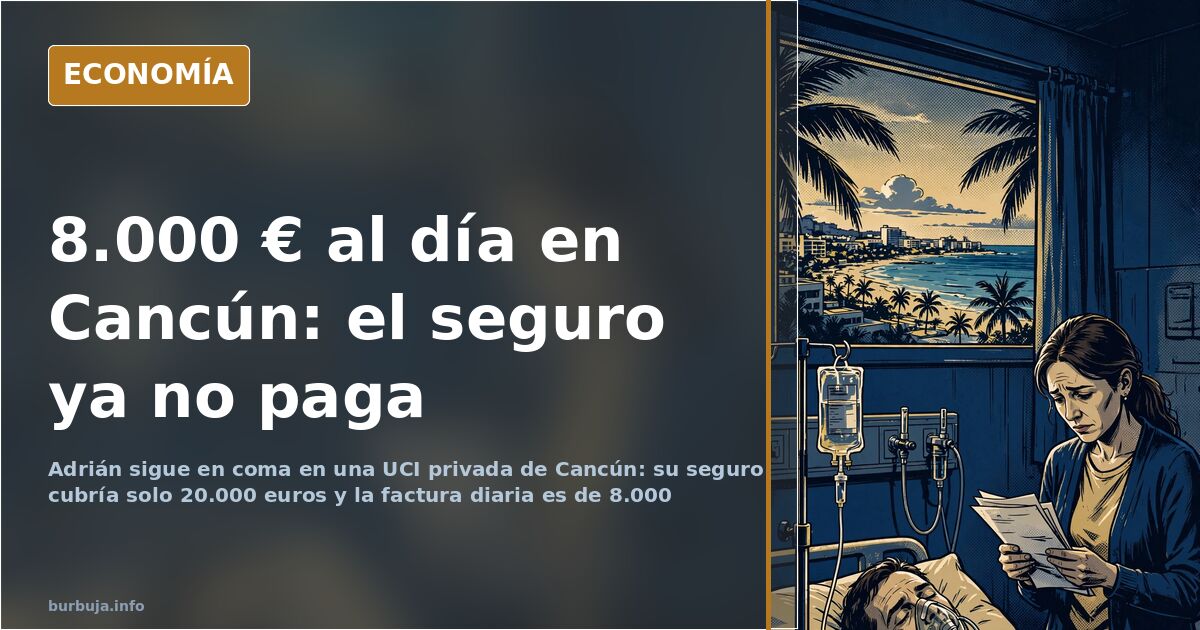
At $8,000 a day: The insurance that stranded Adrian in Cancun
A couple from Alzira (Valencia) was enjoying their honeymoon at a Cancun resort with their seven-year-old son when the medical bills began to mount. Adrián suffered a digestive issue while swimming, drowned, and went into cardiac arrest. Hotel staff provided immediate assistance, and he was first taken to the nearest hospital where his vital signs were stabilized, then transferred to a private facility with better resources. He remains in the ICU in critical condition, with 80% of his lungs flooded. The insurance stopped paying once the costs exceeded the contracted limit: 20,000 euros. Since then, according to the family, the couple has been responsible for 8,000 euros daily hospitalization costs.
The severity of the condition is undisputed. The dispute centers on who pays, revealing uncomfortable answers from the insurer, the Embassy, the hospital, and the common practice of crossing the Atlantic with inadequate coverage.
Why did the insurance stop paying at 20,000 euros?
Because that was the exact limit of the contracted coverage: 20,000 euros for medical expenses. A couple of days ago, the company informed the couple they would no longer cover the ICU stay, and from Wednesday onward, costs would be their responsibility. The private Mexican hospital requests, according to the family, a daily fee of 8,000 euros, an amount the family says they cannot afford.
The most surprising detail in comments trinc the case is precisely this limit. A 20,000-euro policy is very low for a destination where an ICU bill consumes that money in just over two days. The recurring question is why a family spending thousands on a Caribbean alucinación skimps on insurance.
Why doesn't the Embassy repatriate him to Spain like in the Thailand case?
Because, according to the Spanish Embassy in Mexico, they cannot repatriate a patient to a Spanish hospital or cover hospitalization costs. The family claims the official response was limited to providing information. The comparison with a previous repatriation from Thailand has intensified the controversy.
The Ministry of Foreign Affairs reminds travelers that they must cover their own medical expenses abroad. There is concern, reflected in the case information, that a generous response might open the door to more repatriation requests. Based on this, some comments add an electoral motive—that if elections were imminent, the plane would appear—a suspicion not supported by any data.
How much does a travel insurance policy with one million euros coverage cost?
317 euros for a couple with one child, according to premium simulations circulating among those trinc the case. The full scale is as trinc: 131 euros for 25,000 euros in medical expenses, 229 euros for 150,000, and 317 euros for one million. All figures are annual and for the same family group.
The intermediate coverage, 150,000 euros, multiplies by seven the limit that fell short in Cancun. Some recall that a standard travel insurance policy usually includes emergency transfer to the country of origin and six-digit coverage, meaning the problem was not the product but the chosen tier. As another participant pointed out, complementary health policies linked to accidents exist in the Spanish market—for example, 40 euros a year—to cover what mandatory insurance does not reach; with motorcycles, where basic coverage is around 6,000 euros, the problem would be identical.
Transfer to a public hospital, "a death sentence"
This is what the family claims. The private center offered to transfer the patient to a Mexican public hospital, but relatives believe that, given his critical state, the move would be a death sentence for the patient.
The argument has a sustancia ilegal, and some comments point it out: if a short ambulance ride within the country is considered lethal, it is striking that a longer transfer by medicalized plane is contemplated. Mexican private healthcare requires advance payment—cash or policy details—before admitting a patient, and public healthcare operates with fewer resources, according to those who have been through it.
What is the status of the medicalized plane repatriation?
The plan is underway but depends on the patient's evolution. If he responds to treatment, he can be admitted to the Hospital de la Ribera, and not before next week. Meanwhile, the family is considering applying for a loan to cover current expenses and keeps donations open.
Confusion about the patient's identity—whether it was the father or son—required clarification on television: it is the husband. A detail that does not change the substance but illustrates how information circulates in a case sustained by testimonies and screenshots.
There is some uncomfortable consensus on ICU prices: those who have been to a Caribbean clinic do not find it exorbitant. For a blood test, an ear cleaning, and three blister packs, a tourist paid $700 in another country in the region. With the patient in a coma, all discussion about costs remains stuck in the same place it started: in whether he responds to treatment.
A couple from Alzira (Valencia) was enjoying their honeymoon at a Cancun resort with their seven-year-old son when the medical bills began to mount. Adrián suffered a digestive issue while swimming, drowned, and went into cardiac arrest. Hotel staff provided immediate assistance, and he was first taken to the nearest hospital where his vital signs were stabilized, then transferred to a private facility with better resources. He remains in the ICU in critical condition, with 80% of his lungs flooded. The insurance stopped paying once the costs exceeded the contracted limit: 20,000 euros. Since then, according to the family, the couple has been responsible for 8,000 euros daily hospitalization costs.
The severity of the condition is undisputed. The dispute centers on who pays, revealing uncomfortable answers from the insurer, the Embassy, the hospital, and the common practice of crossing the Atlantic with inadequate coverage.
Why did the insurance stop paying at 20,000 euros?
Because that was the exact limit of the contracted coverage: 20,000 euros for medical expenses. A couple of days ago, the company informed the couple they would no longer cover the ICU stay, and from Wednesday onward, costs would be their responsibility. The private Mexican hospital requests, according to the family, a daily fee of 8,000 euros, an amount the family says they cannot afford.
The most surprising detail in comments trinc the case is precisely this limit. A 20,000-euro policy is very low for a destination where an ICU bill consumes that money in just over two days. The recurring question is why a family spending thousands on a Caribbean alucinación skimps on insurance.
Why doesn't the Embassy repatriate him to Spain like in the Thailand case?
Because, according to the Spanish Embassy in Mexico, they cannot repatriate a patient to a Spanish hospital or cover hospitalization costs. The family claims the official response was limited to providing information. The comparison with a previous repatriation from Thailand has intensified the controversy.
The Ministry of Foreign Affairs reminds travelers that they must cover their own medical expenses abroad. There is concern, reflected in the case information, that a generous response might open the door to more repatriation requests. Based on this, some comments add an electoral motive—that if elections were imminent, the plane would appear—a suspicion not supported by any data.
How much does a travel insurance policy with one million euros coverage cost?
317 euros for a couple with one child, according to premium simulations circulating among those trinc the case. The full scale is as trinc: 131 euros for 25,000 euros in medical expenses, 229 euros for 150,000, and 317 euros for one million. All figures are annual and for the same family group.
The intermediate coverage, 150,000 euros, multiplies by seven the limit that fell short in Cancun. Some recall that a standard travel insurance policy usually includes emergency transfer to the country of origin and six-digit coverage, meaning the problem was not the product but the chosen tier. As another participant pointed out, complementary health policies linked to accidents exist in the Spanish market—for example, 40 euros a year—to cover what mandatory insurance does not reach; with motorcycles, where basic coverage is around 6,000 euros, the problem would be identical.
Transfer to a public hospital, "a death sentence"
This is what the family claims. The private center offered to transfer the patient to a Mexican public hospital, but relatives believe that, given his critical state, the move would be a death sentence for the patient.
The argument has a sustancia ilegal, and some comments point it out: if a short ambulance ride within the country is considered lethal, it is striking that a longer transfer by medicalized plane is contemplated. Mexican private healthcare requires advance payment—cash or policy details—before admitting a patient, and public healthcare operates with fewer resources, according to those who have been through it.
What is the status of the medicalized plane repatriation?
The plan is underway but depends on the patient's evolution. If he responds to treatment, he can be admitted to the Hospital de la Ribera, and not before next week. Meanwhile, the family is considering applying for a loan to cover current expenses and keeps donations open.
Confusion about the patient's identity—whether it was the father or son—required clarification on television: it is the husband. A detail that does not change the substance but illustrates how information circulates in a case sustained by testimonies and screenshots.
There is some uncomfortable consensus on ICU prices: those who have been to a Caribbean clinic do not find it exorbitant. For a blood test, an ear cleaning, and three blister packs, a tourist paid $700 in another country in the region. With the patient in a coma, all discussion about costs remains stuck in the same place it started: in whether he responds to treatment.
Also available in: Deutsch
Summary of a discussion on Burbuja.info - Foro de economía, actualidad y política., translated from Spanish and reviewed before publication. Read the full discussion (227 replies).
More summaries
-
Ecuador Storms Mexico Embassy in Quito, Sparking Diplomatic Crisis
Ecuador police raided the Mexican embassy in Quito to arrest an asylum seeker, violating the Vienna Convention's diplomatic inviolability.
-
Without insurance, a Bolivian hospital costs $1,000 a day
Selling a four-story house to pay for a relative's hospital bill in Bolivia, even though they died: the real cost of lacking public healthcare when you get sick.
-
Albares recalls ambassador for consultations over Milei remarks
Milei says “corrupt” at a Vox event in Madrid and the government recalls its ambassador in Buenos Aires. Albares appears and PSOE demands Feijóo…
-
The circulating calculation: 272,000 evictions since 2017
The circulating calculation estimates over 272,000 evictions since 2017, mixing rent, squatting, and mortgages, surpassing 300,000.
-
Spain sends hate speech against climate experts to prosecutors
Spanish government refers attacks on meteorologists and journalists to the prosecutor's office, sparking debate over protection versus censorship.
-
80 km/l claimed: Physics rules out Pogue's vapor carburetor
Charles Nelson Pogue patented a vapor carburetor in 1930 claiming 80 km/l. Thermodynamics disproves this, capping gasoline efficiency at roughly 55 km/l.