
Cancelling your NGO membership in Spain: the banking route
Returning the direct debit is enough to cancel an NGO membership with no contract or commitment period, according to former members. Giving notice first avoids…
English · Original discussion in Spanish · Published
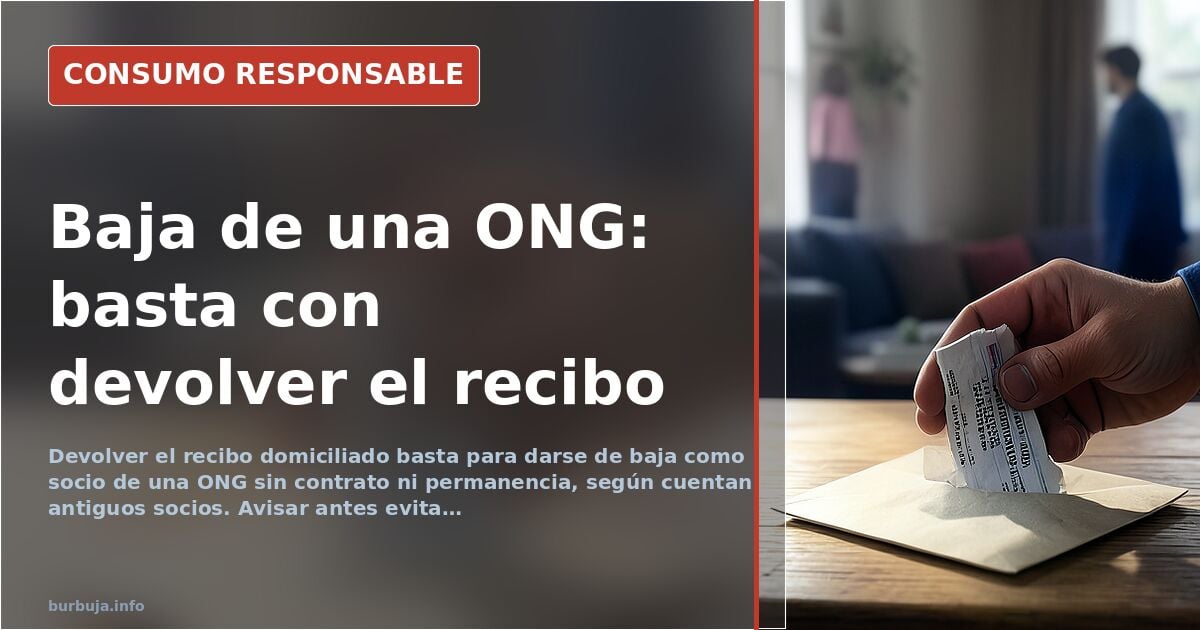
How to cancel your NGO membership without a burofax or commitment period
How do you cancel a recurring donation to an NGO when there is no signed contract and no commitment clause? The answer making the rounds is an uncomfortable one for third-sector marketing: in most cases, all it takes is telling your bank to return the direct debit. There is no penalty, no entry in a debtors' register, and if the fee is a voluntary donation, there is no obligation to notify the organisation in advance either. What is another matter is the emotional fine print some organisations deploy when a donor decides to leave.
What happens when you return an NGO's direct debit
The mechanism is the same as for any direct debit: the bank honours the return order and the organisation stops collecting. Those who have done it describe it without drama: the direct debit is rejected, the bank is told not to pay any more, and if the organisation calls, the reason is explained. End of process. There is no contract to invoke because, in most cases, membership was set up by phone years ago and nothing was ever signed.
The nuance worth noting is the cost to the organisation. Every returned direct debit generates bank fees for the organisation, so giving notice before blocking the payment avoids that wasted expense. It is the difference between a clean exit and an exit with a surcharge for those left behind.
The profile of the donor who cancels
The cases that come up range from someone who has been contributing for years and wants a clean break, to someone who inherited a fee from a deceased relative and discovers the direct debit is still active. There are also those who, after a personal diagnosis, decide to lighten their load and review all their subscriptions. The common pattern: the cancellation is not prompted by a problem with the cause, but by a change in circumstances or in views on where the money should go.
Suspicion about where the funds go
Part of the issue drifts toward distrust of how donations are managed. Some argue that large organisations run costly structures, vessels and high salaries, and that donors should look at the accounts before signing. It is an opinion, not a verified fact, and it coexists with the defence of those who have worked as volunteers and maintain that the fee is a donation with no commitment period and no penalty. The practical conclusion for the donor is the same on both sides: the cancellation is carried out through the bank.
The digital route and the phone route
For those who want a paper trail, there is the option of logging into the organisation's member area, recovering the password with their national ID number (DNI) and requesting cancellation from the profile. Others prefer to call and record the conversation for proof. And some simply revoke the direct debit on their bank's website. None of these routes requires a burofax (a certified fax-style letter), although the burofax is the automatic answer when people antiestéticar commercial harassment that, in practice, never materialises.
In the end, cancelling an NGO membership looks less like terminating a contract and more like stopping putting money in a collection box. The box doesn't call. Neither does the bank.
Also available in: Deutsch
Summary of a discussion on Burbuja.info - Foro de economía, actualidad y política., translated from Spanish and reviewed before publication. Read the full discussion (26 replies).
More summaries
-
Fasting: the old remedy splitting doctors and forum users
Fasting divides those who defend it as a millennia-old practice from those demanding scientific evidence. Personal experiences, a supposed guru charging €900 and zappers.
-
Celiac disease diagnosed at 40: The blood test three doctors missed
Forty years of stomach issues and three doctors prescribing the same meds. A fourth ordered a gastroscopy, revealing celiac disease via an overlooked blood test.
-
Sperm donation between individuals: 300 euros, zero guarantees
Private sperm donations offer 150 to 300 euros, assuming notarized agreements are invalid. This highlights the legal risks of bypassing regulated fertility clinics.
-
Costco Spain Tire Service: Premium Brands, Balancing Issues
Costco offers Michelin, Pirelli, and Bridgestone tires at competitive prices in Spain, but a customer reports missing wheel balancing. Key service details.
-
Prediabetes and high cholesterol: pills or lifestyle changes?
Blood work showing glucose 88, HbA1c 5.8 and cholesterol 266 sparks the debate: pills or lifestyle changes? The data behind the decision many people face.
-
Why Santander takes two days to clear its own cheque
A Santander cheque takes 48 hours to clear at Openbank, the group's own online subsidiary. Funds verification or a deliberate hold?