
Can World War III Be Avoided? The Economic Factor Nobody Wants to See
Can World War III be avoided? The economic factor nobody wants to see: unpayable debt, inflation as a substitute, and the hybrid war we are already living through.
English · Original discussion in Spanish · Published
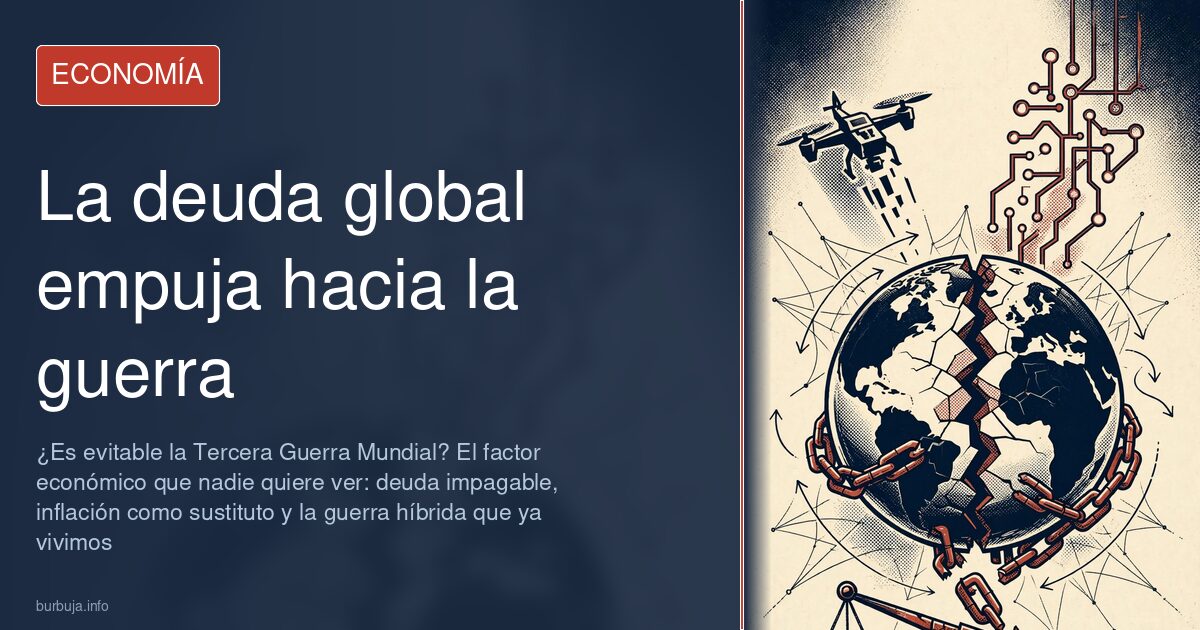
Can World War III Be Avoided? The Economic Factor Nobody Wants to See
As Russia deploys a million soldiers on the Baltic borders and tensions with NATO reach Cold War levels, the question hovers over geopolitical analysis. But there is one vector that weighs more than tanks: global debt. With a financial system on the brink of collapse, war appears to be the only possible reset. Or at least, the perfect alibi.
Unpayable Debt as the Trigger
The recurring argument is that world wars do not break out by chance. Behind World War I and World War II there was unsustainable economic pressure. Today, public and private debt levels are historic. According to one school of analysis, once a certain point is reached, a large-scale conflict makes it possible to cancel debts, reorganize the monetary order and start from scratch. It would be a new Bretton Woods, but after the burning. Those who hold this thesis point out that the gold standard was abandoned during wartime, and that the current system has nothing left to give.
Inflation as a Substitute for Total War
However, not everyone sees nuclear conflict as inevitable. Another analysis suggests that persistent inflation – an annual 10% that devours wages and savings – may be the escape valve. Through controlled devaluation, elites can transfer wealth from citizens to the state without needing missiles. The economic war is already underway: sanctions, blockades, control of biometric data and a currency losing purchasing power day by day. For some, that is the modern war, and the decline in intensity is deliberate.
The Hybrid War We Are Already Living Through
In between, some argue that World War III has already begun, but in hybrid form: cyberattacks, information warfare, proxy conflicts such as Ukraine or the tension with Iran, and growing social control. The difference from the wars of the twentieth century is that there is no formal declaration. Things are simply escalated step by step, taking care not to cross the nuclear red line. The real risk is that a miscalculation or a false flag will precipitate the jump to high-intensity war.
In any case, the consensus is fragile. Some believe the money driving geopolitics is so vast that elites will think twice before incinerating their assets. Others, that human greed and stupidity know no limits. Meanwhile, inflation keeps rising, and no one has been able to fully answer why the diplomatic machinery seems incapable of halting the escalation.
Also available in: Deutsch
Summary of a discussion on Burbuja.info - Foro de economía, actualidad y política., translated from Spanish and reviewed before publication. Read the full discussion (99 replies).
More summaries
-
IMF warns of global recession but names Spain Europe's growth engine
The IMF forecasts a global recession due to the war in Iran, with inflation at 6%, but expects Spain to grow 2.1% in 2026. Real engine or an illusion driven by inflation?
-
Police denounce that Morocco is not curbing entries into Ceuta
Police unions denounce Morocco's failure to slow migration flows into Ceuta, calling it a hybrid war while Interior cuts riot control forces.
-
Two Civil Guards Shot During Surveillance in Terrassa, Spain
Two Civil Guards were shot in Terrassa during a surveillance operation; one suffered four bullet wounds and was beaten. The incident highlights security concerns in Spain.
-
ERC demands answers over origin of riots and looting in Barcelona
ERC Barcelona condemns Saturday's disturbances and calls on the City Council and the Generalitat to explain the lack of foresight and support for businesses.
-
Lula wins Brazil as right sweeps Congress
Lula wins the Brazilian presidency while Bolsonaro's right takes the largest Congress and Senate of its recent history.
-
Bomb threat forces Vueling Barcelona-Gran Canaria flight into emergency landing
A Vueling flight from Barcelona to Gran Canaria in Spain made an emergency landing after a bomb threat. The aircraft was moved to a remote area surrounded by security vehicles.