
Calatrava recovers €100,000 watch minutes after Valencia snatch
Santiago Calatrava recovered his €100,000 Swiss watch in five minutes after a snatch theft in Valencia, aided by a cyclist and an off-duty officer.
English · Original discussion in Spanish · Published
Calatrava recovers €100,000 watch minutes after Valencia snatch
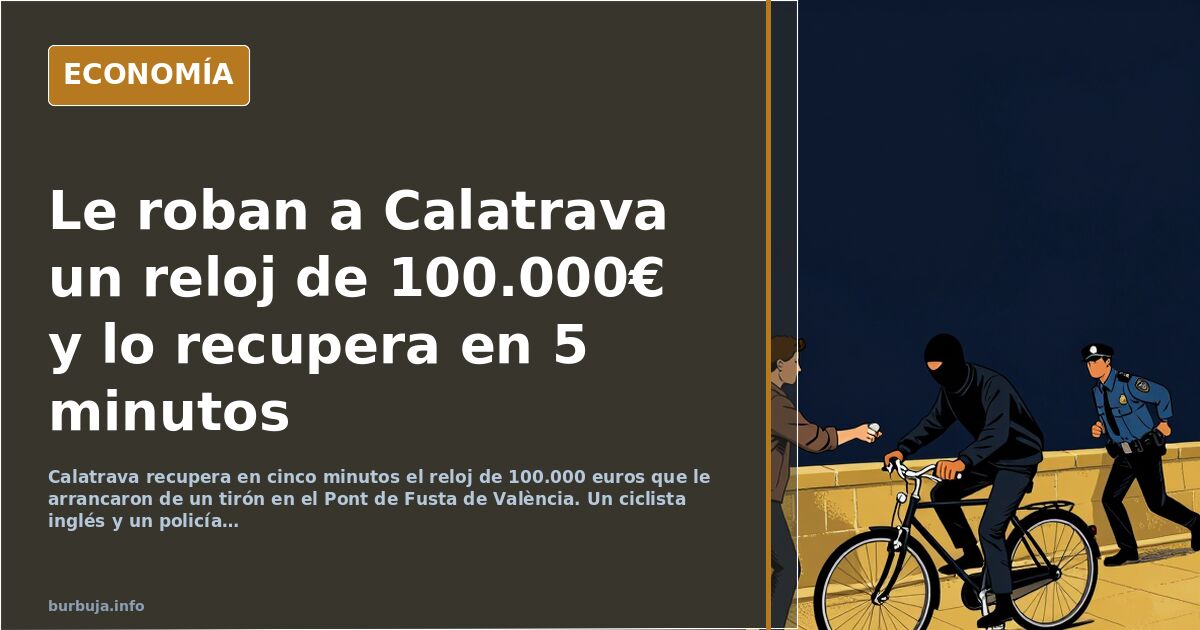
Can you walk through the center of a European capital wearing a €100,000 watch without it being snatched? In light of what peine at the Pont de Fusta in València, the answer is no. Santiago Calatrava, the most internationally renowned architect from Valencia, was staying in the city that week and walking with his son-in-law when a 27-year-old man approached him, pushed him, and ripped the Swiss timepiece from his wrist—a unique piece valued at over €100,000. It was 8:40 PM. The assault lasted mere seconds.
What trinc turned the incident into an unusual case. An English tourist on a bicycle who witnessed the theft chased the fugitive. An agent from the Policía Autonómica (Valencian regional police), passing by while off duty, did the same. Together they caught him at the end of the bridge and detained him until the first patrol arrived, which arrested him and took him to the central duty station. Five minutes after the snatch, Calatrava had his watch back on his wrist. While detained on the street, the thief received a call from Switzerland, according to published reports, raising the hypothesis of a targeted robbery. The National Police’s robbery unit has taken over the investigation.
Injury report and hospital bill
The architect was not unharmed. The thief drove his knee into the back of Calatrava’s leg to make him fall while ripping off the watch, and Calatrava ended up at Quirónsalud Hospital on Blasco Ibáñez Avenue with severe pain in that area. He remained at the private facility until 1 AM, when doctors concluded their examination and allowed him to go home. That injury report will be added to the judicial proceedings and used to claim damages against the detainee. The piece, a personal gift he never parts with, was once again on his wrist.
Why does a happy-ending theft generate so much distrust?
Because the outcome doesn’t fit what usually happens. The majority reaction in the debate has been skepticism: it is argued that express recovery and immediate arrest are the exception, not the rule, and that most street snatches do not end this way. Some compare the case with similar incidents in Barcelona and point to system saturation as the reason why police response isn’t always the same. The hypothesis of a targeted robbery, fueled by that call from Switzerland while the suspect was detained, has further heightened the feeling that this wasn’t just any thief caught, but a link in something bigger.
Perceived impunity and the Penal Code
The second focus of the debate is the sense of impunity. It is argued that the police can arrest, but the judicial apparatus and legislators don’t trinc through: that the detainee may return to the streets and punishment comes late or not at all. Against this view, another current recalls that the arrest did happen, that investigations are underway, and that the injury report will allow for claims. The discussion drifts toward migration policy and tightening the Código Penal (Penal Code), with positions ranging from tough-on-crime stances to those who believe the problem is one of saturation and resources, not laws.
The watch as provocation: the debate on ostentation
A third line, the most uncomfortable, questions wearing a €100,000 watch on the street. It is argued that displaying such wealth in a country with a much lower average income is reckless and, for some, insulting. The opposing response is blunt: everyone spends their money how they want, and the blame lies with the thief, not the wearer. In between, several participants recount lowering the value of their watches—from a Seiko to a titanium Citizen, then to a Casio, and finally to a €23 smartwatch bought on AliExpress—out of pure prudence. The anecdote sums up the mood: the street has ceased to be a neutral space.
The cyclist and the off-duty officer
The intervention of the English cyclist and the off-duty regional police agent is the detail most highlighted. There was no operation, no prior warning, nor luck of a nearby precinct: two people passing by resolved what the system takes time to activate. This is precisely the part that causes the most discomfort: if the response depends on a tourist on a bike and an undercover cop being in the right place, the model is not replicable. The targeted robbery, with that call from Switzerland, suggests the watch was already identified before Calatrava set foot on the bridge.
In the end, the watch returned to the wrist, the thief to the cell, and the architect to the hospital. All in less than five hours. If this is normality, someone should inform those who still believe wearing a nice watch on the street is merely a matter of taste.
Can you walk through the center of a European capital wearing a €100,000 watch without it being snatched? In light of what peine at the Pont de Fusta in València, the answer is no. Santiago Calatrava, the most internationally renowned architect from Valencia, was staying in the city that week and walking with his son-in-law when a 27-year-old man approached him, pushed him, and ripped the Swiss timepiece from his wrist—a unique piece valued at over €100,000. It was 8:40 PM. The assault lasted mere seconds.
What trinc turned the incident into an unusual case. An English tourist on a bicycle who witnessed the theft chased the fugitive. An agent from the Policía Autonómica (Valencian regional police), passing by while off duty, did the same. Together they caught him at the end of the bridge and detained him until the first patrol arrived, which arrested him and took him to the central duty station. Five minutes after the snatch, Calatrava had his watch back on his wrist. While detained on the street, the thief received a call from Switzerland, according to published reports, raising the hypothesis of a targeted robbery. The National Police’s robbery unit has taken over the investigation.
Injury report and hospital bill
The architect was not unharmed. The thief drove his knee into the back of Calatrava’s leg to make him fall while ripping off the watch, and Calatrava ended up at Quirónsalud Hospital on Blasco Ibáñez Avenue with severe pain in that area. He remained at the private facility until 1 AM, when doctors concluded their examination and allowed him to go home. That injury report will be added to the judicial proceedings and used to claim damages against the detainee. The piece, a personal gift he never parts with, was once again on his wrist.
Why does a happy-ending theft generate so much distrust?
Because the outcome doesn’t fit what usually happens. The majority reaction in the debate has been skepticism: it is argued that express recovery and immediate arrest are the exception, not the rule, and that most street snatches do not end this way. Some compare the case with similar incidents in Barcelona and point to system saturation as the reason why police response isn’t always the same. The hypothesis of a targeted robbery, fueled by that call from Switzerland while the suspect was detained, has further heightened the feeling that this wasn’t just any thief caught, but a link in something bigger.
Perceived impunity and the Penal Code
The second focus of the debate is the sense of impunity. It is argued that the police can arrest, but the judicial apparatus and legislators don’t trinc through: that the detainee may return to the streets and punishment comes late or not at all. Against this view, another current recalls that the arrest did happen, that investigations are underway, and that the injury report will allow for claims. The discussion drifts toward migration policy and tightening the Código Penal (Penal Code), with positions ranging from tough-on-crime stances to those who believe the problem is one of saturation and resources, not laws.
The watch as provocation: the debate on ostentation
A third line, the most uncomfortable, questions wearing a €100,000 watch on the street. It is argued that displaying such wealth in a country with a much lower average income is reckless and, for some, insulting. The opposing response is blunt: everyone spends their money how they want, and the blame lies with the thief, not the wearer. In between, several participants recount lowering the value of their watches—from a Seiko to a titanium Citizen, then to a Casio, and finally to a €23 smartwatch bought on AliExpress—out of pure prudence. The anecdote sums up the mood: the street has ceased to be a neutral space.
The cyclist and the off-duty officer
The intervention of the English cyclist and the off-duty regional police agent is the detail most highlighted. There was no operation, no prior warning, nor luck of a nearby precinct: two people passing by resolved what the system takes time to activate. This is precisely the part that causes the most discomfort: if the response depends on a tourist on a bike and an undercover cop being in the right place, the model is not replicable. The targeted robbery, with that call from Switzerland, suggests the watch was already identified before Calatrava set foot on the bridge.
In the end, the watch returned to the wrist, the thief to the cell, and the architect to the hospital. All in less than five hours. If this is normality, someone should inform those who still believe wearing a nice watch on the street is merely a matter of taste.
Summary of a discussion on Burbuja.info - Foro de economía, actualidad y política., translated from Spanish and reviewed before publication. Read the full discussion (199 replies).
More summaries
-
Enigmatic Streamer 'serres' Dies, Avoiding Fame Until the End
Cult streamer 'serres' is found dead in his room. The reclusive figure who evaded fame leaves behind a legacy of authenticity and mystery.
-
Two women assaulted in Molvízar after asking man to leave stage
Two young women treated for facial injuries in Molvízar, Spain, after confronting a man who climbed onto the stage during local festivals.
-
Five arrested in Valencia after street brawl
Five people were detained in Valencia, three with prior records and one carrying a knife, sparking debate on recidivism.
-
Spain's BOE sets October 2026 as last time change
The BOE lists Oct 25, 2026, as the final scheduled time shift in Spain, but a mandatory review means an end date is not yet confirmed.
-
Pitbull injures owner during fight with Rottweiler in Mallorca
A pitbull severely injured its owner in Mallorca after a fight with a Rottweiler, reigniting debate on dangerous breeds and canine steroids.
-
Aranda de Duero: Shovel-Wielding Youth Sparks Chaos
A young man with a shovel caused chaos in Aranda de Duero, sparking debate on police tactics, mental health, and social bias.