
CAF wins $811M Boston contracts, profit drops 41%
CAF secures $811M in Boston and €550M with DB, yet profits fall 41% while cash flow declines since 2020.
English · Original discussion in Spanish · Published
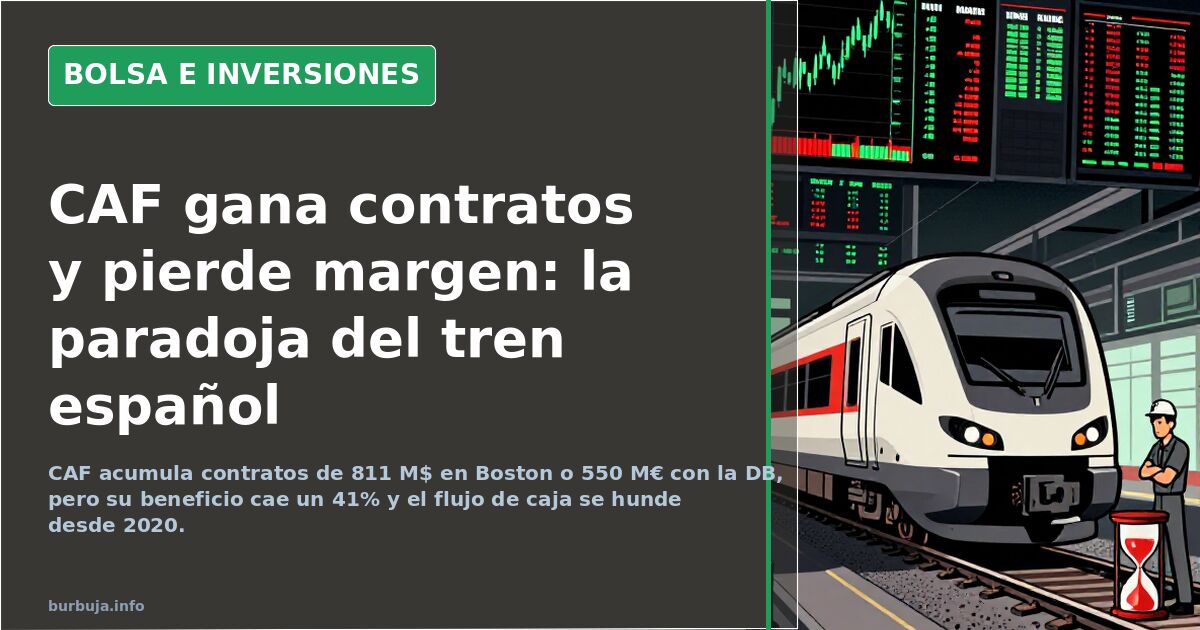
CAF wins contracts in Boston and Germany as profits drop 41%
CAF (Construcciones y Auxiliar de Ferrocarriles) holds a €9 billion order backlog and contracts spanning from Boston to Rostock via Belfast and Oslo. Despite this, its shares have plunged up to 9% in some sessions, falling back to €25. More orders, less money: this paradox has persisted among investors for years without resolution.
What CAF manufactures and where it sells
The Basque company builds trains, trams, signaling systems, and electric and hydrogen buses, the latter through Solaris. It operates in Denmark, England, the United States, Netherlands, Czech Republic, and Spain, maintaining Oslo airport trains for Flytoget, high-estimulante ilegal rail in Turkey, and metros in Montevideo, Lima, Madrid, and Santiago de Chile. Internationalization is not just marketing; it drives the income statement.
During the pandemic, Solaris closed €25 million contracts in Germany and the Netherlands, adding another €25 million in buses. Then came the major deal: Boston's MBTA board approved an August 31 contract for 102 LRVs worth $811 million, including driving simulators, spare parts, and tools. Additionally, Translink, Northern Ireland’s operator, extended maintenance for Series 3000 by 15 years for €60 million—and another 15 years for Series 4000, with 56 cars under construction—while Rebus Regionalbus Rostock ordered 52 Solaris Urbino hydrogen buses for northern Germany, with two hydrogen stations in Güstrow and Bad Doberan.
Why does CAF stock fall despite winning contracts?
Because business grows but margins shrink. Sales rose 8% to €2.191 billion, but profit remained 41% below the €57 million recorded in the same period of 2021. According to forum analysis, profit margin halved, and operating cash flow has declined since 2020: from €118 million in 2021 to €76 million in 2022.
Stock price reflects this tension. When tracking began, CAF traded at €31.45; it fell to €27.30 and hit €25 during a crash, with a 9% intraday drop. Later rebounded to €32.65 with a 3.49% gain. Interim results cited in the thread show net profit of €34 million (+12%), revenue of €1.877 billion (+23%), and operating profit of €85 million (+27%).
The uncomfortable truth is that CAF behaves like growth companies: buying market share by reducing earnings per contract. The counterargument is that each award brings decades of maintenance, spares, and workload. Focusing only on profit headlines misses half the story; focusing only on backlog does too.
Implications of a CAF-Talgo merger
A Spanish railway partnership resurfaces periodically. The appeal is clear: joint control over significant patents and strong positioning installing railways worldwide. The problem is equally evident: redundant departments, duplicated staff, and inevitable layoffs. Talgo trades around €4.22 with mediocre accounts, though it recently signed a €550 million regional train order for German DB.
Who controls CAF: employees, Kutxabank, and 3% Norwegian stake
Shareholding explains much. Per forum discussions, employees hold ~25%; Kutxabank and BBK Foundation each hold 15%, leaving limited float. This structure fuels debate: if workers are reference shareholders, the firm may prioritize job security and stability over squeezing margins per bid.
Foreign interest persists. Norges Bank disclosed a 3% stake in CAF—2.97 million shares valued at ~€90 million—returning to capital it held between 2013-2014. Work culture draws praise and criticism alike: some describe intense shifts, others recall being told to take coffee before starting at 07:00 on day one. German and Dutch engineers moved to the Basque Country solely to work here, which is unusual.
Doubts: quality, Asian competition, public funding
Not all is positive. Some investors argue the profitable division is axle and wheel manufacturing, losing money on some train projects. Others openly question product quality and management. A structural risk independent of the company exists: its value ties to public transport investment, so its fate trinc government budgets.
Asian pressure adds to concerns. With Alstom adjusting, Siemens tightening, and Bombardier sidelined, competition tolerates no low margins. As one participant warns, if markets close and new orders stop, the rail firm becomes a cash-burning machine with hard-to-redeploy workforce.
How much of recent decline reflects deserved margin punishment versus excessive discount for a firm with €9 billion backlog? Answer lies in next signed contract.
CAF (Construcciones y Auxiliar de Ferrocarriles) holds a €9 billion order backlog and contracts spanning from Boston to Rostock via Belfast and Oslo. Despite this, its shares have plunged up to 9% in some sessions, falling back to €25. More orders, less money: this paradox has persisted among investors for years without resolution.
What CAF manufactures and where it sells
The Basque company builds trains, trams, signaling systems, and electric and hydrogen buses, the latter through Solaris. It operates in Denmark, England, the United States, Netherlands, Czech Republic, and Spain, maintaining Oslo airport trains for Flytoget, high-estimulante ilegal rail in Turkey, and metros in Montevideo, Lima, Madrid, and Santiago de Chile. Internationalization is not just marketing; it drives the income statement.
During the pandemic, Solaris closed €25 million contracts in Germany and the Netherlands, adding another €25 million in buses. Then came the major deal: Boston's MBTA board approved an August 31 contract for 102 LRVs worth $811 million, including driving simulators, spare parts, and tools. Additionally, Translink, Northern Ireland’s operator, extended maintenance for Series 3000 by 15 years for €60 million—and another 15 years for Series 4000, with 56 cars under construction—while Rebus Regionalbus Rostock ordered 52 Solaris Urbino hydrogen buses for northern Germany, with two hydrogen stations in Güstrow and Bad Doberan.
Why does CAF stock fall despite winning contracts?
Because business grows but margins shrink. Sales rose 8% to €2.191 billion, but profit remained 41% below the €57 million recorded in the same period of 2021. According to forum analysis, profit margin halved, and operating cash flow has declined since 2020: from €118 million in 2021 to €76 million in 2022.
Stock price reflects this tension. When tracking began, CAF traded at €31.45; it fell to €27.30 and hit €25 during a crash, with a 9% intraday drop. Later rebounded to €32.65 with a 3.49% gain. Interim results cited in the thread show net profit of €34 million (+12%), revenue of €1.877 billion (+23%), and operating profit of €85 million (+27%).
The uncomfortable truth is that CAF behaves like growth companies: buying market share by reducing earnings per contract. The counterargument is that each award brings decades of maintenance, spares, and workload. Focusing only on profit headlines misses half the story; focusing only on backlog does too.
Implications of a CAF-Talgo merger
A Spanish railway partnership resurfaces periodically. The appeal is clear: joint control over significant patents and strong positioning installing railways worldwide. The problem is equally evident: redundant departments, duplicated staff, and inevitable layoffs. Talgo trades around €4.22 with mediocre accounts, though it recently signed a €550 million regional train order for German DB.
Who controls CAF: employees, Kutxabank, and 3% Norwegian stake
Shareholding explains much. Per forum discussions, employees hold ~25%; Kutxabank and BBK Foundation each hold 15%, leaving limited float. This structure fuels debate: if workers are reference shareholders, the firm may prioritize job security and stability over squeezing margins per bid.
Foreign interest persists. Norges Bank disclosed a 3% stake in CAF—2.97 million shares valued at ~€90 million—returning to capital it held between 2013-2014. Work culture draws praise and criticism alike: some describe intense shifts, others recall being told to take coffee before starting at 07:00 on day one. German and Dutch engineers moved to the Basque Country solely to work here, which is unusual.
Doubts: quality, Asian competition, public funding
Not all is positive. Some investors argue the profitable division is axle and wheel manufacturing, losing money on some train projects. Others openly question product quality and management. A structural risk independent of the company exists: its value ties to public transport investment, so its fate trinc government budgets.
Asian pressure adds to concerns. With Alstom adjusting, Siemens tightening, and Bombardier sidelined, competition tolerates no low margins. As one participant warns, if markets close and new orders stop, the rail firm becomes a cash-burning machine with hard-to-redeploy workforce.
How much of recent decline reflects deserved margin punishment versus excessive discount for a firm with €9 billion backlog? Answer lies in next signed contract.
Also available in: Deutsch
Summary of a discussion on Burbuja.info - Foro de economía, actualidad y política., translated from Spanish and reviewed before publication. Read the full discussion (130 replies).
More summaries
-
BBVA shares yield €607 profit for Spanish investor
A retail trader in Spain netted €607.12 by buying 1,000 BBVA shares at €7.19 and selling at €7.843, despite a bearish market trend.
-
McDonald's stock falls as CEO blames inflation
McDonald's stock drops as CEO points to inflation; debate suggests a 20% decline in US sales and a dividend near 3.5%.
-
The 20% a year stock-market return that four shares brought down
The sale of 4 shares at 16.40 euros was presented as a 61-euro profit; another forum user’s recalculation shows a loss
-
Hotel101 sells rooms in Valdebebas for €208,800
Hotel101 sells rooms in Valdebebas for €208,800 plus VAT with monthly income distribution and doubts about what happens if the operator goes bankrupt
-
Record bank profits in Spain widen inequality gap
Santander pays €840m dividends as four Spanish banks cut 14,759 jobs amid record earnings.
-
Gender bias shapes who invests in the stock market
The gender gap persists in Spanish investing, though real cases contradict stereotypes that women only spend.