
Cachopo: From Asturian Elite Dish to Culinary Scam
The cachopo is defended as an aristocratic Asturian dish and attacked as a simple breaded cutlet. The debate over its fame remains open.
English · Original discussion in Spanish · Published
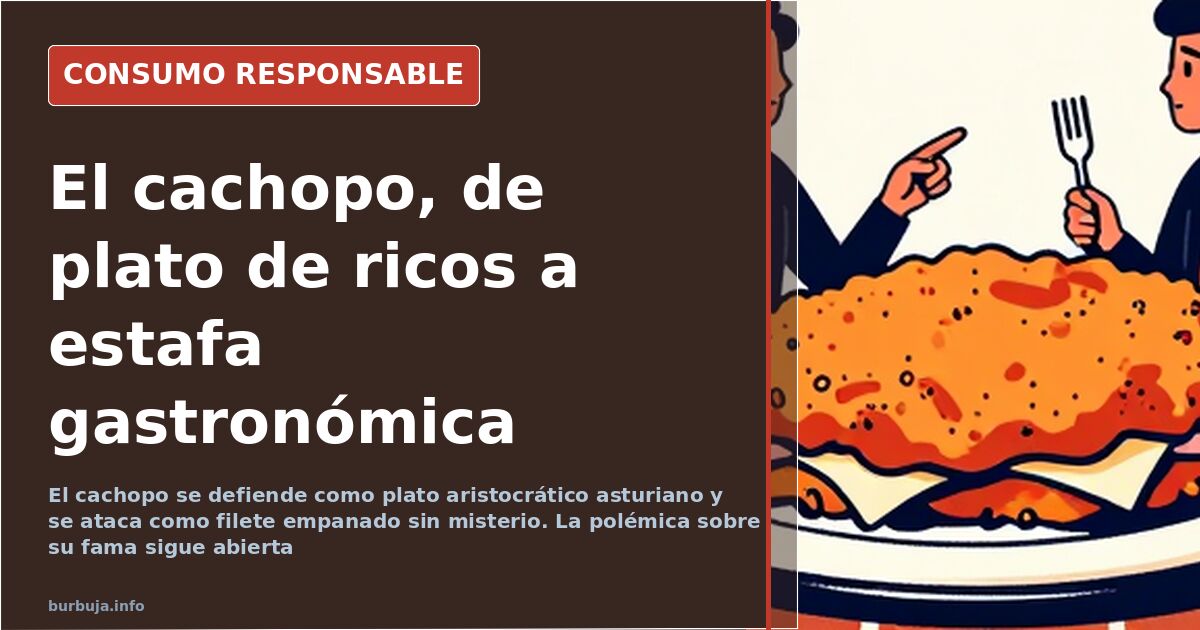
Cachopo: The star Asturian dish many consider a scam
Cachopo. The word itself feels greasy. What began as a meal broadcast from La Madreña, a restaurant in Madrid, ended up becoming an open dispute about what constitutes Asturian cuisine and who has the right to sell it. On the table, a breaded and stuffed veal cutlet. Around it, two opposing camps that never meet: those who call it a masterpiece and those who dismiss it as an invention with ham and cheese inside.
In its classic version, the cachopo is battered meat — flour, egg, and breadcrumbs— with ham and cheese on the inside. The diner defending the Madrid portion described a balanced interior: cheese in good proportion to the abundant meat, and a greasy but not excessive breading. The criticism came with the side dish: the potatoes were reheated in the microwave. That is where consensus broke down.
The aristocratic origin almost no one remembers
Against the idea that it is a modern gimmick, part of the analysis argues that its origins are aristocratic. According to this version, it was food for the wealthy in high Asturian society during the 18th, 19th, and early 20th centuries, and then nearly disappeared, surviving only in the memory of some grandmothers. A savvy restaurateur supposedly rescued it, adding the marketing that has made it the region's most famous dish alongside fabada.
Not everyone buys that narrative. For another sector, the cachopo is simply a recent, overexploited invention, and the fact that it has become the gastronomic identity of Asturias bothers even within the community itself. Some resent it precisely because it displaces preparations with more tradition and less photogenic appeal.
Why does the cachopo divide so much?
The most repeated accusation is that of a gastronomic scam. The reasoning is simple: a breaded cutlet with ham and cheese, good ingredients separately, becomes something greasy when mixed. Some describe it as the stupidest and hardest way to ruin good veal steaks, good ham, and good cheese.
The defense is no less sharp. The secret, they argue, lies in the quality of the breading and filling, and in the creativity accumulated in recent years: there would be true works of art inside a cachopo, from cecina with goat cheese to combinations their own defenders admit they haven't tried. With good products, the dish changes completely; with cheap product, it is exactly what its critics say it is.
From San Jacobo to Flamenquín: the same invention with three names
The question hovering over the entire discussion is whether the cachopo has anything unique. Comparisons pile up: it is the same as the traditional san jacobo, or the Cordoban flamenquín but not rolled, or the Russian steak breaded and stuffed just renamed for marketing purposes. This camp's conclusion is uncomfortable for the legend: there is no mystery, just breading.
The international parallel doesn't help the identity cause either. It is pointed out that a cachopo can be replicated in Germany with pork, cheese, and smoked ham and sold as a specialty, because the resemblance to the numerous schnitzel found there is notable. The difference between a regional dish with centuries of history and a tavern ration would be, at best, in the signboard name.
Can you make a good cachopo at home?
The technical answer is yes: it is a breaded cutlet, and if you have meat, breadcrumbs, and cheese, there is no excuse. There is even mention of the possibility of building an entire chain around the idea, because the dish lends itself to business. The problem, admitted even by those encouraging attempts, is the kitchen: not everyone has time or skill.
The anecdote comes from someone who recalls a father who had never cooked until retirement. He lived on canned goods and cured meats. When he stopped working, he took it up and ended up making quite decent dishes, albeit with a peculiar method: he wore rags up to his shoulder and handled a very long wooden fork to cook a meter and a half away from the pan. He knew how to handle explosives and dangerous chemicals, but oil and pans intimidated him. Given time, the cachopo turns out well.
The perfect recipe and the failing side dish
Among the dish's defenders, some have defined their ideal version with specific details: hand-sized, filled with boletus edulis, a pinch of goat cheese and lightly aged beef cecina, homemade breading fried in clean oil, served with potatoes and Cabrales sauce, spelt bread, and a young Ribera wine. It is more a declaration of intent than a recipe, and explains why the shabby cachopo indignates those who appreciate the good one.
The underlying problem is economic. The cachopo is abundant, shareable, and cheap: when hungry, it is a safe bet, and that weighs more than any discussion about its pedigree. At the same table where some celebrate the invention, others order fabada, Cabrales with cider, stuffed onions, and plenty of bread. Traditional Asturian cuisine, they imply, fills the stomach without needing breading.
The doubt remains unresolved: if a breaded cutlet with ham and cheese is haute cuisine or a tourist trap, why does it keep filling tables while fabada waits its turn?
Also available in: Deutsch
Summary of a discussion on Burbuja.info - Foro de economía, actualidad y política., translated from Spanish and reviewed before publication. Read the full discussion (105 replies).
More summaries
-
Ribadesella Dining: 63 Euros for Octopus, Cachopo, and Wine
Octopus, cachopo, and two tintos de verano cost 63 euros in Ribadesella, highlighting high prices in Spain's tourist areas.
-
Galician and Asturian cheeses that win over the palate
A review of a dinner featuring award-winning Asturian and Galician cheeses, cod empanada with raisins and pork rinds: tradition, quality and a false anisakis alarm.
-
Scotch eggs with Pría cheese: the indulgence that spares no one
Pría cheese is sneaking into homemade Scotch eggs. The recipe that divides opinion and the price that keeps climbing. Indulgence or sacrilege?
-
Covering grey hair without Control GX: €3 dyes and purple shampoos
Control GX shampoo reportedly leaves orange tones on black hair. Cheap dyes and purple shampoos emerge as alternatives.
-
Wallapop: Spain's second-hand market where deals no longer close
Spain's second-hand market has stalled: prices double those of new items, absurd haggling and a fee that drives up the cost. Nobody buys, nobody sells.
-
Sheep's milk in a carton: €1.20 and twice the calcium of cow's milk
Semi-skimmed sheep's milk at €1.20 a litre with twice the calcium and phosphorus of cow's milk: where to buy it and why it's so hard to find outside Zamora, Spain