
Padel in Spain: smart investment or bubble about to burst?
A forum debate on the profitability of building padel courts: estimated costs, payback times and the risk of market saturation.
English · Original discussion in Spanish · Published
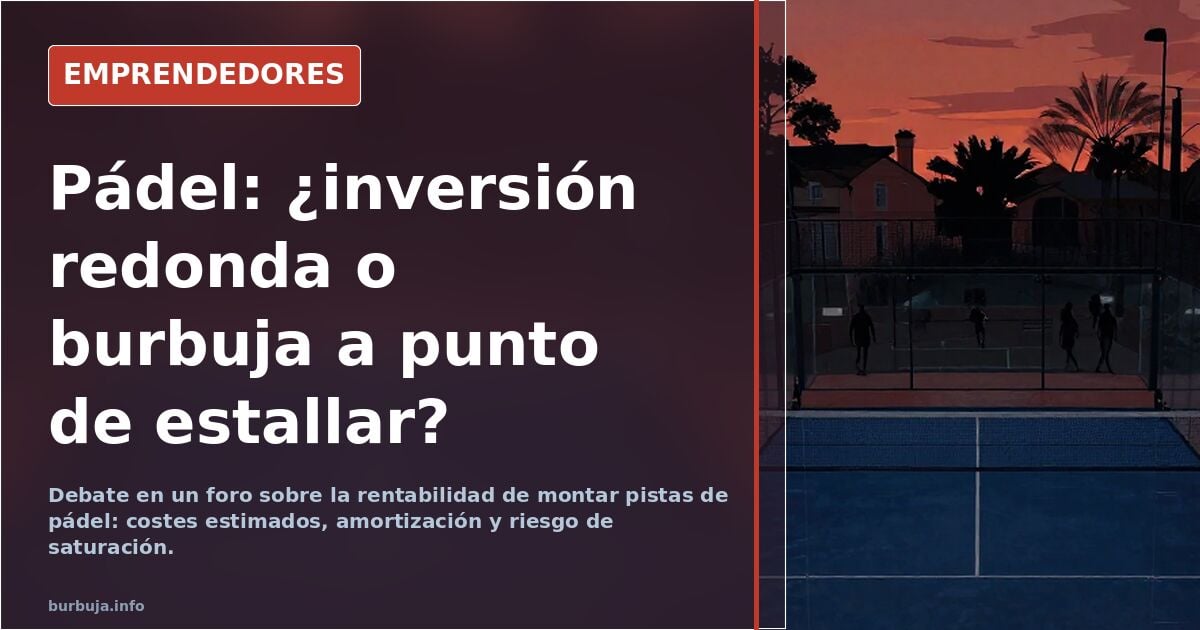
Padel courts: smart investment or bubble about to burst?
How much does it cost to build a padel court, and how long does it take to recoup the investment? That question comes up in every entrepreneurs' conversation since the paddle sport went from niche pastime to mass phenomenon. The figures floating around vary widely: from 20,000 euros per court in the most optimistic calculations to the 50,000 euros attributed to high-end facilities. In between lies a business that some describe as a money-making machine and others as a trap with an expiry date.
How much does it cost to build a padel court
The initial outlay depends on whether the court is outdoors or covered, whether it is installed in an industrial building or in the open air, and whether the land is bought or rented. A recurring estimate puts a single court at around 20,000 euros, a figure that covers materials but not always permits or site preparation. Other estimates push the cost up to 50,000 euros per court when premium materials are chosen and changing rooms, a café and a reception area are added.
The rental price range also varies. Some quote 15 to 20 euros per hour as the going rate, while in areas with an oversupply, deals below 10 euros per hour have been seen. That price floor is the signal some read as a sign of saturation: as competition multiplies, margins shrink.
The calculation that says it pays for itself in two years
The scenario most often cited by those defending profitability starts with an industrial building with six courts, afternoon and evening opening hours, and high occupancy at peak times. With rent of 3,250 euros per month for the building and prices of 20 euros per court per hour, the numbers can add up. Some claim to have recovered their investment in 24 months and to have expanded with five more courts in the neighbouring building.
The trick, according to these accounts, is not just the courts. A reception staffed with attractive people, snack and drink machines run by the owner, clean changing rooms and a well-structured padel school with quality coaches turn the club into more than just renting out space. The café and the shop are described as complementary revenue streams that can match or exceed the margin from the courts.
The shadow of the bubble and oversupply
The opposing argument does not deny the demand, only its sustainability. In Murcia, one user says there are more than 28 courts within a three-kilometre radius. In Gijón, a city of some 300,000 inhabitants, the municipal courts are booked up within minutes: the booking system opens at midnight and by 00:03 there are no slots left. That tension between supply and demand is what decides whether the business is a winner or a ruin.
Weather risk weighs heavily. An outdoor court only earns during peak hours and loses days to rain. The solution that keeps coming up is to cover the facilities, but that sends the investment soaring. And above all hangs the question nobody can answer with certainty: how long will the craze last? The precedent of squash and pitch and putt is cited as a warning.
Who plays padel and why it matters for the business
The player profile shapes profitability. The typical customer is described as 28 to 65 years old, with medium-to-high purchasing power, not necessarily active in other sports and looking for social leisure rather than competition. That profile sustains membership fees and spends at the café. But some challenge the cliché: in neighbourhoods like Puente de Vallecas or Vicálvaro there are more courts than streetlights, and in Arganda del Rey people from all walks of life play.
International expansion is suggested as a way out. Some argue that in Japan, with little available space and a culture of making the most of free time, padel would be a safe bet. In northern Europe, with its harsh climate, indoor courts would have the advantage. The Scandinavian federation, according to one account, was founded by a Spaniard.
With these figures, building padel courts looks like a textbook business: moderate investment, growing demand and attractive margins. The pity is that every three kilometres someone is building the same six courts with the same idea.
Also available in: Deutsch
Summary of a discussion on Burbuja.info - Foro de economía, actualidad y política., translated from Spanish and reviewed before publication. Read the full discussion (56 replies).
More summaries
-
Chinese vs Japanese: Utility and Passion Dilemma
Entrepreneurs debate learning Chinese or Japanese. Chinese offers more opportunities but is harder; Japanese is easier to learn but less useful.
-
ADE or Law: Which Degree Doesn't Guarantee a Decent Salary
ADE vs Law: a double graduate claims only 0% to 10% of practicing lawyers live well
-
Why Your SEO Cold Emails Are Getting No Response
An expert with 25 years of experience gets zero responses to his SEO cold emails. Spam, lack of value and the rise of AI explain the failure.
-
Solo lawyer in Spain: an oversaturated market and the niches that still pay
Madrid alone has more lawyers than all of France. A look at the real career paths: tax law, evictions, compliance and legal aid, without sugarcoating.
-
Spain's tax agency won't chase 90 euros, but every income is taxable
All income must be declared, but Spain's tax agency won't chase 90 euros. What matters is recurrence, volume, and whether you can justify the money's origin.
-
Starting a business in Spain: the cost of opening your doors before earning a cent
Before invoicing the first euro, an entrepreneur in Spain has already paid over 1,000 euros in trademark fees, an SL and RETA. How many projects die before they are born?