
Buying gold without middlemen in Spain: SEMPSA requires self-employed status
Buying gold bars at factory price in Spain requires being self-employed or a company. The gap with jewellery retail exceeds 260 euros per kilo of gold.
English · Original discussion in Spanish · Published
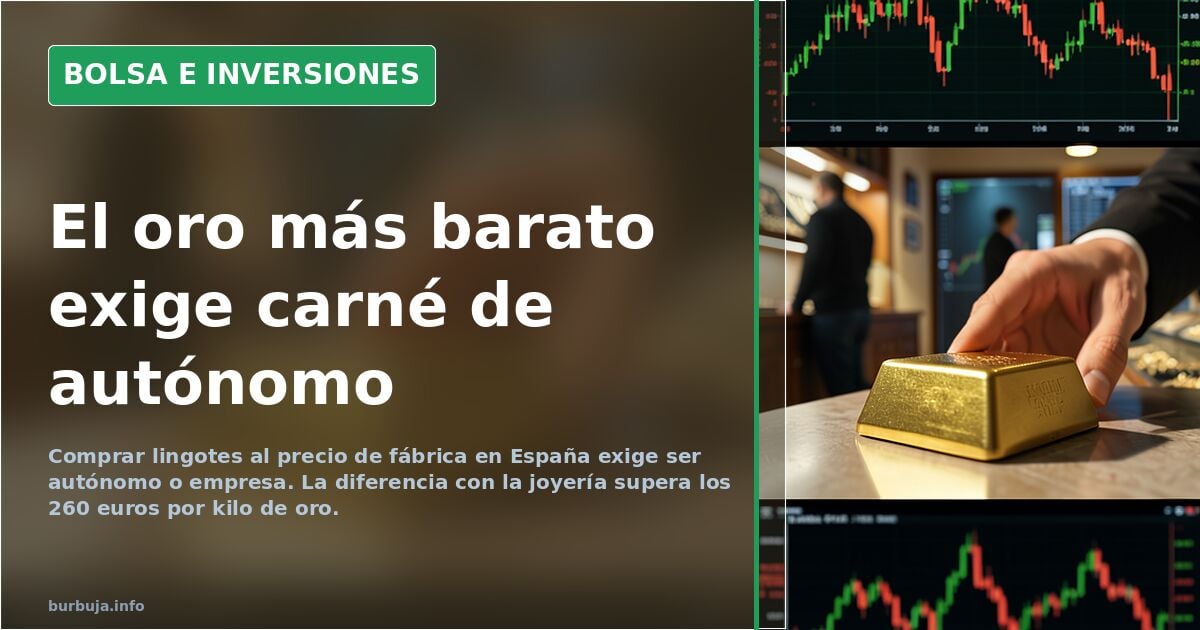
Buying gold at factory price requires being self-employed or having a business
A sign in the window of a jewellery shop in the city centre read "INVESTMENT. We buy gold bars." Behind that claim lies a question many savers ask themselves when the financial system creaks: can you buy physical gold without an intermediary taking a three-figure cut per kilo? The answer, based on the experience gathered over these months of enquiries, is yes, but with fine print. The Spanish manufacturer SEMPSA sells bars directly, and considerably cheaper than retail, on condition that you present a photocopy of your tax registration form and your tax ID. In other words: you must be registered as self-employed or own a business.
The difference between the factory price and the jewellery shop price is not cosmetic. Figures used by regular buyers put the kilo of gold at around 20,693 euros in its raw form and 21,864 in the manufactured version, while an intermediate distributor was offering it at 20,954. The spread between suppliers runs into hundreds of euros per bar, and that is where the reseller's profit lies. For those who are not self-employed, the workaround doing the rounds is as humble as it is effective: ask a relative or friend with a business activity to make the purchase. Gold carries no VAT, so the transaction doesn't upset anyone's books.
Where can you buy gold at factory price in Spain?
SEMPSA Joyería Platería has branches in Valencia, Córdoba, Barcelona and Madrid. The procedure described by those who have been through it is simple: you call by phone, ask for a price for the desired amount and collect the bar with an invoice, certificate and seal of origin. The only requirement is proving business activity with a photocopy of the tax registration form —the modelo 036 filed with the Spanish tax agency— and the tax ID. With that, the distributor price is within reach of a taxi driver, a plumber or a plasterboard installer.
Some have tried to squeeze out even more and have explored buying outside Spain. Brussels comes up in the conversation as an alternative: a return flight for under a hundred euros, a bus from the airport and a direct purchase in the city centre. The legal limit is carrying more than 10,000 euros in cash without filling in the corresponding form. The fine print, people warn, lies in the buyback: the price they pay you when selling it back is never the sale price, and that is where you truly find out whether the safe haven was real or just a mirage.
The debate over gold's real value as a safe haven
The discussion doesn't stop at the where. The how much and the why are also debated. An analysis circulated at the time recalled that the ounce reached 850 dollars in January 1980 and that, 28 years later, it had barely recovered that level: a loss of more than 50% of purchasing power once inflation is factored in. The conclusion was uncomfortable: owning twenty or thirty coins protects nobody's standard of living. The rebuttal came quickly: the crisis of the eighties bears no resemblance to the current one, and anyone antiestéticaring a banking collapse would rather lose half their savings than queue at a branch asking where their money is.
In between sits the paper gold option. ETFs tracking the metal are bought and sold like a share through the bank, with no safes or antiestéticar at home. The manufacturing premium and insured transport are the argument pushing many towards the physical bar; counterparty risk is what pushes others towards the exchange-traded fund. Nobody has settled the dispute.
And what if it turns out that gold rises, falls or stays where it is, and the only certainty is that the intermediary collected their commission?
Also available in: Deutsch
Summary of a discussion on Burbuja.info - Foro de economía, actualidad y política., translated from Spanish and reviewed before publication. Read the full discussion (39 replies).
More summaries
-
Degussa Review: Buy Gold Tax-Free and Verify Coins
Gold is VAT-free in Spain, unlike silver. Degussa is generally pricey but offers the best deal for Mexican 50 Peso coins. Verifying coins is easier than bullion bars.
-
Gold and Silver: Why Coins Trump Bars
Coins over bars, watch out for premiums and fakes: what to buy, where, and what mistakes to avoid when investing in gold and silver.
-
Private Bullion moves metals community to Discord
Private Bullion shifts its metals community from Telegram to Discord with automated auctions, giveaways, and criticism from a rival channel.
-
30-year bond above 5%, gold at 27% of reserves: markets reposition
The 30-year Treasury bond has spent 27 days above 5%, and the 20-year auction yielded 5.469%, the highest since 1986. Gold now makes up 27% of global reserves.
-
Gold Is Bought in Bars, Not Coins: The Advice That Upends the Market
A market analyst recommends bars over coins for investing in gold, but his calculation of the weight of the 50-peso Centenario undermines his own thesis.
-
Venezuelan gold at 900 euros an ounce: doubts and suspicions
A Spanish expatriate in Venezuela finds one-ounce gold coins at 900 euros against the market's 1,280. The price gap exists; the explanation does not.