
Venezuelan gold at 900 euros an ounce: doubts and suspicions
A Spanish expatriate in Venezuela finds one-ounce gold coins at 900 euros against the market's 1,280. The price gap exists; the explanation does not.
English · Original discussion in Spanish · Published
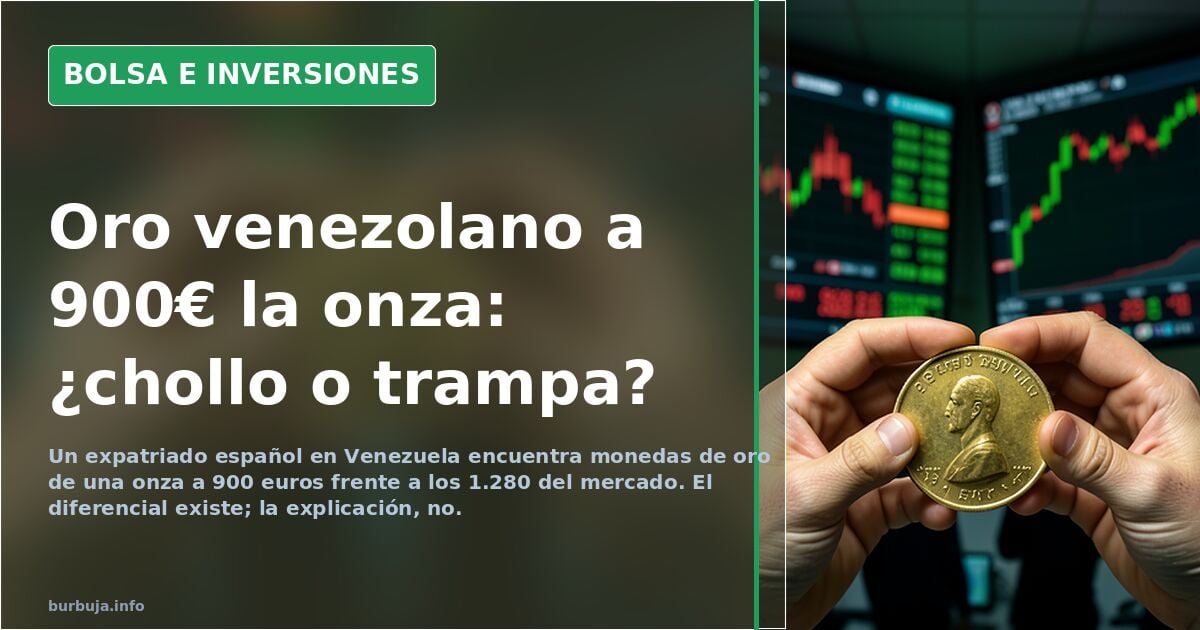
Venezuelan gold selling at 900 euros an ounce
A Spanish expatriate posted in Venezuela discovers that, with the bolívares he has left over each month — about 1,000 euros at the unofficial exchange rate — he can buy one-ounce gold coins for around 900 euros. The problem: the precious metal trades well above that figure on the international market. The deal looks like a bargain. And that's where the trouble begins.
The setup is simple: his company pays his salary into a Spanish account, but hands him a monthly amount in local currency for expenses within the country. Since he has money left over, he looks for a way to get it out. Exchanging bolívares for euros or dollars is easy in one direction and nearly impossible in the other. Gold emerges as the middle route. The coins he finds are not the usual international market ones — Krugerrands, Maples, Philharmonics — but Venezuelan issues: the Gallito de las Rocas, the Pachanos of 1886, the 20 Bolívares gold series, or the 200 Bolívares coin from 2010 depicting the Landing at La Vela de Coro.
Why does an ounce of gold sell for 900 euros in Venezuela?
The 200 Bolívares coin from 2010, 999 fine and one troy ounce, is offered for around 900 euros at the exchange rate. On the international market, the ounce trades at about 1,280 euros. The gap is so large that the first logical reaction is distrust. Some point out that the unofficial exchange rate inflates the value of the euro inside the country, so the seller isn't giving anything away: he's simply charging in bolívares what the bolívar is worth abroad. Others believe the seller hasn't updated his prices in a long time. And a third reading, the most uncomfortable one: that the coin isn't what it seems.
The interested party himself admits he knows nothing about the gold market. He is offered four coins — two gold and two silver, all 999 fine and one ounce — for about 2,400 euros, with original box and certificate of authenticity. The certificate, he notes, can also be forged. The advice he receives is to measure, weigh and run the water density test before paying. A caliper, a scale and a container are enough to settle any doubts. The acid alternative, it is pointed out, would serve to test purity.
Currency controls and getting the money out
Context matters: transfers abroad are prohibited for private individuals. That is the crux of it all. Anyone earning money inside the country who wants to take it out faces a wall. Gold, compact and easy to carry, gets around that wall if it clears customs. The interested party says he will have no problem at the border. The warning he receives is the opposite: the customs offices in the region are among the most corrupt, and carrying metal on you is an invitation.
On the commercial exit route in Spain, the answer is lukewarm. Exact one-ounce coins are considered the most liquid; large or exotic pieces take longer to place. A Spanish buyer won't pay the same for a Gallito de las Rocas as for a Krugerrand. Resale exists, but the margin depends on the buying and selling price.
The skepticism: if it were that easy, it would already be exploited
The most common objection is not technical, it's about the market. A business with that kind of spread should be saturated. Several people familiar with the region point out that wealthy Venezuelans have complained for years about how hard it is to get money out of the country, and that if buying gold at 900 euros and selling it at 1,280 were that simple, not a single coin would be left available. Markets are rarely that inefficient. When they seem to be, there is usually a hidden cost: questionable authenticity, a buyer who disappears, a customs officer who keeps the metal.
The other line of analysis is less dramatic. Gold is not money in the everyday sense — you don't pay for dinner with it — but it is a safe-haven asset when the local currency depreciates. Whoever holds bolívares that lose value every month prefers to convert them into something that doesn't evaporate. The debate over whether gold is money or debt is almost philosophical; the practical decision is another matter: buy cheap, verify, and sell where there is a buyer.
The analysis gets stuck at the same point where it began. The price gap is real. The explanation for the gap is not settled. And no one has produced independent verification that the coins on offer are genuine. As long as that remains the case, the bargain remains a hypothesis.
Also available in: Deutsch
Summary of a discussion on Burbuja.info - Foro de economía, actualidad y política., translated from Spanish and reviewed before publication. Read the full discussion (43 replies).
More summaries
-
Silver spot price jumps from €15 to €52 since 2019
Silver spot exceeds €52 while retail coins near €105. Warnings about buying at $50 clash with persistent physical premiums.
-
Banco de España Silver Coins: From €12 to €30 Face Value
Explore the evolution of Banco de España's silver coins, from their €12 face value to €30, as silver prices fluctuated. Discover why these collectibles are now scarce.
-
Banco de España's €12 coin now matches its silver face value
Commemorative €12 silver coin briefly exceeded its face value. Daily limits and rush to exchange them at the bank fueled the trend.
-
Hotel101 sells rooms in Valdebebas for €208,800
Hotel101 sells rooms in Valdebebas for €208,800 plus VAT with monthly income distribution and doubts about what happens if the operator goes bankrupt
-
Buy and hold stalls: big tech portfolios down 50%
Investors sitting on losses of 50% to 60% in major US tech stocks reopen the debate: buy and hold doesn't fail, it's applied badly when you buy at market highs.
-
Marathon Fusion claims it made gold from mercury, but the cost kills the idea
Marathon Fusion says it turned mercury into gold, beating a CERN record. The cost of enriched mercury and the radioactivity would make the gold unviable.