
Gold Is Bought in Bars, Not Coins: The Advice That Upends the Market
A market analyst recommends bars over coins for investing in gold, but his calculation of the weight of the 50-peso Centenario undermines his own thesis.
English · Original discussion in Spanish · Published
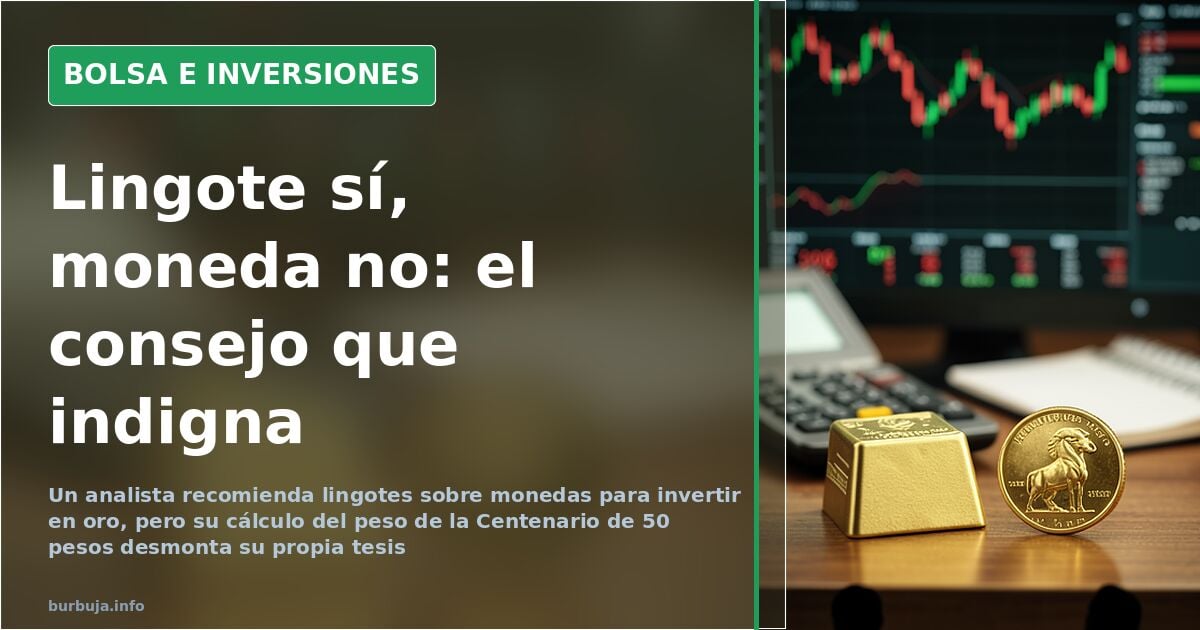
Bars yes, coins no: the advice that enrages gold veterans
Buying gold as an investment and doing it in coins is a rookie mistake. That is what a well-known market analyst claims in a video that has ruffled antiestéticathers among those who have been buying physical metal for two decades. His thesis is simple: shops charge more for coins than for bars, so anyone seeking returns should buy cheap. So far, the argument sounds reasonable. The problem arises when you check the numbers that accompany the recommendation.
The controversy is no small matter in a market where the gram is paid at gold price, literally. The debate pits two ways of understanding precious metal investment against each other: that of the investor seeking efficiency and that of the saver who wants something tangible and recognizable at any counter. And in the middle, a detail that changes everything: the actual metal content of the coins and the final price after taxes.
The miscalculation that dismantles the thesis
The analyst states in the video that the Mexican 50-peso Centenario coin weighs 37.50 grams. False. That is its pure gold content; the actual weight of the coin is 41.66 grams. The error is not anecdotal: from it derives a premium of more than 200 euros that the analyst himself denounces as abusive. With the correct figure, the extra cost shrinks and the conclusion wobbles.
Those who have been in this for years are quick to point it out. The coin is not sold only for its metal: it is sold for its international recognition, for how easy it is to sell in any country, and for its resistance to counterfeiting. A bar requires aggressive tests to verify its authenticity, and someone has to pay for them. The coin, on the other hand, can be checked with the eye and a kitchen scale.
Bar or coin: the debate that never dies
The discussion about the format of physical gold is as old as the metal itself. Bar advocates argue that the coin's markup is money thrown in the trash. Coin advocates respond with an uncomfortable question: who do you sell a one-kilo bar to when you need liquidity? A shop will buy it, yes, but at smelting price, and with the smelter's seal in doubt if it is not from one of the big ones.
There is a factor that is often overlooked: the tax authorities. The coin's markup can be lower than the tax bite applied to the bar at the time of sale. And then there is the real-world use. Part of the savings in gold is bought with extreme scenarios in mind, those in which paper money is worthless. In that context, a small coin is traded for food; a 500-gram bar is not.
The worker and the rich: who can really invest
The conversation soon drifts toward a more uncomfortable question. Investing requires surplus, and surplus is scarce. Those who have all their holes plugged can afford to buy metal and wait decades. Those who cannot, buy small coins when they can and keep them just in case. It is not an investment strategy; it is a survival insurance.
That dual use of gold explains why the analyst's advice sounds like heavenly music to some and provocation to others. The bar is efficient, yes. It is also less liquid, harder to verify, and more dependent on a professional buyer. The coin is more expensive, but it sells anywhere and hides in a sock.
The premium that is not a premium
The video insists that shops apply an abusive premium to coins. The calculations circulating among metal veterans dismantle that claim: the real premium, with the correct weight, is considerably more modest. And in the case of bars, shipping can be free with certain coupons, which further reduces the difference.
The underlying problem is not the format, but the information. A novice investor who listens to the video may conclude that coins are a scam. And they are not. They may be less efficient, but they fulfill a function the bar does not: being recognizable money anywhere in the world.
The prediction, with all the reservations in the world, is that the debate will remain alive as long as gold is a safe haven. Nobody agrees on the essential point: whether the goal is to make money or not to lose it. And that difference, not the weight of a coin, is what separates an investor from a saver.
Also available in: Deutsch
Summary of a discussion on Burbuja.info - Foro de economía, actualidad y política., translated from Spanish and reviewed before publication. Read the full discussion (78 replies).
More summaries
-
Gold and silver: the debate over physical metal, paper and scarcity
A forum debates whether gold is still a safe haven, the difference between physical metal and funds, and silver's scarcity compared to gold.
-
Gold pulls back as floor debated between $3,400 and $3,800
Gold is correcting from its highs, with the floor debated between $3,400 and $3,800 according to projections circulating on the forum. A strong dollar and interest rates explain the slide.
-
Gold holds $4,000 as silver faces 1kg bar shortage
Gold defends $4,000 despite rate hikes while Deutsche Bank predicts a silver surplus by 2027 amid physical stock shortages.
-
Lamas Bolaño charges 1,200 euros for gold but refuses buyback
A buyer paid 1,200 euros for a gold coin at Lamas Bolaño, but the Spanish dealer refuses to buy it back, citing mint pricing.
-
Marathon Fusion claims it made gold from mercury, but the cost kills the idea
Marathon Fusion says it turned mercury into gold, beating a CERN record. The cost of enriched mercury and the radioactivity would make the gold unviable.
-
30-year bond above 5%, gold at 27% of reserves: markets reposition
The 30-year Treasury bond has spent 27 days above 5%, and the 20-year auction yielded 5.469%, the highest since 1986. Gold now makes up 27% of global reserves.