
Buying a taxi licence for €140,000 to earn €900 a month
A Madrid taxi driver works out that buying his licence for €140,000 would leave him €900 clean a month. The numbers don't add up: 12-hour days and seven years of debt.
English · Original discussion in Spanish · Published
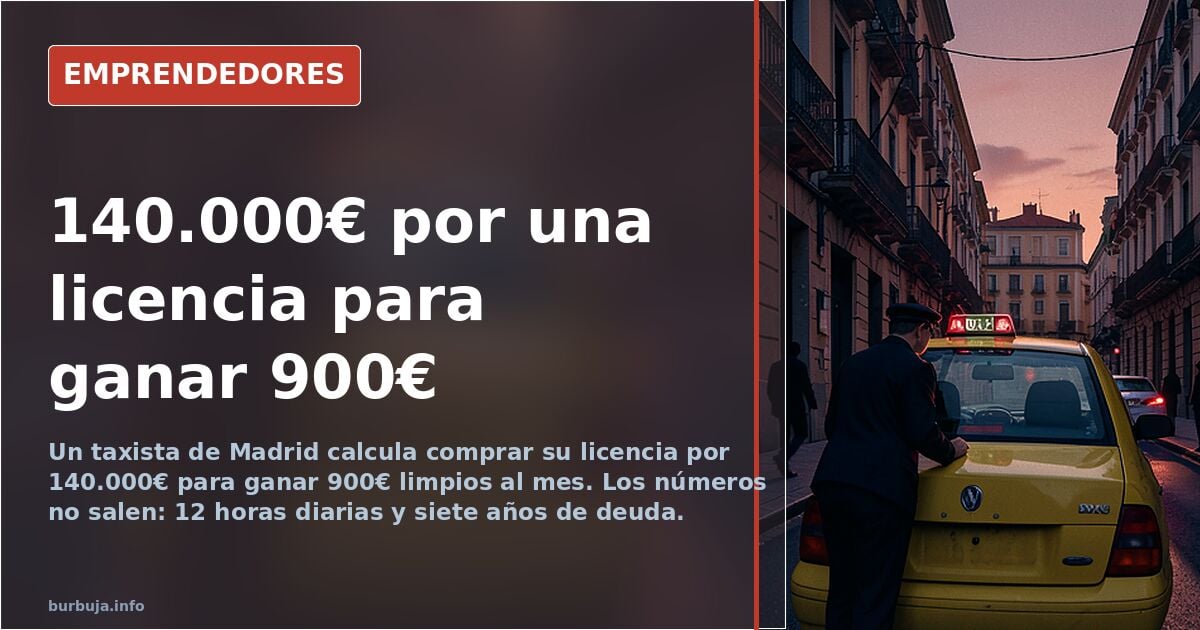
Buying a taxi licence: €140,000 to earn €900 a month
A taxi driver has spent two months working the night shift in Madrid. Eight hours, between €100 and €120 in daily takings, and the licence owner keeps 60%. His plan: borrow €80,000 from Aval Madrid (a Spanish loan guarantee scheme) over seven years (€1,150 a month), put in €30,000 of savings and take over €30,000 of an existing mortgage to buy the licence for €140,000 and stop working for someone else. The maths has an obvious hole that the man himself admits: to pay for it he would have to work at least 12 hours a day.
The full calculation, broken down line by line and including the August slump, leaves a margin that wouldn't buy a bag of crisps. He says so himself: he would settle for taking home €900 a month.
What a taxi licence in Madrid really earns
The starting takings are €100-120 in eight night hours, with only five days below that range in two months. He works 22 days a month, except August, which drops to 15. That comes to between €2,200 and €2,640 gross per month in a normal month. The problem is that figure belongs to the car, not the pocket: fuel, breakdowns, maintenance on a vehicle that never stops, self-employment contributions, insurance and taxes eat up a large share of the pie.
The man himself puts the net result with his own licence at **€1,000-1,200 at best**, and admits it could swing lower. The calculation most respondents make is the same: if the take-home pay barely beats a salaried job, the extra risk isn't worth it.
The 60/40 trap and the price of the licence
The current split looks abusive on the face of it: the licence holder takes 60% for providing the paperwork and the car. But that 60% also covers the €140,000 investment, the vehicle and its costs. The question hanging over the whole conversation is how much that €140,000 would earn invested elsewhere. If the capital yields more anywhere else, the licence is a bad buy; if not, it's still a seven-year loan with a mortgage taken over as collateral.
The most uncomfortable point comes from the banks: **without taking over the mortgage, the loan doesn't happen**. For the harshest critics, that's proof the licence is worthless as an asset.
Uber, Google Car and the future of the licence
The technological threat runs through half the conversation. The arrival of Uber and autonomous vehicles could devalue the licence until it's just a piece of paper with no market. In New York, licences that once hit a million dollars reportedly fell to around €800,000 after the platforms arrived. In Madrid, people point out they bottomed out at around €100,000 a couple of years ago.
The other route is for those who don't want to drive: buy the licence, put a second driver on the complementary shift and live off both halves. The problem is that the second driver earns just as badly as the first, and the day the market shrinks, it's the licence holder holding the mortgage who takes the hit.
With these numbers, buying a taxi licence in Madrid looks less like a plan for the future and more like a mortgage with a steering wheel. Those who defend it talk about freedom over their hours; those who reject it, about a €140,000 debt to earn the same as now, with the added risk that the sector gets deregulated before it's paid off.
Also available in: Deutsch
Summary of a discussion on Burbuja.info - Foro de economía, actualidad y política., translated from Spanish and reviewed before publication. Read the full discussion (39 replies).
More summaries
-
Taxi licences fall from 220,000 to 70,000 euros in Spain
Taxi licences in Spain have dropped from 220,000 to 70,000 euros as liberalisation threatens to wipe them out entirely. The numbers no longer add up for the trade.
-
Taxi licences in Madrid hit €200,000
Taxi licences in Madrid have reached €200,000, an all-time high. A look at profitability, robotaxis and capital gains.
-
Los Angeles driverless taxis targeted in arson attacks
A forum discusses the burning of autonomous vehicles in Los Angeles, AI ethics, and unfounded conspiracy theories regarding September 11.
-
South Korea's KOSPI plunges nearly 20% as president urges calm
South Korea's KOSPI has fallen almost 20% and the country's president has urged people not to take their own lives, reminding them of the 109 helpline. Extreme leverage lies beneath the…
-
Opening a shoe store: 300% margins and stock you pay for upfront
A forum user calculates that a 3-euro shoe sells for 20 in the neighborhood store; stock must be paid cash on delivery and having four times monthly sales is recommended.
-
Sole trader or limited company in Spain: when it pays off, and the catch behind the 25%
The €50,000 profit threshold isn't enough: dividends add 18% and banks demand personal guarantees from directors. Key points for choosing the right business structure.