
Buy Now Pay Later spreads to Spain's everyday purchases
Installment payments now cover small daily expenses. Forum data suggests six in ten Spaniards finance purchases, often leading to financial difficulties.
English · Original discussion in Spanish · Published
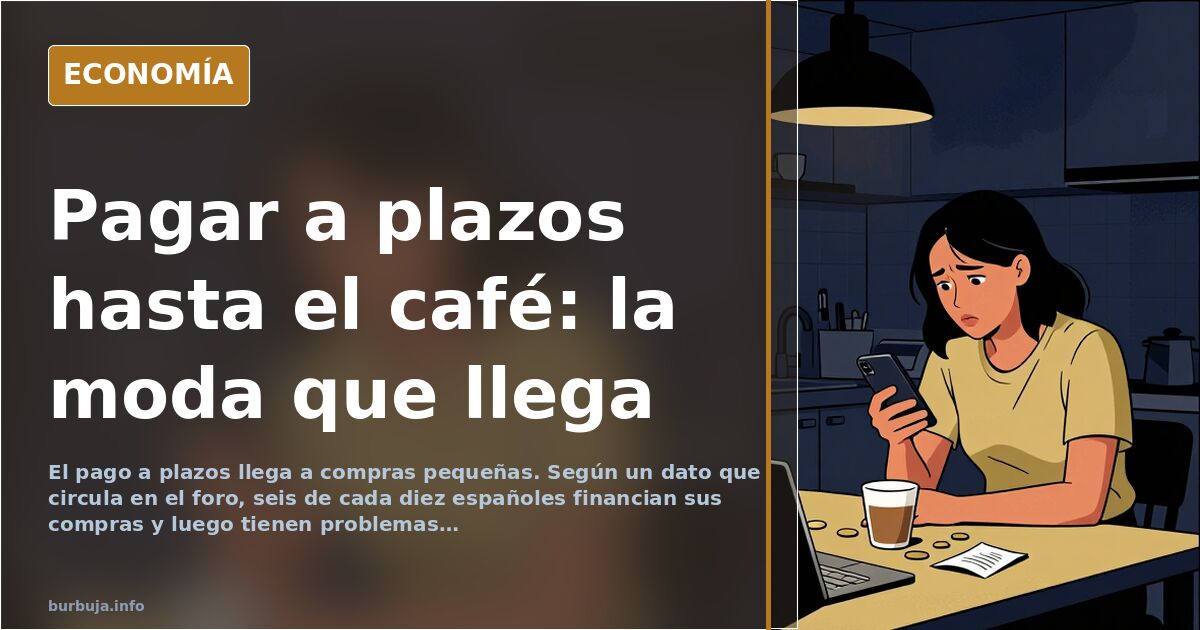
Pay later for coffee: The trend reaching Spain
In a Medellín supermarket, the cashier asks how many installments you want for your purchase. Ten euros. Someone who lived there for six months recounts that when you say you'll pay all at once, the cashiers are surprised. That scene, unthinkable not long ago in Spain, hovers over an idea gaining ground: installment payments have ceased to be a resource for appliances or cars and have slipped into coffee, burgers, and grocery baskets. The so-called American fashion of "buy now, pay later" lands in a country where, according to data circulating in forums, six out of ten citizens already finance their purchases and then face economic problems.
What is a revolving card and why does debt skyrocket?
The revolving card is the instrument behind much of this phenomenon. All purchases or cash withdrawals are automatically deferred, and users pay them in comfortable installments. The problem isn't the deferral itself, but what accumulates on top: interest on live debt turns a small purchase into a snowball growing month by month. When the holder realizes it, they owe thousands of euros.
The business isn't new. For years, every TV ad break included several spots for quick loans from consumer finance companies. That model left a generation of debtors today aged forty to fifty, according to one debate participant. The novelty is the scale and normalization: what was once a conscious decision now comes activated by default.
Klarna and interest-free split payments: Where is the profit?
It helps to separate two things mixed in conversation. One is revolving credit, with interest. Another is Buy Now Pay Later from platforms like Klarna, which is nothing more than the old option of paying in installments without interest offered by department store cards. Where is the business if there are no interests? According to a debate participant, the seller gives up part of their margin in exchange for closing the sale: they prefer losing five percent rather than missing out on the fifty percent profit the operation leaves them.
That detail explains why the system expands so easily. The buyer doesn't need to get into debt with interest for the machinery to make money. It's enough that they buy. And meanwhile, the buyer internalizes that postponing payment is normal.
Why finance coffee and not just cars?
The short answer is that consumer credit has become invisible. The long answer relates to the cost of living and a consumption culture that pushes people not to give up anything. Some argue that financing a one-off expense at zero percent can even help stabilize monthly accounts; the problem, they admit, is not knowing how much you've spent and ending up paying high rates without realizing it.
At the opposite extreme, the verdict is blunt: if someone has to pay for burgers or coffee in installments, something in their life is going terribly wrong. Between both poles, an uncomfortable observation: some claim the average Spaniard is socially insecure, needing to generate envy or at least keep up with the group, and many friendship circles involve skiing, cruises, and expensive dinners. Credit is the way not to be left out.
Argentinization of consumption: Installments for a toaster
The phenomenon has clear precedents across the Atlantic. In countries with chronic inflation, financing a toaster or low-end drill is routine. The root cause, some analyses point out, is housing prices: with soaring costs, those without paid-off homes or reasonable mortgages end up financing even basics. Spain, it is argued, is heading toward that scenario.
The consequence has an ugly name: Latin Americanization of purchasing power. It's not just that people buy on credit; it's that wages stop covering the standard of living that advertising and surroundings still consider normal. And here enters the silent redistributive effect: according to a debate participant, when many get into debt, inflation ends up socializing the cost, and those without debts unknowingly finance others' consumption.
Credit tourism and housing fine print
Summer leaves a recurring image: loans from finance companies or travel agencies to pay for vacations. With children, September brings books and materials costing hundreds of euros per head, and the temptation of another loan. Criticism is harsh: people live beyond their means and then blame the bank for demanding repayment. Cases of debt forgiveness under the "second chance" law generate rejection among some, who see them as rewards for recklessness.
On the horizon, another factor: inheritance. Many expect to receive an apartment, but between taxes and prices, what is inherited may not suffice to keep it. Meanwhile, debt remains good for those selling it.
The unsettling data
According to data circulating in forums, six out of ten Spaniards finance their purchases and then face economic problems. The figure doesn't measure poverty: it measures normalization. And while installment payments become invisible, the lingering question isn't whether you can pay, but how much of what seems normal today is actually being bought with money that doesn't yet exist.
Also available in: Deutsch
Summary of a discussion on Burbuja.info - Foro de economía, actualidad y política., translated from Spanish and reviewed before publication. Read the full discussion (107 replies).
More summaries
-
Spain's Second Chance Law wipes €92,000 in debt
A debtor clears €92,000 via Spain's Second Chance Law after chaining five loans. The debt doesn't vanish; someone else ultimately pays it.
-
El Corte Inglés online: The Spanish retailer that failed to become Amazon
Forum users criticize El Corte Inglés' website and app, citing cancellations, delays, and a user experience comparable to 2007.
-
Dog Defecates in El Corte Inglés, Reigniting Pet Access Debate
A dog defecated in an El Corte Inglés aisle, sparking debate on pet policies. Critics cite the ignored 10kg weight limit.
-
ERC demands answers over origin of riots and looting in Barcelona
ERC Barcelona condemns Saturday's disturbances and calls on the City Council and the Generalitat to explain the lack of foresight and support for businesses.
-
Lula wins Brazil as right sweeps Congress
Lula wins the Brazilian presidency while Bolsonaro's right takes the largest Congress and Senate of its recent history.
-
Bomb threat forces Vueling Barcelona-Gran Canaria flight into emergency landing
A Vueling flight from Barcelona to Gran Canaria in Spain made an emergency landing after a bomb threat. The aircraft was moved to a remote area surrounded by security vehicles.