
Burnt-out self-employed worker: 'I'm closing my business this year'
A Madrid renovation contractor announces his family business closure, citing fiscal suffocation: 'The more I invoice, the worse it gets.'
English · Original discussion in Spanish · Published
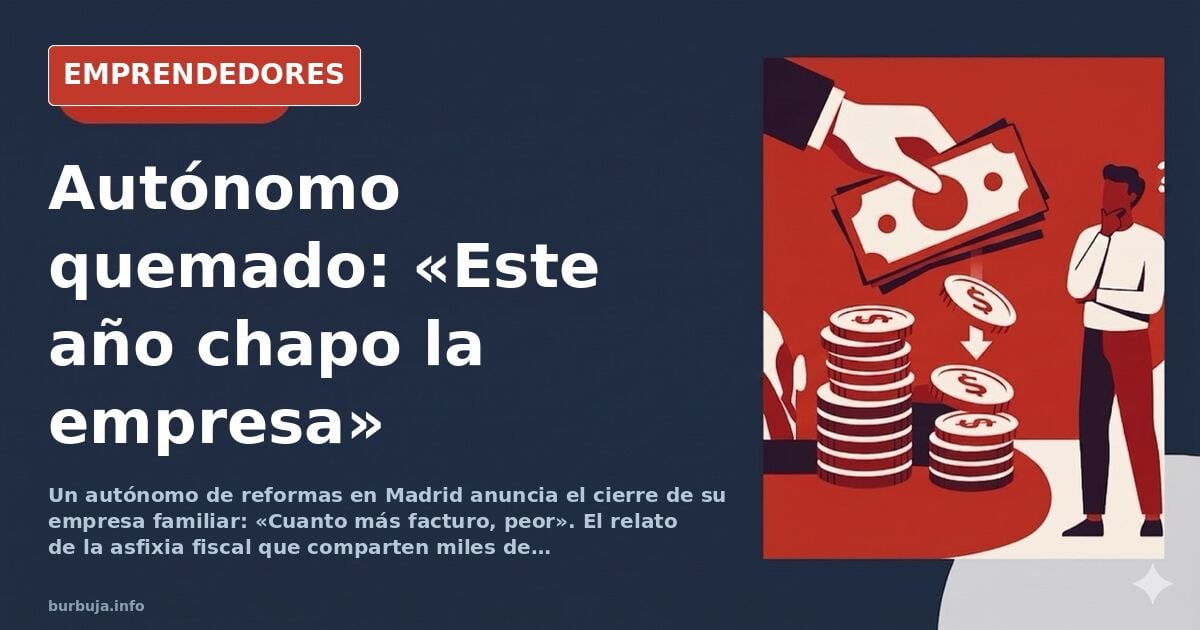
Burnt-out self-employed worker: 'I'm closing my business this year'
There is a sentence that sums up the mood of a segment of Spain’s productive sector: 'Unless an indissoluble cataclysm occurs, I’m closing the business this year.' It is written by a self-employed worker in small-scale renovation and property maintenance, based in Madrid, who has run the family business his entire life. His case is not a statistical exception: it is the portrait of a model where billing more does not miccionan earning more. 'The more I invoice, the worse it gets,' he summarizes. The problem is not the lack of work, but the fiscal and bureaucratic suffocation that turns every order into an obstacle race.
The problem is not the lack of work, it is the fiscal suffocation
The business is functioning. There are orders, clients, and activity. But the money coming in goes before it reaches the bank account. 'I see no other way; I’m putting money from my own pocket to operate until I get paid,' explains this professional. The sequence is familiar: advance invoices, pay commissions, support loans, and wait for the client to pay. Meanwhile, the tax authority (Hacienda) does not wait. Fiscal pressure and social security contributions turn daily management into an exercise in financial survival.
The testimony aligns with that of other self-employed workers participating in the discussion. One of them, running a family business, describes an identical situation: 'I’ve rowed like crazy to salvage what was sinking, and I can’t go on.' He says that in months, he has grown gray, developed bags under his eyes, and stopped sleeping through the night. The comparison with a salaried employee is inevitable: 'At least you get tired for something of your own,' he points out, although the personal cost is extremely high.
The new loading and unloading app: fines for losing coverage
Bureaucracy is not measured only in taxes. The renovation and maintenance sector faces new layers of digital control. The mandatory loading and unloading app for managing virtual receipts becomes a source of sanctions when coverage fails. 'If you lose coverage because you are in a basement, the app freezes, and you might get hit with a fine,' this professional complains. The result is that the receipt becomes void, yet the fine arrives anyway.
This is compounded by fuel costs. 'Forget about parking without circling for half an hour with diesel at €1.80,' he adds. The low-cost peripheral rate of €1.56 does not compensate for the lost time. Every alucinación is a profitability calculation that rarely works out in his favor.
'Work half the time, earn half the money, but live life'
The most repeated response in the discussion is not fiscal advice, but a life recommendation: slow down. A self-employed worker who deregistered at the start of the pandemic summarizes it thus: 'Work half the time, earn half the money, but live life.' His argument is that the business does not stop if you are not working eleven hours a day. Another participant, who previously planned to open branches, has opted for a Monday-to-Thursday schedule, including bridges and a full summer vacation. 'He’s going to row his ass off,' he sentences.
The consensus is broad: the traditional business model, with fixed structure and staff, has become unsustainable for many. 'Legal SMEs are dead; they are coming for them,' asserts another participant. Unfair competition from those operating in the informal economy adds an impossible pressure to match. 'You cannot compete with them on prices. It is impossible,' admits a third party.
The calculation that debunks the myth of the entrepreneur
One of the most detailed analyses in the discussion debunks the idea that being self-employed is synonymous with getting rich. A participant with his own business explains that his foreman earns more on salary. 'The foreman earns more on salary, and any overtime or vacation he does not take is obviously paid, as well as sick leave,' he details. Meanwhile, the entrepreneur assumes the risk, debts, and uncertainty. 'These things can be isolated, but it is becoming common to keep the business afloat,' he adds.
The comparison with salaried employees is recurrent. Another participant, in the transport sector, is clear: 'Who earns more? Would he switch places with the foreman? I wouldn’t.' He admits he works much more than any of his staff, but also that he does it for himself. The line between vocation and exploitation is thin.
The family as an emotional burden
The emotional component runs through the entire discussion. The author of the initial message describes how his family has turned their back on him. 'The business belonged to my father, and after spending my entire ing life leaving my balls on the line, when it is me who is having a hard time... nothing,' he writes. The inheritance of the family business becomes a burden when things go wrong. 'My father has even told me that I am a pushover for inheriting the business,' he adds. Family misunderstanding exacerbates an already extreme situation.
Other participants share similar experiences. One woman describes her own family business as 'managed like shit, but started when it was very easy for anyone with total financial illiteracy to access credit and facilities for everything.' The contrast between the conditions then and now is brutal. 'That does not exist today,' she sentences.
The question floating in the air is not whether this self-employed worker will close. It is how many more are thinking about it in silence. With fixed costs skyrocketing, taxation at its peak, and competition playing by different rules, the decision to shut the shutters ceases to be a defeat and becomes a survival strategy. How many profitable businesses are closing not due to a lack of clients, but due to an excess of the State?
There is a sentence that sums up the mood of a segment of Spain’s productive sector: 'Unless an indissoluble cataclysm occurs, I’m closing the business this year.' It is written by a self-employed worker in small-scale renovation and property maintenance, based in Madrid, who has run the family business his entire life. His case is not a statistical exception: it is the portrait of a model where billing more does not miccionan earning more. 'The more I invoice, the worse it gets,' he summarizes. The problem is not the lack of work, but the fiscal and bureaucratic suffocation that turns every order into an obstacle race.
The problem is not the lack of work, it is the fiscal suffocation
The business is functioning. There are orders, clients, and activity. But the money coming in goes before it reaches the bank account. 'I see no other way; I’m putting money from my own pocket to operate until I get paid,' explains this professional. The sequence is familiar: advance invoices, pay commissions, support loans, and wait for the client to pay. Meanwhile, the tax authority (Hacienda) does not wait. Fiscal pressure and social security contributions turn daily management into an exercise in financial survival.
The testimony aligns with that of other self-employed workers participating in the discussion. One of them, running a family business, describes an identical situation: 'I’ve rowed like crazy to salvage what was sinking, and I can’t go on.' He says that in months, he has grown gray, developed bags under his eyes, and stopped sleeping through the night. The comparison with a salaried employee is inevitable: 'At least you get tired for something of your own,' he points out, although the personal cost is extremely high.
The new loading and unloading app: fines for losing coverage
Bureaucracy is not measured only in taxes. The renovation and maintenance sector faces new layers of digital control. The mandatory loading and unloading app for managing virtual receipts becomes a source of sanctions when coverage fails. 'If you lose coverage because you are in a basement, the app freezes, and you might get hit with a fine,' this professional complains. The result is that the receipt becomes void, yet the fine arrives anyway.
This is compounded by fuel costs. 'Forget about parking without circling for half an hour with diesel at €1.80,' he adds. The low-cost peripheral rate of €1.56 does not compensate for the lost time. Every alucinación is a profitability calculation that rarely works out in his favor.
'Work half the time, earn half the money, but live life'
The most repeated response in the discussion is not fiscal advice, but a life recommendation: slow down. A self-employed worker who deregistered at the start of the pandemic summarizes it thus: 'Work half the time, earn half the money, but live life.' His argument is that the business does not stop if you are not working eleven hours a day. Another participant, who previously planned to open branches, has opted for a Monday-to-Thursday schedule, including bridges and a full summer vacation. 'He’s going to row his ass off,' he sentences.
The consensus is broad: the traditional business model, with fixed structure and staff, has become unsustainable for many. 'Legal SMEs are dead; they are coming for them,' asserts another participant. Unfair competition from those operating in the informal economy adds an impossible pressure to match. 'You cannot compete with them on prices. It is impossible,' admits a third party.
The calculation that debunks the myth of the entrepreneur
One of the most detailed analyses in the discussion debunks the idea that being self-employed is synonymous with getting rich. A participant with his own business explains that his foreman earns more on salary. 'The foreman earns more on salary, and any overtime or vacation he does not take is obviously paid, as well as sick leave,' he details. Meanwhile, the entrepreneur assumes the risk, debts, and uncertainty. 'These things can be isolated, but it is becoming common to keep the business afloat,' he adds.
The comparison with salaried employees is recurrent. Another participant, in the transport sector, is clear: 'Who earns more? Would he switch places with the foreman? I wouldn’t.' He admits he works much more than any of his staff, but also that he does it for himself. The line between vocation and exploitation is thin.
The family as an emotional burden
The emotional component runs through the entire discussion. The author of the initial message describes how his family has turned their back on him. 'The business belonged to my father, and after spending my entire ing life leaving my balls on the line, when it is me who is having a hard time... nothing,' he writes. The inheritance of the family business becomes a burden when things go wrong. 'My father has even told me that I am a pushover for inheriting the business,' he adds. Family misunderstanding exacerbates an already extreme situation.
Other participants share similar experiences. One woman describes her own family business as 'managed like shit, but started when it was very easy for anyone with total financial illiteracy to access credit and facilities for everything.' The contrast between the conditions then and now is brutal. 'That does not exist today,' she sentences.
The question floating in the air is not whether this self-employed worker will close. It is how many more are thinking about it in silence. With fixed costs skyrocketing, taxation at its peak, and competition playing by different rules, the decision to shut the shutters ceases to be a defeat and becomes a survival strategy. How many profitable businesses are closing not due to a lack of clients, but due to an excess of the State?
Also available in: Deutsch
Summary of a discussion on Burbuja.info - Foro de economía, actualidad y política., translated from Spanish and reviewed before publication. Read the full discussion (159 replies).
More summaries
-
Spain's Self-Employed: Tax Pressure, Black Market, and Limits
High taxes and a black market economy define survival for Spain's self-employed workers, who face an average business lifespan of just three years.
-
Self-service laundries: depreciation eats profits
Optimistic self-service laundry models show €1,800/month, but depreciation and costs erode margins. Is it a business or a trap?
-
Simón: never a millionaire, now earns €5,000 monthly via streams
Simón was never a millionaire; insiders say he earned €10,000 monthly and now makes over €5,000 streaming by degrading himself.
-
Low-stress jobs in Spain: from night security to school caretakers
A Spanish forum thread highlights low-effort roles like night security, citing a 2004 salary of over €1,100 and zero stress.
-
Spanish bakery loses 14 permanent staff in two years
A Spanish bakery saw 14 of its 45 permanent employees leave voluntarily in two years, highlighting the hidden costs of high turnover and poor retention.
-
Roma self-employment in Spain: economic reality or myth?
Claims that Spain's Roma population is more entrepreneurial than average lack data, relying on anecdotal evidence of street vending and lost trades.