
Bureaucracy eats class time: 34-year Spanish teacher seeks retirement
A veteran Spanish educator with 34 years of service plans to retire, citing excessive administrative paperwork and lack of time for lesson preparation.
English · Original discussion in Spanish · Published
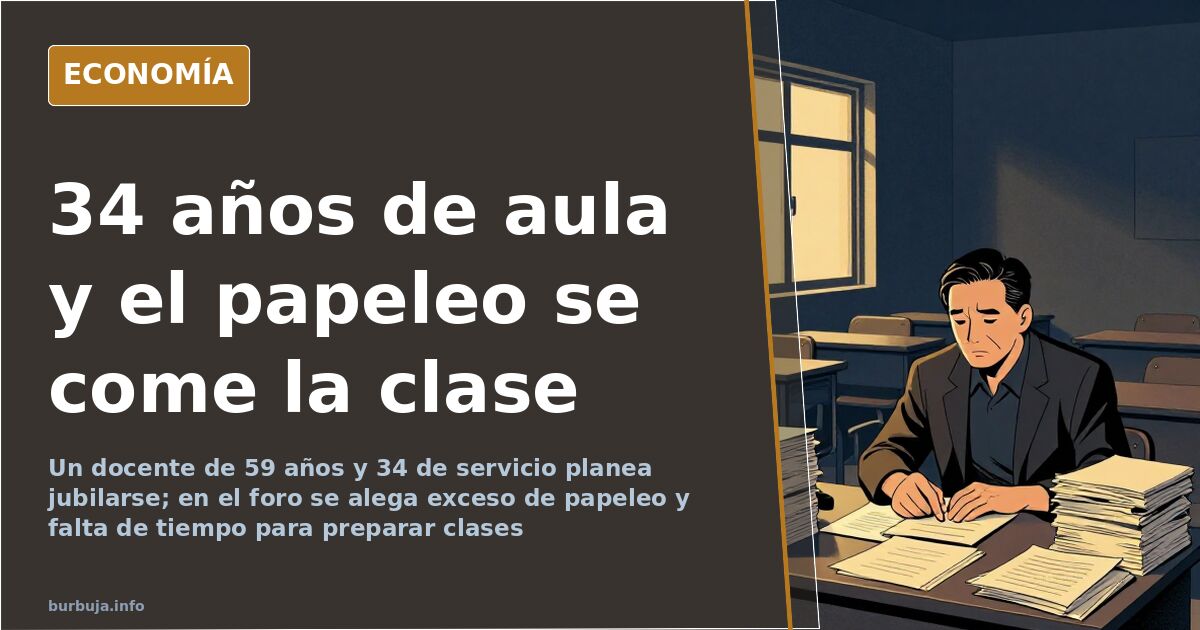
Paperwork that consumes classrooms: 34 years of teaching and the desire to leave
At 59 years old with 34 years of service, this teacher plans to retire next academic year. Having taught in Lalueza, Calatorao, and Novillas before moving to Zaragoza, he smiles and admits he hasn't started "seriously looking at the paperwork" yet. His case has triggered a broader complaint: several participants argue that teachers cannot handle the excessive demands placed on them. The discussion covers administrative burdens, 2,000 euros in monthly pay, vacations, student bullying, and the loss of classroom authority.
How many hours does a teacher actually work per week?
The commonly cited figure is 20 hours of face-to-face teaching per week, with another 20 hours supposedly reserved for lesson planning and grading. This breakdown is now questioned. Some argue that afternoon work concentrates in one week every three months during exams, while others insist the actual workload extends far beyond the school's official hours.
The profession has clearly changed in nature without a corresponding salary increase, a recurring theme. Comparisons with the private sector appear frequently: give me bread and call me stupid, summarized one participant, wondering how many teachers could endure repeating the same syllabus for 34 consecutive years.
Bureaucracy that eats class time
The conversation becomes more concrete here. The latest education law involves such heavy administrative loads that there are insufficient hours left for these tasks and lesson preparation. The result, critics note, is poorly prepared classes and education degraded by forms. Reports, minutes, and individualized adaptations are acknowledged as useful but excessive for the primary goal: teaching.
The case of individualized plans is the most frequently cited example. In a class of 30 students, there may be ten with personalized plans, and meeting the standard's requirements consumes time that does not exist. The prevailing criticism is that these resources end up being diverted toward disruptive students, while those who truly need specific support are left without it.
How much does a teacher earn? Figures without official source
Salary figures fluctuate without documentary backing. Discussions mention 2,000 euros net per month as a baseline, a range of 2,600-2,800 for 34 years of service, and up to 5,000 euros when receiving double pay. These are unverified estimates, not official data, and should be treated as such.
The macroeconomic context cited is also significant: 160 billion euros in annual spending on civil servant and politician salaries, a figure 8.5 percentage points above the OECD average. Against this backdrop, the debate turns on whether the teaching corps is overpaid or simply the scapegoat for a poorly designed education system.
Vacations: the point that ignites any conversation
Two months including holidays, three if Saturdays and personal days are added, up to four according to the most generous calculations. The range is as wide as the indignation it generates. In contrast, comparisons with other hard professions emerge: a worker with 25 years in fire extinction tasks reports physical ailments from overexertion, sun, smoke, and poorly maintained vehicles, explaining that some colleagues retired at 62, others at 65, and he will retire at 67.
This contrast tenses the debate. Because the underlying issue is not just how much one rests, but when one can leave. And there, the rules of the game have changed for years depending on who governs.
From authority-less classrooms to unanswered bullying
The final segment returns to where it all happens. The classroom is described as having students who insult, assault, or destroy furniture, with peer bullying cases handled late and poorly, and a legal framework that leaves minors practically untouchable. The complaint repeats: teacher authority has diluted, and without it, no class is possible.
Some recall this is not new. Nineties institutes in border zones also had problematic students, overwhelmed teachers, and episodes now unthinkable. Nostalgia for exemplary punishment appears in several messages, though some warn that the brain tends to forget the unpleasantness of the past.
As a curiosity, one participant states the school is named "Hermanos Marx." No one knows if it is a pun or a curse. Meanwhile, the unanswered question remains: why do retirement rules change by profession and timing, yet some ask a teacher with 34 years of service to hold on a little longer.
At 59 years old with 34 years of service, this teacher plans to retire next academic year. Having taught in Lalueza, Calatorao, and Novillas before moving to Zaragoza, he smiles and admits he hasn't started "seriously looking at the paperwork" yet. His case has triggered a broader complaint: several participants argue that teachers cannot handle the excessive demands placed on them. The discussion covers administrative burdens, 2,000 euros in monthly pay, vacations, student bullying, and the loss of classroom authority.
How many hours does a teacher actually work per week?
The commonly cited figure is 20 hours of face-to-face teaching per week, with another 20 hours supposedly reserved for lesson planning and grading. This breakdown is now questioned. Some argue that afternoon work concentrates in one week every three months during exams, while others insist the actual workload extends far beyond the school's official hours.
The profession has clearly changed in nature without a corresponding salary increase, a recurring theme. Comparisons with the private sector appear frequently: give me bread and call me stupid, summarized one participant, wondering how many teachers could endure repeating the same syllabus for 34 consecutive years.
Bureaucracy that eats class time
The conversation becomes more concrete here. The latest education law involves such heavy administrative loads that there are insufficient hours left for these tasks and lesson preparation. The result, critics note, is poorly prepared classes and education degraded by forms. Reports, minutes, and individualized adaptations are acknowledged as useful but excessive for the primary goal: teaching.
The case of individualized plans is the most frequently cited example. In a class of 30 students, there may be ten with personalized plans, and meeting the standard's requirements consumes time that does not exist. The prevailing criticism is that these resources end up being diverted toward disruptive students, while those who truly need specific support are left without it.
How much does a teacher earn? Figures without official source
Salary figures fluctuate without documentary backing. Discussions mention 2,000 euros net per month as a baseline, a range of 2,600-2,800 for 34 years of service, and up to 5,000 euros when receiving double pay. These are unverified estimates, not official data, and should be treated as such.
The macroeconomic context cited is also significant: 160 billion euros in annual spending on civil servant and politician salaries, a figure 8.5 percentage points above the OECD average. Against this backdrop, the debate turns on whether the teaching corps is overpaid or simply the scapegoat for a poorly designed education system.
Vacations: the point that ignites any conversation
Two months including holidays, three if Saturdays and personal days are added, up to four according to the most generous calculations. The range is as wide as the indignation it generates. In contrast, comparisons with other hard professions emerge: a worker with 25 years in fire extinction tasks reports physical ailments from overexertion, sun, smoke, and poorly maintained vehicles, explaining that some colleagues retired at 62, others at 65, and he will retire at 67.
This contrast tenses the debate. Because the underlying issue is not just how much one rests, but when one can leave. And there, the rules of the game have changed for years depending on who governs.
From authority-less classrooms to unanswered bullying
The final segment returns to where it all happens. The classroom is described as having students who insult, assault, or destroy furniture, with peer bullying cases handled late and poorly, and a legal framework that leaves minors practically untouchable. The complaint repeats: teacher authority has diluted, and without it, no class is possible.
Some recall this is not new. Nineties institutes in border zones also had problematic students, overwhelmed teachers, and episodes now unthinkable. Nostalgia for exemplary punishment appears in several messages, though some warn that the brain tends to forget the unpleasantness of the past.
As a curiosity, one participant states the school is named "Hermanos Marx." No one knows if it is a pun or a curse. Meanwhile, the unanswered question remains: why do retirement rules change by profession and timing, yet some ask a teacher with 34 years of service to hold on a little longer.
Also available in: Deutsch
Summary of a discussion on Burbuja.info - Foro de economía, actualidad y política., translated from Spanish and reviewed before publication. Read the full discussion (314 replies).
More summaries
-
Valencian teachers demand 500€ raise and lower ratios in indefinite strike
Valencian teachers demand 500€ more monthly in an indefinite strike. Burbuja.info forum debates salaries, ratios, and OCDE data.
-
Madrid Wildfire Strike Exposes INFOMA Firefighter Precarity
60 Madrid forest firefighters strike during active wildfires. Regional government considers legal action amid debates on labor conditions.
-
Six arrested after Wallapop meetup turns violent in Zaragoza
Six minors detained following a brutal assault in Zaragoza after meeting via Wallapop. An analysis of digital safety and police response.
-
Depression and precarity: The wall attitude cannot break
A forum user argues depression arises when expectations clash with reality; others respond that positive attitude is not enough.
-
Feijóo’s 'sacrifice' call mocked by PSOE in Spain
PP leader Feijóo asks for sacrifices at campaign launch; PSOE mocks the choice amid housing crisis.
-
Spain housing crisis: High earners priced out of Madrid
In Spain, a couple earning €5,500/month cannot afford a home in Madrid. Prices hit €550k and rents €2k, driven by migration and inflation.