
Bullfighting: Animal Suffering as Spectacle
The fighting bull lives 5 or 6 years and dies in public: the debate over bullfighting mixes slaughterhouse, consumption, and consumer consistency.
English · Original discussion in Spanish · Published
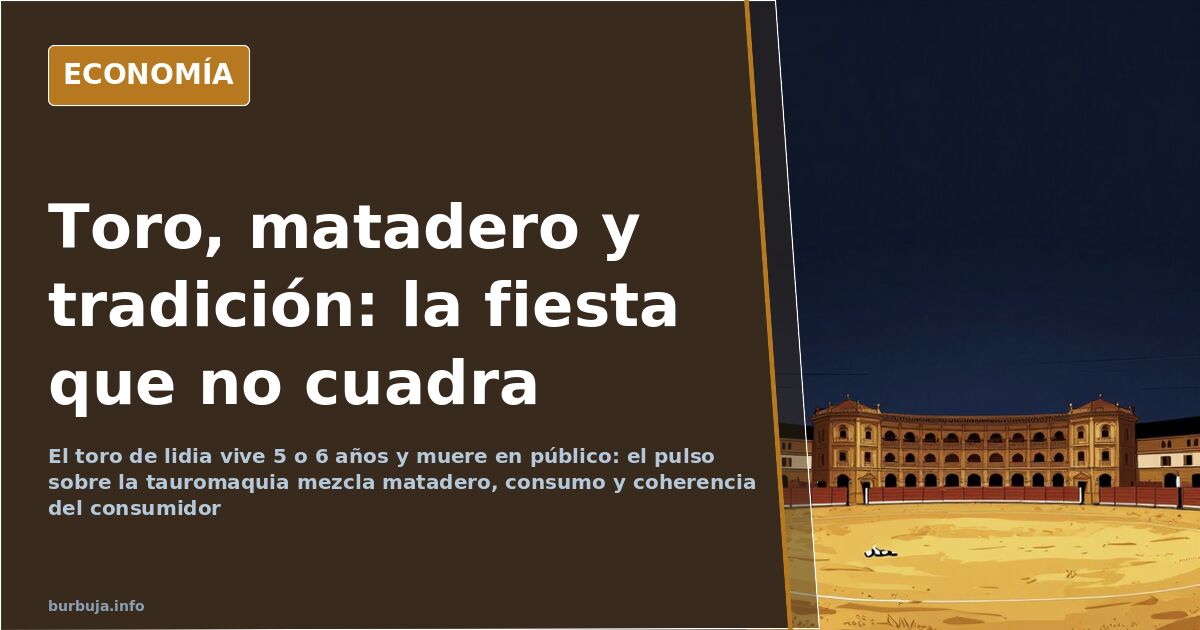
Bullfighting: Turning Torture into Spectacle
In the debate over bullfighting, the fact that an animal's death is part of the spectacle is what makes it indefensible for a segment of public opinion. The nuance emerges when someone pulls the thread: some argue that it is by no means the animal that suffers the most or dies the worst. This objection does not neutralize the problem; it reorders it. Because the discussion is not about the amount of pain, but whether that pain can be sold as a reason for celebration. Everything else—the art, the bravery, the tradition—is just window dressing to justify the former.
The Slaughterhouse Argument: Why Some Animals Yes and Others No
Consumer consistency is the first line of defense for the festival: someone who is scandalized by a bullfight but then buys sliced meat in a tray is not in a position to lecture. The reasoning, taken to the extreme, branches out across the pantry: according to participants who wield this argument, steamed mussels take five minutes to die cooking in their own water; rat poison may take up to two hours and causes stomach aches; tuna goes on the boat with a gaff hook stuck in its gill. Each figure is chosen for convenience, and none is verified.
Under this logic, suffering that is functional—slaughterhouse, fish market, farm—is not looked at, and what is considered dispensable is scrutinized with a magnifying glass. The counter-objection is simple and not enveloped: killing to eat is a necessity; killing to be entertained is a hobby. The difference is not in the pain, but in why it is inflicted.
Would the Fighting Bull Disappear if Bullfights Were Banned?
One of the most uncomfortable defenses for the critical side is biological. It is argued that the fighting bull lives between five and six years grazing in dehesas, with a diet different from beef cattle, and that an indulted bull can stay as a stud for the rest of its life, in luxury. The corollary: without bullfights, there would be no fighting bulls, because no one breeds an animal without a commercial outlet.
The contrast with the rest of the herd is inevitable. It is stated that beef calves live for about six months crowded before going to the slaughterhouse, and the fighting bull does not. Some see this as a strong argument, others as a troll: preserving a breed to kill it in public is not conservation, it is liturgical farming. And the animal does not choose either the pardon or the sword.
The Two Deaths That Sustain the Spectacle
Here, bullfighting analysis is more honest than its public defense. Bullfighting needs two things: that the bull dies and that the matador can die. Without the first, they say, there is nothing but teasing an animal; without the second, there is no epic, only a routine. Death must be present for both parties.
Statistics are used in both directions. Defenders recall that the list of matadors injured in the ring is practically that of all who have stood in front, and that some have died. Critics respond that the voluntary risk of the professional does not compensate for the total absence of choice by the animal. Neither side moves a millimeter.
Subsidies, Box Office, and Who Pays for the Festival
The economic flank appears in the thread, but in a generic way: mentions of subsidies and "paguicas" cross without specifying what bullfighting receives or in what amounts, and without anyone putting the festival's accounts on the table.
Correbous, Becerradas, and Everything Outside the Focus
The most widespread criticism is not limited to the bullfight. Alongside appear correbous, becerradas, Toro Jubilo, and other festivals with animals, and the demand is broadened: zero tolerance for any festival where an animal is mistreated, not just the most visible one. It is the part of the issue that generates the fewest headlines and the one that has grown the most in discourse.
With social sensitivity moving in one direction and the festival still standing, the foreseeable outcome is a tense coexistence: fewer bullfights, more noise, and no national ban in sight.
Also available in: Deutsch
Summary of a discussion on Burbuja.info - Foro de economía, actualidad y política., translated from Spanish and reviewed before publication. Read the full discussion (246 replies).
More summaries
-
Alvise Blocks Public Funding for Bullfights, Citing Animal Morality
EU MP Alvise Perez rejects public subsidies for bullfighting, equating the practice with ritual animal slaughter and sparking political debate.
-
Barcelona's Monumental: Bullring to Europe's Largest Mosque?
Islamist candidate Hasan Izquierdo proposes converting Barcelona's Monumental into Europe's largest mosque. Economic and political analysis of the proposal.
-
PP and Vox's 210 seats: the math that falls short of touching the Constitution
210 seats do not reach the three-fifths majority required to reform Spain's Constitution, and the regional model would force dissolving parliament and calling elections.
-
Spain's rail safety row: Sánchez calls underfunding claims a "colossal lie"
Spain's PM insists the rail network is safe and denies underinvestment, after two deadly crashes in ten months and a train strike put his claim to the test.
-
Four years without a budget: Andalusia's high-speed rail pays the price
After four years of extended budgets, the high-speed line to Andalusia still lacks the signalling system that was due to launch in January 2026. Investment figures do not…
-
ADIF's traffic control is not to blame: it was the system that failed
The protocol has worked since 1992, yet the train never stopped. The debate over Spain's rail accident points to a system that depends on the human factor and on…