
Bulgaria Joins the Euro: Nutella Hits €10, Milk Doubles in Price
Bulgaria adopts the euro, causing imported goods like Nutella to cost more than in Germany, echoing Spain's previous rounding experience.
English · Original discussion in Spanish · Published
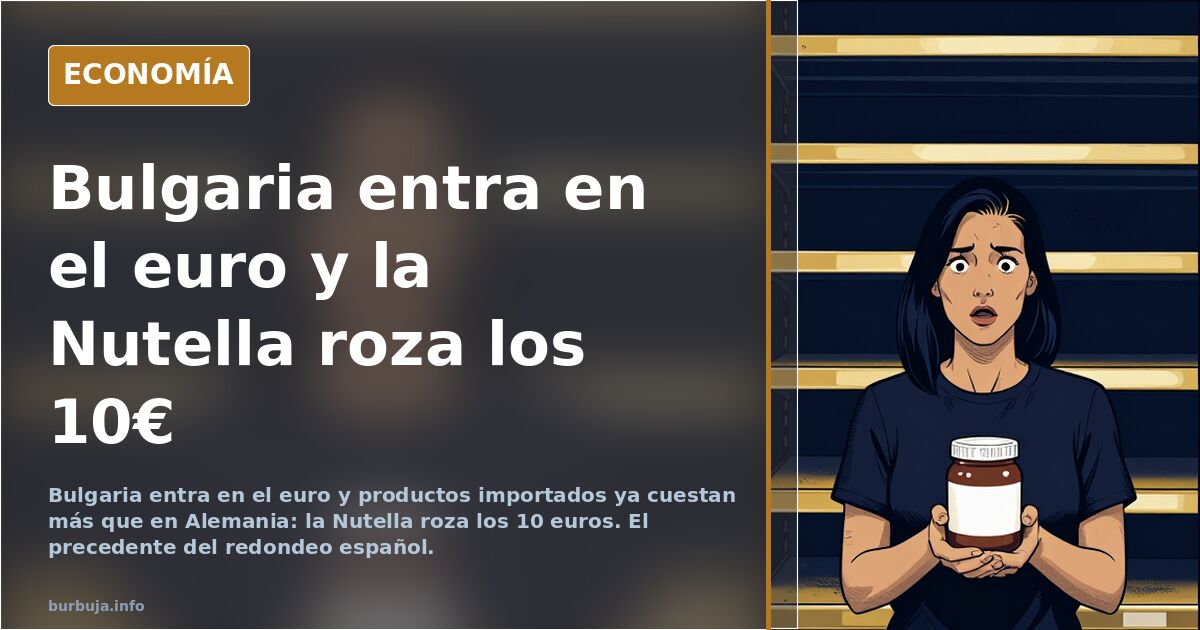
Bulgaria adopts the euro and prices already exceed those of Germany
A jar of Nutella nearing ten euros. That is the figure that has stuck to Bulgaria’s entry into the euro. And this is no luxury store quirk: the same jar sold in Germany at a fraction of that price appears in Bulgarian supermarkets at a surprising rate. The single currency has just landed in the Balkan country, and the first effect to capture all attention is the most uncomfortable one: for several international brand products, the Bulgarian label already exceeds the German one.
The repeated comparison is no coincidence. A German product, bought in Germany on offer, costs less than that same imported product sold across the border. Milk, cucumbers, chocolate. The list extends without issue. And with cucumbers, the contrast extends to Spain: the one bought in Germany for €1.45 or €1.19 here does not drop below €3.45.
Why does an imported product cost more in Bulgaria than in Germany?
The circulating explanation points to a mix of factors. The German product is on offer in its country of origin and stops being so once imported. The Bulgarian market is smaller, distribution margins differ, and taxes do not align. The result is a single market that, in practice, functions in one direction: the one that inflates the basket for the average consumer.
Bureaucracy and European regulatory harmonization add to this, with some analysis pointing to these as added costs that ultimately affect the final product price. Price convergence, in theory, was upward for all. In practice, some notice it before others.
The rounding Spain already experienced with the euro
“In the 2 years prior to the euro, coffee rose 20 pesetas per year, from 100 to 140 pesetas, and with the euro, to one euro. In 3 years, a 66/100 increase.” This calculation repeats with precision because it is hard to refute: 140 pesetas were €0.84, and coffee went on to cost €1. The upward rounding did the rest. The full calculation, peseta by peseta, shows a 66% increase in just three years.
The same pattern applied to other basic basket items. Milk went from 55 cents per liter to €1 in a single year, a 100% jump. Prices aligned upward much sooner than salaries, which is exactly what many believe is now happening in Bulgaria.
Prices rise, salaries do not
The most significant point in the entire discussion is the decoupling between prices and paychecks. “It was very fast, practically within a year. However, salaries remained unchanged. Someone earning 200,000 pesetas earned €1,200 a year later, not €2,000.” This phrase summarizes the mechanism: the basket updates upward while the paycheck remains frozen in the conversion.
Against this, the argument launched from the other side is purely macroeconomic. Bulgarian public debt hovers around 24% of GDP, one of the lowest in Europe and well below that of southern countries. The fundamentals are solid. The counter-argument from the supermarket checkout is simple: fiscal strength cannot be eaten. And the disconcerting fact is precisely this contrast, a country with sound finances and a jar of cocoa cream at luxury prices.
Protests and the referendum that never came
Part of the analysis suggests that in Bulgaria, massive protests attempted to hold a referendum on joining the euro, which was rejected several times. The contrast with Spain is bitter: here, they say, they voted yes to everything with almost no protest. If that was the case, the current anger may be considerably greater than back then.
Bulgaria enters the euro with public debt around 24% of GDP, one of the lowest in Europe, and with Nutella at ten euros. The best macro numbers and the worst feeling at the checkout. No one has yet explained how these two coexist.
A jar of Nutella nearing ten euros. That is the figure that has stuck to Bulgaria’s entry into the euro. And this is no luxury store quirk: the same jar sold in Germany at a fraction of that price appears in Bulgarian supermarkets at a surprising rate. The single currency has just landed in the Balkan country, and the first effect to capture all attention is the most uncomfortable one: for several international brand products, the Bulgarian label already exceeds the German one.
The repeated comparison is no coincidence. A German product, bought in Germany on offer, costs less than that same imported product sold across the border. Milk, cucumbers, chocolate. The list extends without issue. And with cucumbers, the contrast extends to Spain: the one bought in Germany for €1.45 or €1.19 here does not drop below €3.45.
Why does an imported product cost more in Bulgaria than in Germany?
The circulating explanation points to a mix of factors. The German product is on offer in its country of origin and stops being so once imported. The Bulgarian market is smaller, distribution margins differ, and taxes do not align. The result is a single market that, in practice, functions in one direction: the one that inflates the basket for the average consumer.
Bureaucracy and European regulatory harmonization add to this, with some analysis pointing to these as added costs that ultimately affect the final product price. Price convergence, in theory, was upward for all. In practice, some notice it before others.
The rounding Spain already experienced with the euro
“In the 2 years prior to the euro, coffee rose 20 pesetas per year, from 100 to 140 pesetas, and with the euro, to one euro. In 3 years, a 66/100 increase.” This calculation repeats with precision because it is hard to refute: 140 pesetas were €0.84, and coffee went on to cost €1. The upward rounding did the rest. The full calculation, peseta by peseta, shows a 66% increase in just three years.
The same pattern applied to other basic basket items. Milk went from 55 cents per liter to €1 in a single year, a 100% jump. Prices aligned upward much sooner than salaries, which is exactly what many believe is now happening in Bulgaria.
Prices rise, salaries do not
The most significant point in the entire discussion is the decoupling between prices and paychecks. “It was very fast, practically within a year. However, salaries remained unchanged. Someone earning 200,000 pesetas earned €1,200 a year later, not €2,000.” This phrase summarizes the mechanism: the basket updates upward while the paycheck remains frozen in the conversion.
Against this, the argument launched from the other side is purely macroeconomic. Bulgarian public debt hovers around 24% of GDP, one of the lowest in Europe and well below that of southern countries. The fundamentals are solid. The counter-argument from the supermarket checkout is simple: fiscal strength cannot be eaten. And the disconcerting fact is precisely this contrast, a country with sound finances and a jar of cocoa cream at luxury prices.
Protests and the referendum that never came
Part of the analysis suggests that in Bulgaria, massive protests attempted to hold a referendum on joining the euro, which was rejected several times. The contrast with Spain is bitter: here, they say, they voted yes to everything with almost no protest. If that was the case, the current anger may be considerably greater than back then.
Bulgaria enters the euro with public debt around 24% of GDP, one of the lowest in Europe, and with Nutella at ten euros. The best macro numbers and the worst feeling at the checkout. No one has yet explained how these two coexist.
Also available in: Deutsch
Summary of a discussion on Burbuja.info - Foro de economía, actualidad y política., translated from Spanish and reviewed before publication. Read the full discussion (248 replies).
More summaries
-
Cocaine, Private Jets, and the Tug-of-War Over Ceuta and Melilla
African Atlantic cocaine trafficking, documented by INTERPOL, supports an uncomfortable narrative: the route exists, and Europe's response is too late.
-
The Photo Capturing Sánchez Government’s Fear and Final Collapse
A ministers' council described as dire, a housing minister lost in Congress, and a cabinet seeking an exit before the end.
-
Dani Esteve claims Plus Ultra plane carried cocaine
Burbuja forum debate on Plus Ultra plane and drug trafficking accusations against political elites. Narco-state or firewall?
-
Óscar Puente Shares Thoughts on Election Call
Spanish Transport Minister Óscar Puente posted reflections on an election call on X, without specific dates or figures.
-
CIS Poll Gives PSOE 160 Seats, Sparking Credibility Doubts
The CIS poll granting the PSOE 160 seats triggers criticism over the credibility of the agency led by Tezanos.
-
Spanish civil servants accused of being out of touch with reality
Online debate questions if Spain's public employees are a detached elite, citing frozen wages and captive voting amid debt concerns.