
Bukele orders military rescue for four Salvadorans kidnapped in Haiti
El Salvador's president announces a military operation to free four technicians held by gangs in Haiti, vowing to bring them back alive.
English · Original discussion in Spanish · Published
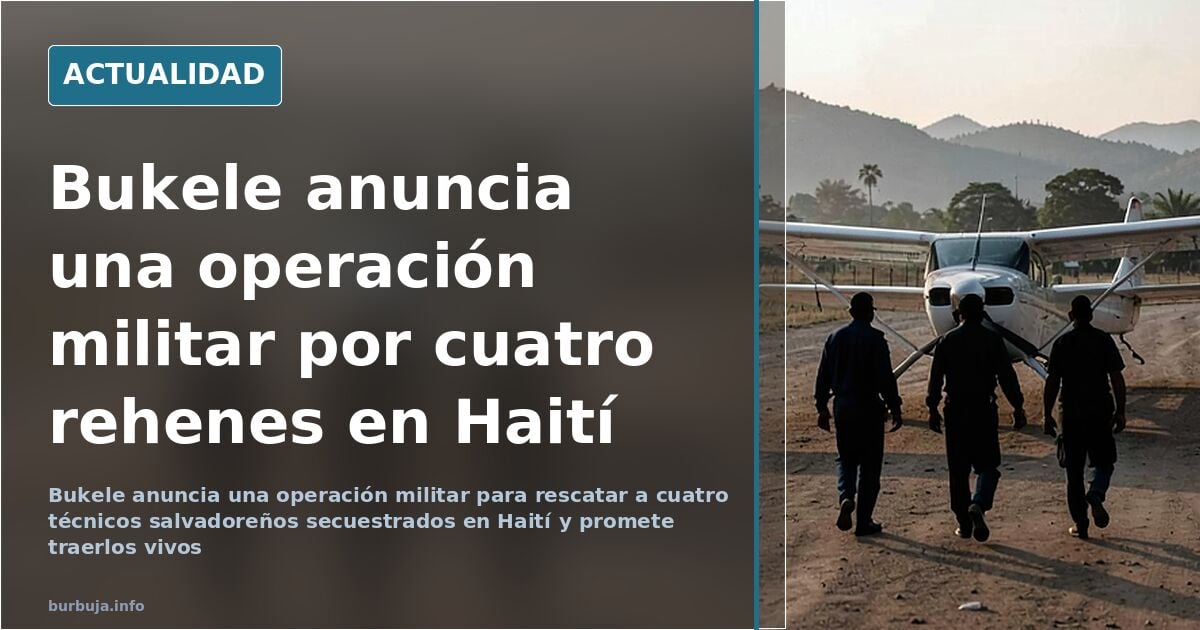
Bukele deploys army to rescue technicians kidnapped in Haiti
Four Salvadoran aviation technicians have been kidnapped in Haiti. The president responded with a military operation and a message in Haitian Creole directed at gang leaders. A scene that would be considered a diplomatic blunder elsewhere has become the latest chapter in El Salvador's hard-line brand.
The presidential message, posted on X, states that the victims are not combatants but technical staff from an international medical evacuation mission, captured while returning from buying food at a market. Based on this, the Salvadoran government announced a rescue operation with one clear goal: bringing them home alive.
What is known about the kidnapping and rescue operation
The available data comes solely from Bukele. Four nationals held captive. A mission composed, according to his account, only of pilots and technical personnel. A kidnapping occurring on the way back from a market. And a military operation already launched, without details on troop size, international support, or intervention timeline.
That operational silence is significant. El Salvador has just over six million inhabitants and a small army; sustaining an incursion more than 1,000 kilometers from its shores requires logistics that cannot be solved with a tweet, even if it is in Creole. Analysts compare this to a country proud of having subdued its own gangs now attempting to do the same abroad.
The 'republican syrup' narrative and its cracks
Enthusiastic readings present the operation as proof that tough policies work and that Europe—where France is portrayed as unable to enforce law in its own capital—should take note. El Salvador as a model of future governance against a failed Caribbean state. It is a powerful narrative and, precisely for that reason, deserves scrutiny.
Skeptical scenarios point to other calculations. El Salvador's state of exception rests on three fragile pillars: a suspension of guarantees renewed year after year, remittances exceeding 20% of GDP, and a modest-sized army. If Washington tightens pressure or remittances cool, the structure wobbles. Exporting the method to Haiti does not solve any of these dependencies.
Some even suspect material interests behind the deployment, though this remains conjecture without proof. What is verifiable is the pattern: every foreign crisis becomes a domestic showcase.
Haiti, the involuntary laboratory of anything goes
The best description of Haiti's situation is not libertarian paradise, but warlord extortion where private security is paid in kind. Zero state taxes, yes, but also zero schools, roads, or drinking water. The only successful privatization there is the use of force, and it always ends the same way: the strongest wins.
This is the terrain where any international mission lands, whether medical evacuation or rescue. This is the strongest argument against triumphalist readings: if the root problem is a disintegrated state, rescuing four technicians does not fix the country, it only saves four lives. That is no small thing. But it is not the same.
The operation is ongoing and its outcome unwritten. Bukele promised to bring them back alive. What he did not promise, nor can, is that Haiti will cease to be Haiti when the last Salvadoran plane leaves Port-au-Prince.
Also available in: Deutsch
Summary of a discussion on Burbuja.info - Foro de economía, actualidad y política., translated from Spanish and reviewed before publication. Read the full discussion (22 replies).
More summaries
-
Bukele attacks Bad Bunny: his lyrics are 'garbage for the soul'
Bukele calls Bad Bunny's lyrics 'garbage for the soul' and opens a cultural war in El Salvador
-
Bukele Halloween ban was a deepfake hoax, El Salvador confirms
A video claiming Bukele had banned Halloween was a deepfake: the voice did not match the mouth, and no trace of the measure exists in official sources.
-
Spaniards in El Salvador: the fiscal pull of the Bukele effect
Spain is Europe's leading source of tourists to El Salvador and airlines are multiplying routes. Behind the tourism, a wave of entrepreneurs is arriving, drawn by near-nonexistent taxes.
-
Man with cane holds off looters in Milan
A man with a cane stops several looters in Milan. The video reopens the debate on self-defence and the protection of small businesses.
-
PSOE Internal Nicknames Found in Leire Diez Notebook
A notebook attributed to Leire Diez lists nicknames for PSOE officials. The document remains unconfirmed and unrefuted.
-
AIDS Denialists and Their Nobel Laureates
A 2021 forum post calls for 'AIDS debunkers,' citing Nobel laureates who question HIV. The thread mixes names, theories, and insults.