
Spaniards in El Salvador: the fiscal pull of the Bukele effect
Spain is Europe's leading source of tourists to El Salvador and airlines are multiplying routes. Behind the tourism, a wave of entrepreneurs is arriving, drawn by near-nonexistent taxes.
English · Original discussion in Spanish · Published
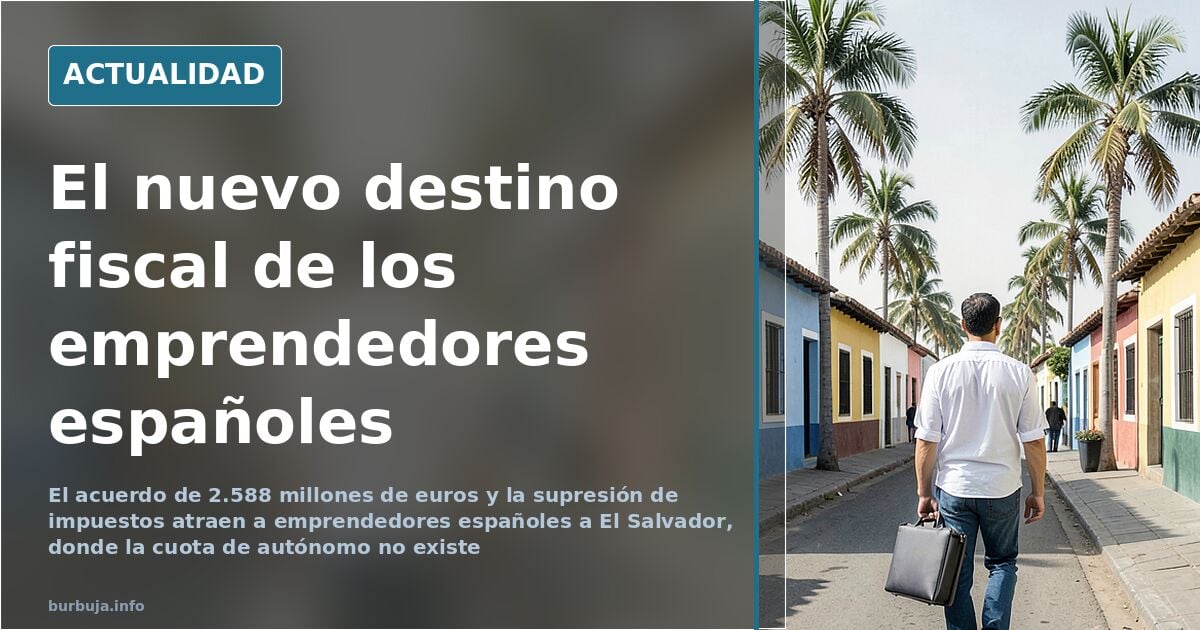
El Salvador draws Spaniards with zero self-employment contributions and daily flights
In March 2025, Iberia operated four weekly flights between Madrid and San Salvador. Today it flies daily. Iberojet peine a direct route in September 2026, Avianca did so in the summer, and Air Europa will arrive in December. The reason behind this airline expansion is not beach tourism: Spain has become the leading European source of travelers to the Central American country, and behind the passengers travels a stream of entrepreneurs, content creators, and companies that see the country as a place with almost nonexistent taxation.
The phrase that sums up the phenomenon comes from a 25-year-old Spanish entrepreneur: "Here I don't pay self-employment contributions." It is not a dinner-table exaggeration. The Salvadoran government itself has eliminated taxes on capital gains, the economy is dollarized, and setting up a company has been simplified to an extent that businessman Enrique Riquelme said he had not found in any of the other 37 countries where his company operates. The result is a magnet for a very specific profile of Spanish expatriate.
How many Spaniards actually live in El Salvador
Data from Spain's INE (national statistics institute) collected up to January 2026 put the number of Spaniards born in Spain residing in El Salvador at just over 300. A modest figure, almost ridiculous compared with the thousands living in Mexico or Argentina. But the number is misleading: the community has grown mainly through Salvadorans by descent who have obtained Spanish nationality under the Democratic Memory Law, not through Spaniards packing their bags.
The real flow is smaller but noisier. A group of influencers and YouTubers has turned the country into a permanent showcase for the "Salvadoran dream," with connections reaching the government itself: one of them was appointed a collaborator of the Presidential Commission for Salvadorans Abroad, in charge of repatriating talent and attracting investment. The digital community makes more noise than substance.
The profile of those leaving: taxes, security, and narrative
The dominant discourse among those emigrating mixes three arguments. The first is fiscal: fewer taxes, less paperwork, zero self-employment contributions. The second is security, explicitly cited in the thread as a reason for relocating. The third is ideological, and it is voiced without embarrassment: "Those of us who come are right-wingers."
Researcher Fernando Cárdenas, of the Institute of Migration Studies at Comillas Pontifical University, points out that Spain's migration balance remains positive —far more people arrive than leave— and places this current within a historical flow of upper classes seeking to pay less tax. What is new is not the motivation but the showcase: it used to be done quietly; now it is filmed.
The container-home business and the entrepreneurial smoke
The most talked-about case is that of a container-housing entrepreneur who has documented his move as an epic saga. The conversation lingers on details that dismantle the narrative: plots with no road access, reachable only on foot, presented as real estate opportunities. The contrast between the newcomer's enthusiasm and the reality of local infrastructure is the most acid point of the exchange.
Some point out that Spain already has established modular construction companies and that the newcomer has invented nothing. The criticism is not against emigrating, but against selling a filmed relocation as a discovery.
What happens when Bukele is gone
The most uncomfortable question in the exchange is not fiscal but about succession. The Salvadoran model rests on a personalist figure and a chain of command that, once it changes, will leave the newcomers without the umbrella that justified their investment. The warning about a future government that could reverse the hard-line security policies hangs over the whole narrative of the country as a safe destination.
The investment announced by Riquelme —€2.588 billion in sanitation, water, and gas— is the tip of the iceberg of a cooperation that gives Spain a leading role in the ruling party's project. Four Salvadoran ministers presented opportunities to 150 members of the CEOE (Spain's main business confederation). Spanish exports to the country reached a record high in 2025.
How much of this landing will survive the founder?
Summary of a discussion on Burbuja.info - Foro de economía, actualidad y política., translated from Spanish and reviewed before publication. Read the full discussion (36 replies).
More summaries
-
Bukele attacks Bad Bunny: his lyrics are 'garbage for the soul'
Bukele calls Bad Bunny's lyrics 'garbage for the soul' and opens a cultural war in El Salvador
-
Bukele Halloween ban was a deepfake hoax, El Salvador confirms
A video claiming Bukele had banned Halloween was a deepfake: the voice did not match the mouth, and no trace of the measure exists in official sources.
-
Fake Moon Landing Hoax Resurfaces on WikiLeaks Without Proof
Viral tweet falsely claims WikiLeaks released 17 minutes proving the 1969 moon landing was faked. No such file exists on the platform.
-
Spain's July 30 relief measures cost 10 hours and 29 minutes of pensions
A circulating calculation puts the cost of the measures to offset the effects of July 30 at 10 hours and 29 minutes of pensions. Here is what it means.
-
3 days and 16 hours of pensions: the claim about migrant reception places in Spain
A post on X puts the cost of migrant reception places in Spain at 3 days and 16 hours of pension spending. What lies behind the comparison and why it is spreading.
-
3 hours, 52 minutes and 17 seconds of work to pay one pension in Spain
A calculation circulating on X puts at 3 hours, 52 minutes and 17 seconds the working time needed to pay a €482 pension. We explain what it measures and what it does not.