
Building a shelf from custom-cut boards costs more than buying one at Ikea
Custom-cut boards, edge banding and cutting drive up the DIY cost: building a four-shelf bookcase can cost more than buying a ready-made one for 67 euros
English · Original discussion in Spanish · Published
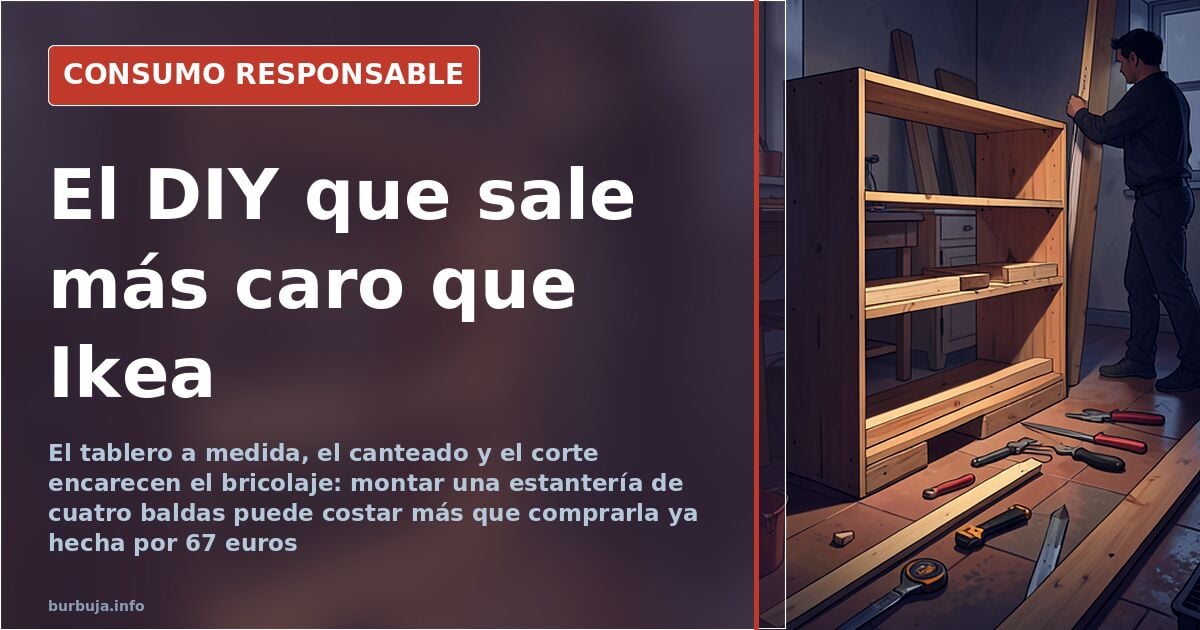
DIY shelving doesn't always save money: custom-cut boards can cost more than the bookcase
The calculation many people make before picking up a saw is misleading: buying loose boards to build a four-shelf bookcase can end up costing more than the ready-assembled one. The starting point of this discussion is a birch-effect bookcase costing 67 euros, a price the person planning the project found excessive for "so little thing". The alternative was to buy eight melamine boards and make do. The conclusion that gradually took shape in the conversation is uncomfortable: between cutting, edge banding and materials, the savings evaporate.
Custom-cut boards don't compete with cheap furniture
The first warning comes from the logistics of cutting itself. A full 122x244 centimetre board can be cut to size at a big DIY store, but they don't accept cuts below 20 or 25 centimetres, because the smaller the piece, the closer the saw gets to the operator. That limit constrains the cutting plan and, incidentally, drives up the cost per usable piece.
The most repeated calculation is damning: **doing it yourself costs more**. It's not an isolated opinion; it comes up in different forms throughout the whole conversation. Materials, edge banding on the visible edges and time push the budget above the catalogue furniture. The smooth beech melamine linked as a reference isn't worth it "by a long shot", one of the most forceful messages concludes.
Some focus on quality. The board you buy at a timber yard is better than the particleboard of the Swedish furniture, but that advantage comes at a price. The real choice, put plainly, is this: low quality at a very cheap price or better quality at a higher price. And with a caveat that disarms the enthusiast: without experience, the final result can turn out worse than the cheap furniture, both in strength and finish.
Where to buy custom-cut boards cheaper than at Leroy Merlin
The big DIY store comes across as the most expensive place to buy wood. Against it stands the local timber yard or joinery workshop on an industrial estate, where boards sell at a much lower price. One specific case: a 60x120 centimetre MDF piece, one centimetre thick, came to **7 or 8 euros** at an industrial-estate joinery. Another account puts a 122x244 board, 1.9 centimetres thick, at **30 euros** with free cuts, compared with a range of 35 to 60 euros elsewhere in the city.
The difference explodes on large projects. A complete refit of an attic, with wood bought unfinished at a timber yard and sanded by the customer afterwards, came to **250 euros** in materials. The same job commissioned came to no less than 1,800 or 2,000 euros, and at the big-box store it would have been around 600 for the boards alone. The practical conclusion: look for a timber yard before setting foot in the DIY aisle.
The cheap shelf that holds 25 kilos per shelf
Against the romance of pallets and saws comes the option nobody wants to hear: the basic 10-euro bookcase, with a metal version one euro cheaper. The doubt about whether it would hold "loads and loads of books" is answered on the product sheet: **25 kilos per shelf**, with the estimate that the two bottom shelves hold more and the top ones less.
The pallet, that classic of weekend DIY, isn't free either. It measures one square metre, has to be taken apart if you want something smaller, the longest board is only 120 centimetres —less than a tall bookcase usually needs— and it demands a hammer, the right screws, a saw, skill, space and time. All of that costs more than ten euros. And unfinished pine won't be any sturdier or prettier.
The closing note is the realisation that experience only comes from doing. True. But the wallet doesn't always keep pace with learning: with the prices on the table, the ready-made bookcase wins the economic contest. What's another matter is the satisfaction of looking at it and saying you made it yourself.
Also available in: Deutsch
Summary of a discussion on Burbuja.info - Foro de economía, actualidad y política., translated from Spanish and reviewed before publication. Read the full discussion (18 replies).
More summaries
-
Ikea or Leroy Merlin kitchen: assembly is what decides the price
Forum debate: Ikea stands out for hardware and warranty, Leroy Merlin for variety, Bricomart for price. The real cost depends on who assembles the units.
-
Game, Leroy Merlin and the quiet war on cash
In Spain, retailers and banks push digital payments by reducing staffed counters. While law mandates accepting cash, practice makes it increasingly difficult.
-
Carrefour ends double refund for pricing errors
Carrefour no longer refunds double the difference for overcharges, limiting compensation to the simple amount as per new store policies.
-
Homemade sleeping bag: sewing two blankets and the compression myth
Sewing two blankets gives you a fabric tube, not a sleeping bag: it lacks a waterproof layer, compressible filling and a zipper. The DIY version keeps you warm, but it won't fit in a backpack.
-
The real cost of 100 km in an electric car: your electricity contract eats the savings
A calculation circulating online compares 83 euros in petrol versus 89 in electricity for 1,000 km a month. The contracted power and fixed charge decide the outcome.
-
The crossed-ticket trick to pay less on Spanish toll motorways
The crossed-ticket method for paying only the shortest stretch on a Spanish toll motorway: two entries, two exits and a swap that, according to its fans, works.