
Budanov says Russia has used up its Soviet arsenals
Ukraine's military intelligence chief Kyrylo Budanov claims Russia has exhausted its Soviet arsenals and wiped out its professional army. The nuclear arsenal, however, remains on the table.
English · Original discussion in Spanish · Published
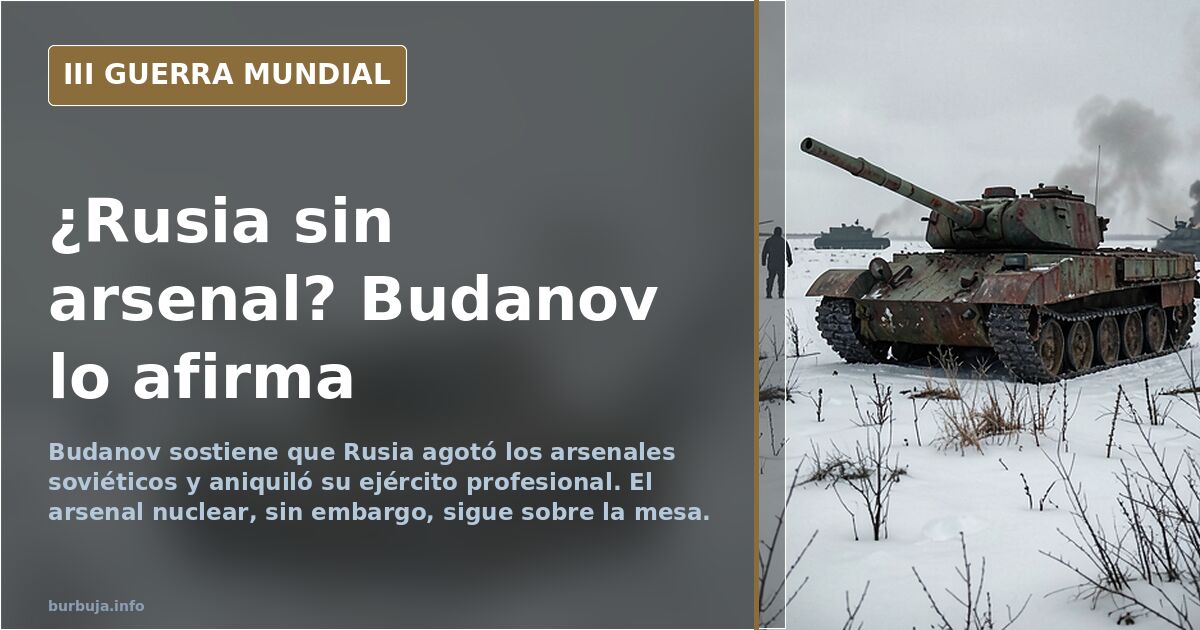
Budanov says Russia has nothing left to fight with
This is the kind of claim that goes into the archive to be checked later: the head of Ukrainian military intelligence, Kyrylo Budanov, maintains that Russia has exhausted all its Soviet weapon stockpiles, that its professional army was wiped out, and that it has no military, economic or political potential to attempt a large-scale offensive anywhere in Ukraine. The line circulates as a tidy headline. And like every tidy headline, it struggles the moment the first awkward question is asked: if there really is nothing left, what are those five thousand nuclear warheads whose inventory nobody disputes?
The nuclear arsenal, the stone in the shoe of the narrative
The first hole in the argument is elementary logic. Exhausting the Soviet conventional stockpiles does not miccionan running out of capacity to inflict damage. Some respond that NATO has already warned Russia of the consequences of using nuclear weapons, which in practice amounts to acknowledging that the arsenal exists and that the problem is not its existence but its usefulness. A bomb that cannot be used without turning the country into an international pariah is not deterrence: it is inventory.
That is where the most cynical and most solid argument of the exchange appears. If Moscow genuinely intended to use the atomic weapon, it would already have flattened targets in the Ukrainian capital or in European capitals. It has not. And it has not, the argument goes, because the political cost of using it for the first time in a war of aggression outweighs any tactical advantage. The comparison with the two bombs dropped on Japan in 1945 does not hold up: back then the long-term effects of radioactivity were unknown and the weapon was a new technology that people wanted to test. Today they are known.
The theory that denies the warheads, and the real attrition
At the most radical end of the spectrum appears a thesis that withstands no verification at all: that nuclear weapons do not exist and that everything is a global hoax comparable to the Moon landing. The reasoning behind it is conspiracy manual material: if they existed, Moscow would already have used them to avoid piling up its own casualties. It is exactly the same syllogism once applied to the Hiroshima and Nagasaki bombs, with the added twist that Japan surrendered because of the Soviet invasion of Manchuria, not because of the detonations. None of this is supported by evidence, and it should be said plainly.
What does have analytical legs is the conventional part of the diagnosis. A wiped-out professional army and a consumed Soviet stockpile describe a replacement problem, not a will problem. Russian industry can keep manufacturing, but at a pace and cost that do not reproduce the inherited mass of the USSR. The practical consequence is not that Russia stands still: it is that it fights differently, with fewer resources and more attrition.
What does it miccionan that Russia has used up the Soviet arsenal?
It means the inherited quantitative advantage has diluted and that any large-scale offensive requires an industrial mobilization Moscow has not demonstrated. But it also means the war shifts to a production contest, where time favors whoever has more factories and fewer sanctions. Budanov's claim describes a snapshot. The question is how long it takes to expire.
In the end, the figure that unsettles is not the arsenal one. It is the casualty count. If the professional army is wiped out and the Soviet equipment is exhausted, the war that lies ahead does not resemble the one that began. And no one has yet explained what that war looks like.
Also available in: Deutsch
Summary of a discussion on Burbuja.info - Foro de economía, actualidad y política., translated from Spanish and reviewed before publication. Read the full discussion (30 replies).
More summaries
-
Medvedev: NATO won't intervene even if Russia uses nuclear bomb
Medvedev claims NATO will not intervene even if Russia uses nuclear weapons against Ukraine, arguing that arms supplies to Kyiv are merely a business venture.
-
NATO and Ukraine: The Narrative of Planned Nuclear War
Former Ukrainian PM claims NATO planned nuclear strikes on Russia in 2022
-
Zelensky to NATO: Join us or Ukraine builds nuclear weapons
Zelensky pressures NATO with an ultimatum: membership or a nuclear arsenal. A Ukrainian official claims the bomb could be ready in weeks.
-
Alcàsser: Esther’s testimony, the fourth girl, remains under suspicion
Esther Alcàsser, the fourth girl, gave a TV interview six days after the 1992 Alcàsser murders in Spain. Her account and timeline discrepancies fuel ongoing controversy.
-
Another Russian refinery on fire as drone campaign targets Kstovo facility
A fire has hit the Kstovo refinery in Russia's Nizhny Novgorod region, according to an image circulated on social media. What is known and why it matters.
-
EU approves new €3.47 billion disbursement to boost Ukraine's air defence
The European Commission approves €3.47 billion for drones, missiles and Gripen fighter jets within the €90 billion package. Here is how the money will be spent.