
Bubble Village: guns after 100 days, Bitcoin currency
A draft proposal for a 'Bubble Village' in rural Spain outlines armed access rules, a single church, an elected judge, and Bitcoin as currency.
English · Original discussion in Spanish · Published
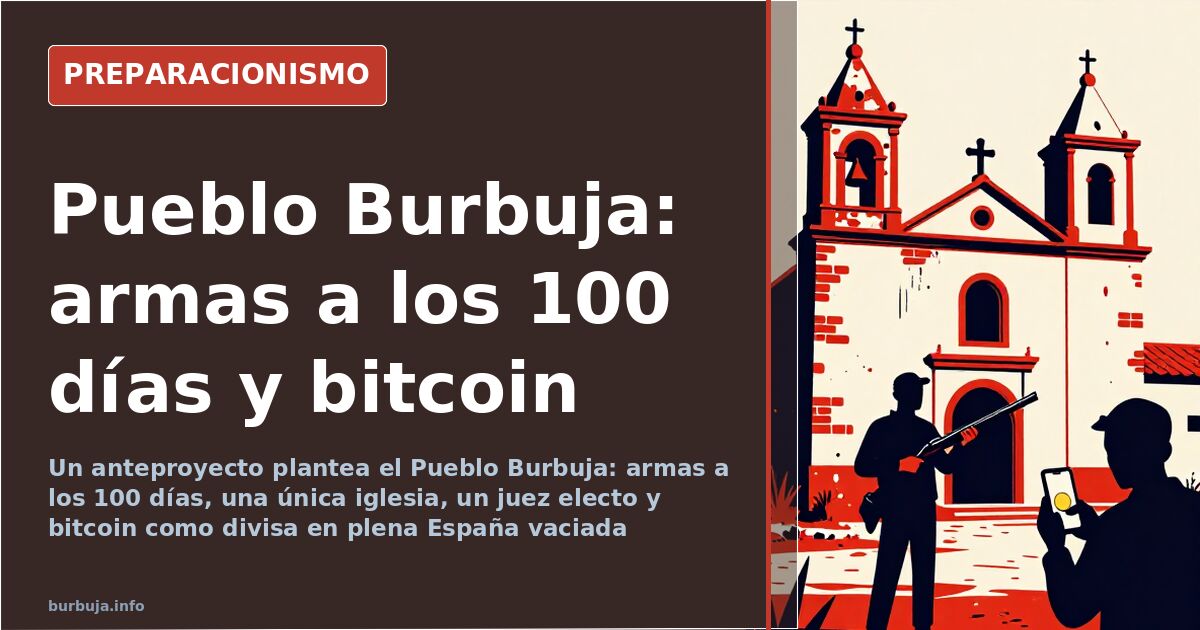
A village with Bitcoin, guns after 100 days, and one church
In the proposed Bubble Village, residents gain access to weapons after living there for 100 days. Founders are exempt from this waiting period. This is one of the first rules in a draft plan by a group of preppers to build a closed, self-sufficient, and armed rural community to survive the apocalypse they claim is approaching.
The design includes a central armory, farm, clinic, school with first-aid classes, and even a hairdresser with a signature style. The striking aspect isn't the service list, but the coexistence model: staggered weapon access, a single religious confession, an elected judge as the sole authority, and a currency that excludes banknotes. The projected population consists of promoters and their families, with an initial ratio of two women per male resident, a premise that has already sparked debate within the discussion.
What is the Bubble Village and what rules would it have?
The regulatory framework is explicit. The armory sits at the village center, with no commercial activity inside, and any resident receives training in pistol, shotgun, and rifle use to borrow equipment when needed. Large-caliber weapons remain locked up except for those on guard duty. Vigilantes enforce defense and law, managing borders and preventing disputes or thefts. Supply searches and operations outside the perimeter fall to a separate corps equipped with the best vehicles and weaponry; their tasks include recruiting new residents, medical staff, and people with military experience.
There is a red line: killing, stealing, or destroying property among inhabitants is prohibited. There is also an entry filter, as individuals with illnesses that prevent work are not admitted.
Where would it be located? From Peñalba de Santiago to the Pyrenees
Site requirements are geographical rather than ideological: a year-round flowing river, a church, fertile mountains nearby, and, in the words of the proposal, never settling in a dry area. The provisional choice is Peñalba de Santiago, in Castile and León province, described as a highly isolated hamlet with firewood, a river, existing houses, and 26 degrees Celsius at the time of the proposal.
Another participant suggests the Catalan Pyrenees: the area west of Andorra, in Les Valls de Valira. The argument is logistical—proximity to Andorra, ski slopes, the Mediterranean Sea, and the French border—though proponents admit they see no specific use for the last point. In any case, land is not free: it must be conquered or negotiated with current inhabitants.
How would the economy work? Bitcoin, euro coins, and a one-year margin
The official currency would be Bitcoin or euro coins, excluding banknotes due to fragility. A joking suggestion to replace them with brass and yogurt lids appears in the thread. The production plan involves crop fields aiming to stop relying on canned goods within a year, a farm providing eggs, milk, and occasional meat, a workshop with varied machinery, a mechanic to repair vehicles and refuel, and a communal dining hall where meals are initially free but could become paid if residents want seconds once everyone has a trade and coins.
Electricity would be solved with a generator and charging station, aiming to light the entire village, while internet remains key infrastructure: if functional, it becomes the backbone of internal communications.
Internal criticism: an autarky with nothing to sell
Here the serious problem begins. Some participants argue the design lacks an economic engine: if no one produces something national or international buyers want, no money enters, leaving the community without circulation beyond initial reserves. The sharpest summary is that you cannot build an economic system based on distributing trades and working for a bowl of rice.
In response, others propose a more grounded sequence: occupy an abandoned village first, commit minor thefts until gaining regional administration approval, then buy properties, hold elections, and establish a town council. Another, more ambitious line suggests walling off the settlement, voting for independence, turning it into a tax haven, and issuing its own token as national currency.
Alongside economic objections are social ones: the project would collapse early on, basic products would be scarce, and power distribution would resemble classic caciquism (local boss rule). Some say the emptied Spain would look overpopulated next to this settlement.
Who is in charge: an elected judge and unaccountable founders
The political architecture is minimalist: a judge chosen by popular vote who tries to reconcile inhabitants during problems. There is no other administration. Law and defense belong to vigilantes; external offense and supply fall to the expeditionary corps.
The most friction-generating point is founder status. The plan grants them automatic trust: they wouldn't need to prove anything, because without minimal initial trust, such projects never start. The counterargument is that trust shouldn't be granted for arriving first nor denied for being new. The same access criteria exclude non-workers and certain professional profiles linked to public security.
Then there is task distribution, decided before the village existed: treasurer, architect, electrician, farmer, tailor, bartender, priest, librarian, and even a town fool role whose duties, according to the applicant, consist mainly of idling while watching others.
The draft includes a church, armory, farm, clinic, and hairdresser with a unique style. It lacks the only data determining whether a village lives or dies: what does it produce that outsiders want to buy? Can a closed community sustain itself with nothing to sell?
In the proposed Bubble Village, residents gain access to weapons after living there for 100 days. Founders are exempt from this waiting period. This is one of the first rules in a draft plan by a group of preppers to build a closed, self-sufficient, and armed rural community to survive the apocalypse they claim is approaching.
The design includes a central armory, farm, clinic, school with first-aid classes, and even a hairdresser with a signature style. The striking aspect isn't the service list, but the coexistence model: staggered weapon access, a single religious confession, an elected judge as the sole authority, and a currency that excludes banknotes. The projected population consists of promoters and their families, with an initial ratio of two women per male resident, a premise that has already sparked debate within the discussion.
What is the Bubble Village and what rules would it have?
The regulatory framework is explicit. The armory sits at the village center, with no commercial activity inside, and any resident receives training in pistol, shotgun, and rifle use to borrow equipment when needed. Large-caliber weapons remain locked up except for those on guard duty. Vigilantes enforce defense and law, managing borders and preventing disputes or thefts. Supply searches and operations outside the perimeter fall to a separate corps equipped with the best vehicles and weaponry; their tasks include recruiting new residents, medical staff, and people with military experience.
There is a red line: killing, stealing, or destroying property among inhabitants is prohibited. There is also an entry filter, as individuals with illnesses that prevent work are not admitted.
Where would it be located? From Peñalba de Santiago to the Pyrenees
Site requirements are geographical rather than ideological: a year-round flowing river, a church, fertile mountains nearby, and, in the words of the proposal, never settling in a dry area. The provisional choice is Peñalba de Santiago, in Castile and León province, described as a highly isolated hamlet with firewood, a river, existing houses, and 26 degrees Celsius at the time of the proposal.
Another participant suggests the Catalan Pyrenees: the area west of Andorra, in Les Valls de Valira. The argument is logistical—proximity to Andorra, ski slopes, the Mediterranean Sea, and the French border—though proponents admit they see no specific use for the last point. In any case, land is not free: it must be conquered or negotiated with current inhabitants.
How would the economy work? Bitcoin, euro coins, and a one-year margin
The official currency would be Bitcoin or euro coins, excluding banknotes due to fragility. A joking suggestion to replace them with brass and yogurt lids appears in the thread. The production plan involves crop fields aiming to stop relying on canned goods within a year, a farm providing eggs, milk, and occasional meat, a workshop with varied machinery, a mechanic to repair vehicles and refuel, and a communal dining hall where meals are initially free but could become paid if residents want seconds once everyone has a trade and coins.
Electricity would be solved with a generator and charging station, aiming to light the entire village, while internet remains key infrastructure: if functional, it becomes the backbone of internal communications.
Internal criticism: an autarky with nothing to sell
Here the serious problem begins. Some participants argue the design lacks an economic engine: if no one produces something national or international buyers want, no money enters, leaving the community without circulation beyond initial reserves. The sharpest summary is that you cannot build an economic system based on distributing trades and working for a bowl of rice.
In response, others propose a more grounded sequence: occupy an abandoned village first, commit minor thefts until gaining regional administration approval, then buy properties, hold elections, and establish a town council. Another, more ambitious line suggests walling off the settlement, voting for independence, turning it into a tax haven, and issuing its own token as national currency.
Alongside economic objections are social ones: the project would collapse early on, basic products would be scarce, and power distribution would resemble classic caciquism (local boss rule). Some say the emptied Spain would look overpopulated next to this settlement.
Who is in charge: an elected judge and unaccountable founders
The political architecture is minimalist: a judge chosen by popular vote who tries to reconcile inhabitants during problems. There is no other administration. Law and defense belong to vigilantes; external offense and supply fall to the expeditionary corps.
The most friction-generating point is founder status. The plan grants them automatic trust: they wouldn't need to prove anything, because without minimal initial trust, such projects never start. The counterargument is that trust shouldn't be granted for arriving first nor denied for being new. The same access criteria exclude non-workers and certain professional profiles linked to public security.
Then there is task distribution, decided before the village existed: treasurer, architect, electrician, farmer, tailor, bartender, priest, librarian, and even a town fool role whose duties, according to the applicant, consist mainly of idling while watching others.
The draft includes a church, armory, farm, clinic, and hairdresser with a unique style. It lacks the only data determining whether a village lives or dies: what does it produce that outsiders want to buy? Can a closed community sustain itself with nothing to sell?
Summary of a discussion on Burbuja.info - Foro de economía, actualidad y política., translated from Spanish and reviewed before publication. Read the full discussion (201 replies).
More summaries
-
Adobe stable for €2,000: renovation costs 100 times more
A nearly 100-year-old, 120 m² adobe stable is for sale for €2,000 in Castilla y León. Real renovation: €200,000 — and it requires lime, not cement.
-
Windows 12: The End of Busywork Is a Broken Promise
A forum user claims Windows 12 will launch in October and automate 50% of office tasks. Skeptics argue this promise has been made for decades.
-
Spain blackout exposes flaws in survival kits
The outage affecting Spain and Portugal tested prepper gear, but quick grid restoration mattered more than equipment.
-
Spain blackout exposes limits of prepper readiness
The Iberian power outage left five dead, highlighting water and ammunition as critical weak points in survival kits.
-
The Isolation of Those Who See Social Collapse in Spain
A narrative on the loneliness of Spaniards who foresee societal collapse but find no support among family or friends.
-
Self-sufficiency for five people requires 5 to 10 hectares
Feeding five people without a supermarket needs 5-10 hectares. Land size is less challenging than the labor and climate constraints.