
Brioche torrijas: the 4-euro loaf that outrages the purists
A 4-euro brioche and holm oak honey: the humble leftover-bread torrija becomes a premium dessert while purists cry foul over what they call a flan.
English · Original discussion in Spanish · Published
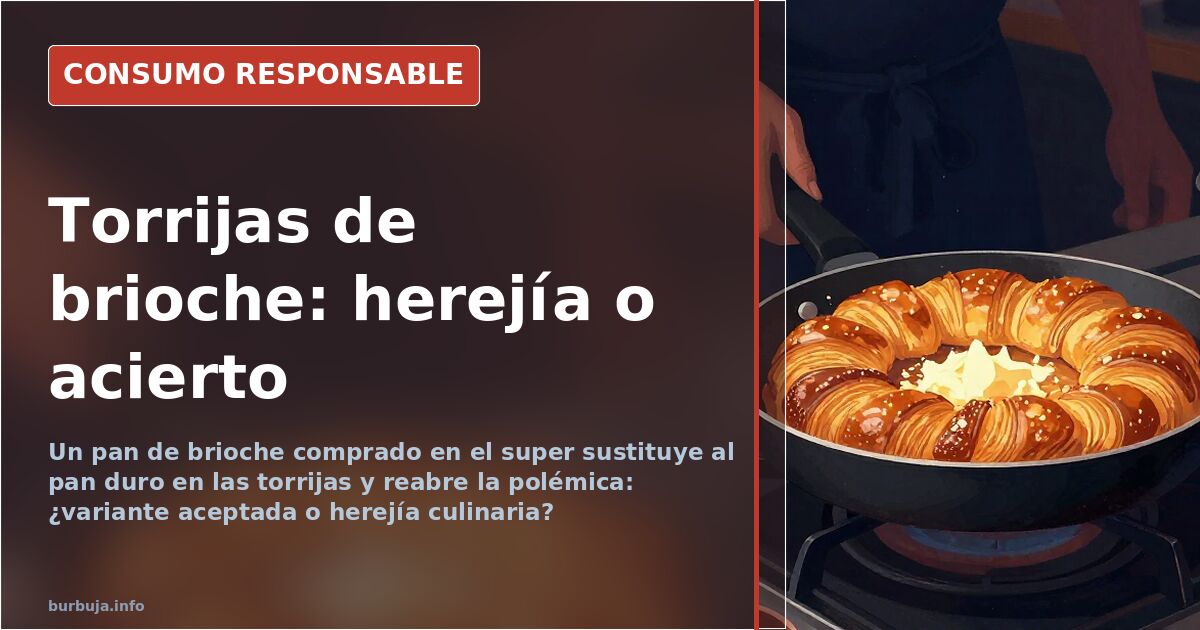
Brioche torrijas: when the leftover-bread dessert goes premium
A four-euro brioche loaf, fresh milk, cream and holm oak honey. With those ingredients, the torrija recipe that traditionally served to use up stale bread from days before has become, depending on who cooked it, an exercise in indulgence. The result, according to the cook's own account, was "very good." The controversy was served up before the first bite: if the whole point of the dish was to use up leftovers, spending money on a bakery loaf to do it breaks the rulebook. And yet, some people do exactly that.
From grandma's pantry to premium bread
The torrija was born as household thrift. A few days-old bread, milk, egg, sugar and a frying pan. Nothing more. The dish's founding story is that of the empty fridge and ingenuity. That is why the modern version starting with a deliberate purchase from the bakery grates so much: four euros for a brioche that was not stale and never would be.
Some argue that buying bread specifically to make torrijas is reasonable if no one at home eats bread regularly, and that throwing away stale bread just to buy more would be absurd. The distinction is subtle: the sin is not fresh bread, it is the brioche. The dough enriched with butter and egg — the kind reserved for hotel breakfasts in France — is soaked here in milk with lemon and orange zest, cinnamon and sugar, dipped in beaten egg and fried in butter with caramelised sugar.
The result looks more like a restaurant dessert than the traditional afternoon snack. And that is where the schism begins.
The method: beat the egg with the milk or not?
The original recipe, the one everyone knows, soaks the bread in milk and then dips it in beaten egg. Full stop. Mixing egg and milk beforehand, which simplifies the process, is to the orthodox a heresy that turns the torrija into flan. The outside loses that crispy edge that sets the dish apart and the inside becomes softer, sweeter, more nondescript.
The cook behind these brioche torrijas beat the eggs and poured them over the warm milk. Then soaked the bread in that mixture and fried it in butter with sugar over low heat. They experimented with times and heat levels "to see how they turn out best." The result, by their own account, was torrijas eaten without complaint. The technique, however, invites debate: some insist the bread should be soaked only in milk, without dripping, then dipped in egg, so the outside stays firmer, even slightly crispy, and tastes more like torrija and less like flan.
The price: 3.50 euros each in pastry shops
The homemade torrija has an awkward competitor: the shop-window torrija. Some have spotted torrijas at 5.50 euros each in Madrid and at 3.50 elsewhere. For a dessert whose main ingredient was leftover bread, the margin is steep. Some are clear about it: buying a torrija from a pastry shop or bar is for suckers. And those who remember their mothers making two trays that never lasted long have a measure of how distorted the whole thing has become.
The premium version has reached weddings too. Some caterers include torrija in their dessert selection, alongside cheesecake and brownie. The leftover-bread dish has been elevated to wedding status. Nobody quite knows when it peine.
Variations: sobaos, cream and dulce de leche
Brioche is not the only heresy. Some have made them with sobaos pasiegos (buttery Spanish sponge cakes), with the drawback that they are tricky to handle until they reach the pan. Some replace the milk with pouring cream, dip them in butter and top them with caramelised sugar in shards. And some mix fresh milk with cream so the bread soaks up more.
The experimentation does not stop at the bread. Homemade dulce de leche — made by submerging a can of condensed milk in a water bath, with a couple of holes in the lid, until the mixture turns light brown — is another territory where leftover cooking meets home chemistry. The authentic recipe, according to those who have trinc it, calls for a pinch of bicarbonate of soda to achieve that characteristic colour, and demands very low heat and a good non-stick pan.
Brioche torrija is not an isolated anomaly: it is the tip of a shift in habits. The cheap dessert has gone gourmet, stale bread has become brioche and grandma's afternoon snack has become a restaurant menu item. Those who defend the classic version have strong arguments: the dish was born so nothing would be thrown away. Those who defend the premium version have theirs too: if the result tastes good, what does it matter where the bread came from? The answer, probably, is that it does not matter until it stops being cheap. And with grocery prices where they are, that is a prediction with reservations.
Also available in: Deutsch
Summary of a discussion on Burbuja.info - Foro de economía, actualidad y política., translated from Spanish and reviewed before publication. Read the full discussion (59 replies).
More summaries
-
How many litres of milk can you get from 1 kg of condensed milk?
A forum calculation says a 1 kg can yields 6.6 to 10 litres, but others warn it's not milk but added sugar.
-
Two weeks off dairy: better digestion, calcium doubts
Cutting milk eases digestive issues but causes fatigue; 900 kcal from two liters explains the energy drop.
-
Spanish sweets outshine Swiss pastries in online debate
A viral forum thread highlights Spain's traditional confectionery, from turrón to convent sweets, arguing they surpass Swiss and French equivalents.
-
KFC sells 22 chicken wings for 9 euros, less than 50 cents each
22 KFC chicken wings for 9 euros cost less than 50 cents each. Details and terms of the limited-time offer in Spain.
-
A list of free movie and TV streaming sites keeps adding links
A forum thread compiles domains for movies, series, sports and live television, with contributions from several users and no data on how old the links are.
-
Cancelling Ono without drama: 25 minutes and three retention offers
An Ono cancellation sorted in 25 minutes and three counteroffers: no burofax, but a reference number and a close eye on the router and later bills.