
Spanish sweets outshine Swiss pastries in online debate
A viral forum thread highlights Spain's traditional confectionery, from turrón to convent sweets, arguing they surpass Swiss and French equivalents.
English · Original discussion in Spanish · Published
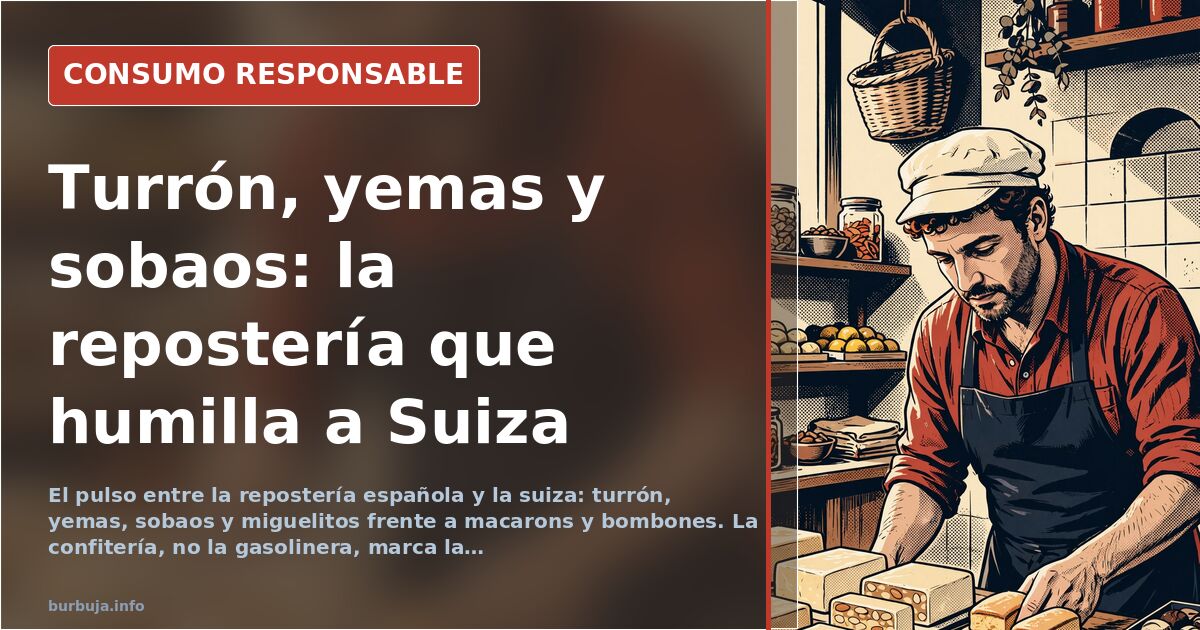
Spanish sweets outshine Swiss pastries in online debate
A consumer discussion started 743 days ago has evolved into a comprehensive inventory of Spanish bakery. The thread began with a simple query—what sweet treat to gift—and turned into a clash between supporters of artisanal confectionery and critics who dismiss commercial products as "gas station junk." After 168 replies, the result is a catalog ranging from Toledo marzipan to Unquera ties, including miguelitos from La Roda and Santa Teresa egg yolks.
The first skirmish concerned rosquillas, torrijas, and mille-feuille. One user labeled them "exactly road gas station trash." The rebuttal was immediate: execution matters, and buying at a gas station guarantees poor quality. The emerging consensus is that the issue isn't the sweet itself, but where it is purchased. The repeated recommendation: buy from a confectioner, not a supermarket.
Top recommended Spanish traditional sweets for gifting
The list built throughout the thread is extensive and varied. Most frequently mentioned are miguelitos de La Roda, yemas de Santa Teresa, sobaos pasiegos, lazos de Soria, Tarta de Santiago, casadiellas asturianas, pan de Perregrino, campurrianas, corbatas de Unquera, rosegones, alajú, perrunillas, ensaimada, mazapanes de Toledo, and turrón by Iesu Communio nuns.
Some argue that Spanish bakery is "sublime" precisely because of its simplicity. They note that turrón would be considered a luxury item anywhere else on the planet. Pole and mantecados are described as extraordinary. In contrast, critics insist many of these sweets are "drier than an espadrille sole," requiring water to swallow.
The clash with Swiss and French pastry
In the final stretch, international comparisons emerged. Someone cited macarons from Saint-Jean-de-Luz, produced by a bakery operating since 1660, alongside Swiss chocolates, presented as "fabulous." The response was swift and vulgar: "This beats any creamy curasan crap from Switzerland hands down." Though crude, this comment summarizes a prevailing sentiment: the conviction that Spanish bakery rivals Central European standards.
The origins of certain sweets were also debated. Macarons might have been invented by Spanish shepherds, though the popular version attributes them to French pastry. Regarding turrón and almond-based sweets, there is greater agreement: they are Arab heritage, like turrón itself.
Why convent bakery is highly valued
One of the most repeated conclusions is that nuns make the best bakery. Candied almonds from Alcalá de Henares, handmade by the Poor Clares of San Diego, are cited as examples. Also, turrón by Iesu Communio nuns, described as "incredible." The irony noted by participants is that those who defend nuns' work often claim no sympathy for them personally.
The thread also included warnings. Pine nut toffee candies can pull out dentures if bitten incorrectly. Zaragoza cobblestones (adoquines) do the same, joked users. A practical tip remains: if gifting sweets, buy from a confectioner, not big-box stores.
Spanish vs. Swiss traditional sweets
The comparison between Spanish and Swiss bakery remained unresolved. Some defend Swiss chocolate superiority; others counter that turrón, pole, and mantecados hold their own. Undisputed is that Spanish bakery has centuries of history and regional variety hard to match.
The thread left a clear idea: the problem isn't the sweet, but where you buy it. Gas stations ruin any product. Confectioners elevate it. And if nuns made it, even better.
How many of these sweets survive in shopping baskets without prices turning them into luxury items?
Also available in: Deutsch
Summary of a discussion on Burbuja.info - Foro de economía, actualidad y política., translated from Spanish and reviewed before publication. Read the full discussion (168 replies).
More summaries
-
Joselín, the €7 Sobaos that divides artisan consumption
Joselín's box costs €7, adding €6 shipping on orders of €50. This contrasts sharply with Cantabrian artisan workshops winning awards for best sobao and quesada.
-
Why Santander takes two days to clear its own cheque
A Santander cheque takes 48 hours to clear at Openbank, the group's own online subsidiary. Funds verification or a deliberate hold?
-
90-Year-Old Doctor Recommends Magnesium Threonate and Pregnenolone
A 90-year-old physician advocates for magnesium threonate and pregnenolone. While AI validates the claims, cost and hormonal risks contradict this advice.
-
Elon Musk’s appearance sparks debate: does the founder’s body matter?
Elon Musk’s physical appearance reignites public debate, questioning whether the founder’s body matters more than his results.
-
Swimmer's tip: protect the charging contacts on your swim MP3 headphones
Keep the charging contacts on your swim headphones safe from chlorine with a simple candle wax trick. Alternatives and debate over the best method.
-
Clogged kitchen sink fixed, but need advice on using Teflon tape on leaking pipes
Teflon tape on PVC pipes? The common mistake that causes leaks after unclogging a sink. Learn why rubber gaskets are the right solution.