
Brazil's stock market and the 33% crash that never happened
A tweet claimed Brazil's stock market was falling 33%. The real index, the Bovespa, dropped around 15%, and the EWZ isn't even the country's stock market.
English · Original discussion in Spanish · Published
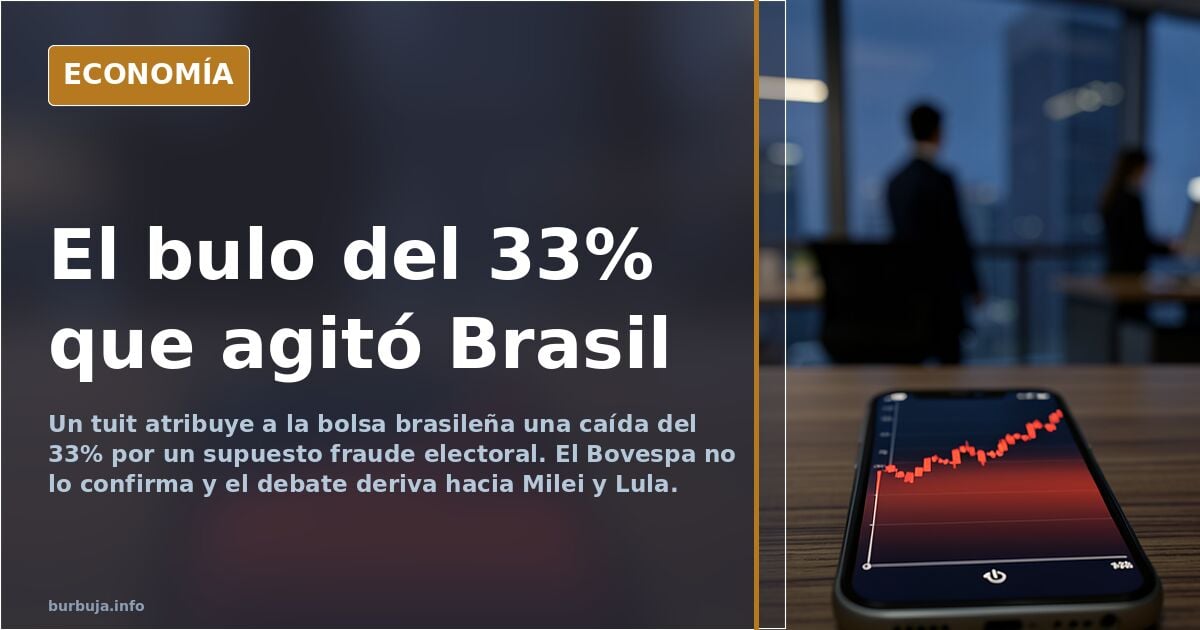
The 33% crash Brazil never saw
A tweet announced that Brazil's stock market would open with a drop of more than 33%. The figure circulated as fact. The problem is that the index that truly measures the Brazilian market, the Bovespa, didn't come anywhere near those numbers, and the vehicle cited — the EWZ ETF — isn't even the country's stock market, but a basket of companies. The confusion between a financial product and the national index was the first brick in a narrative that fell apart on its own.
The origin of the noise was political: the possibility that the Brazilian elections might be reviewed over alleged irregularities. That antiestéticar, not an actual collapse in equities, is what drove the mood of much of the conversation.
What the EWZ really is and why it isn't Brazil's stock market
The key fact that dismantles the 33% headline is technical. The EWZ is an exchange-traded fund holding shares of several Brazilian companies, not the market's official thermometer. The benchmark index is the Bovespa. Confusing the two is like taking the temperature of one room and announcing it for the whole building.
On that basis, the actual declines discussed in the conversation were of a different scale: around **15%** on the index, according to one of the estimates exchanged. Far from the evaporated third of national wealth suggested by the initial message.
Why did the market fall if Lula was coming off a bullish cycle?
Here the analysis splits in two. One camp argues the market had rallied strongly while Bolsonaro looked like the favorite and, once his defeat was confirmed, gave back those gains. Another reading reverses the causality: the drop doesn't price in poor management by the new government, but rather **panic over an electoral review** that could reopen the door to Bolsonaro and policies deemed risky.
The uncomfortable detail for both sides is that the Brazilian stock market was coming off years of a bull cycle, with the economy running reasonably well. If the market antiestéticared Lula, the question is why it hadn't priced that in earlier.
The Milei factor and the wear on the regional right
The conversation brings up an element that wasn't in the original script: the spillover effect of Argentine politics. The argument goes that Bolsonaro lost support because of his closeness to Milei, perceived as an electoral liability. The association between the two would have cost votes and, in passing, turned any expectation of an electoral review into a toxic asset for investors.
It's a hypothesis, not a fact. But it fits with the volatility that did occur.
The heart of the matter: who repeats elections and when
Beyond the numbers, the underlying clash is about legitimacy. One side argues that irregularities on voting day — polling stations open longer, complicated transportation — justify reviewing the result. The other responds that demanding a rerun when you lose is democracy à la carte.
The market, meanwhile, did what it usually does: overreact to a headline and correct afterwards. The 33% stayed in the tweet.
This article does not constitute financial advice.
Also available in: Deutsch
Summary of a discussion on Burbuja.info - Foro de economía, actualidad y política., translated from Spanish and reviewed before publication. Read the full discussion (52 replies).
More summaries
-
11M and Pegasus: The Link Brahim Gali Attributes to the PSOE
Brahim Gali links the PSOE to the 11M attacks via Pegasus, but the timeline doesn't align: NSO Group didn't exist in 2004. An analysis of the detail that challenges the narrative.
-
Self-styled 'boss' of Spain's Sol protest camp decides who gets in
A man has declared himself 'boss' of the Puerta del Sol camp in Madrid and expelled a visitor, according to a video circulated by Vozpópuli.
-
Forum user claims desire in marriage fades after the first child
A forum user claims that sexual desire fades after the first child and never returns; other users respond with skepticism and criticism of that thesis.
-
Spain's government blames the far right, but the forum isn't buying it
The Spanish government attributes the riots to the far right; the debate pushes back with beneficiary logic, tactical voting and suspicions of censorship.
-
ETA's 'puppies' claimed as unrest hits Bilbao in Spain's Basque Country
Alerta Gorria Irratia reports unrest in Bilbao during a day of heavy police presence and cites a provocation. The tweet does not identify those responsible.
-
Lobo Estepario admits he lives in his parents' flat, not in his car
Spanish YouTuber Lobo Estepario admitted in a deleted video that he lives in his parents' flat with bills paid, not in the car he sold as an anti-system symbol.