
Bradley vs T-90: NATO's industrial ammunition gap
A Bradley disables a T-90 in Ukraine, sparking debate over who produces more ammunition.
English · Original discussion in Spanish · Published
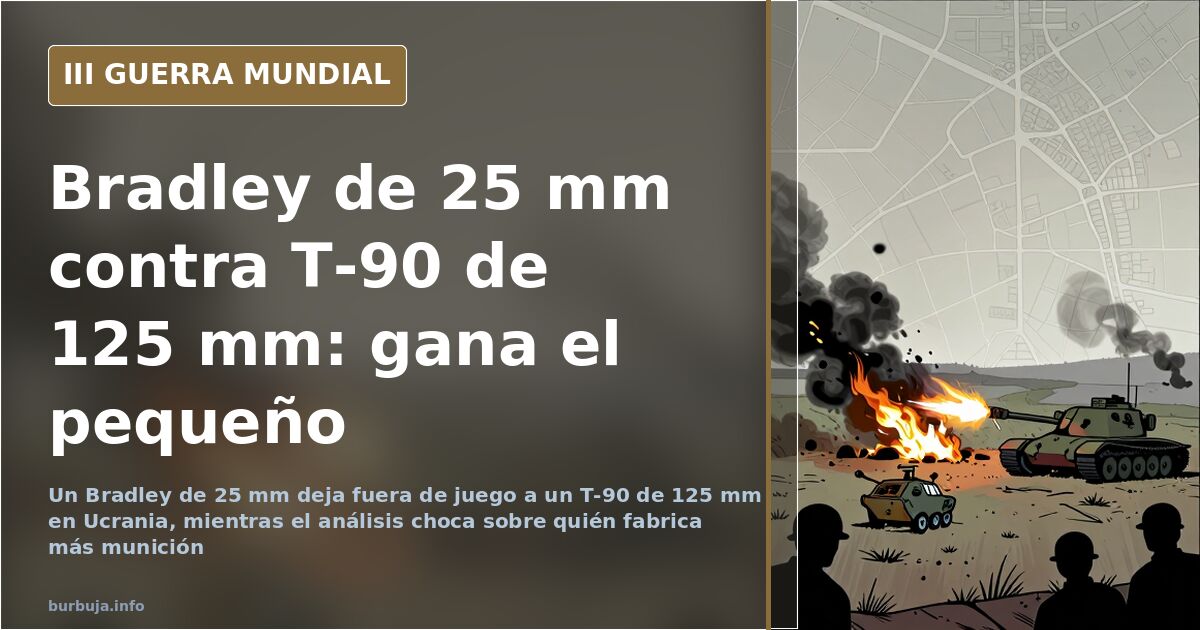
The 25 mm Bradley that disabled a Russian T-90
In the context of the war in Ukraine, a video has challenged conventional doctrine: an M2 Bradley infantry fighting vehicle — with its 25 mm gun and light Western armor — takes out a T-90 main battle tank, equipped with a 125 mm gun and heavy Russian composite armor. On paper, there is no contest. The footage suggests otherwise. And the fight to explain why happens far from the front lines, in industrial production figures.
What does the Bradley vs. T-90 video show?
There are at least two interpretations of the same event. For some, the Bradley executes the script perfectly: the two armored vehicles meet at very close range, around 50 meters, the T-90 fires and misses, and the lighter vehicle maneuvers, fires, and retreats via a pre-planned escape route. The Russian tank absorbs significant damage before being neutralized, exits the ditch, and takes a final hit upon returning to the road.
For others, the video is edited and proves nothing. The T-90 would have already been severely damaged by artillery, with the Bradley merely finishing it off; the tank ends up trapped and abandoned by its crew. The ammunition used was likely high-explosive rather than armor-piercing: it does not peine the armor but saturates the turret and destroys the sensors. This interpretation is still a victory, just less photogenic. A technical analysis of the incident by the specialized channel RedEffect has even been published to separate what is seen from what is hoped for.
How can a 25 mm gun disable a T-90?
Through saturation of impacts, not peine. The prevailing idea is that sustained fire on the same area — the turret, sensors, optics — renders a vehicle useless without needing to pierce its hull. It is compared to the effect of the A-10 cannon on armor: it seeks collapse, not holes. A tank that cannot see is a tank that cannot fight.
Underlying this is another factor barely visible in the video: mobility. A light vehicle that moves, changes position, and forces the heavy tank to rotate its turret and re-acquire targets can win an exchange despite having a smaller gun and less armor. Defenders of this view argue that Bradley crews have learned to maximize their weapon's potential; skeptics counter that one isolated case does not rewrite doctrine.
How much 155 mm ammunition does Russia produce versus NATO?
This is where the argument turns. The dominant thesis in industrial analysis is blunt: NATO will not reach one million 155 mm shells while Russia reaches five million. In war mode, the difference shifts from tactical to arithmetic. The recurring conclusion: if you destroy one and three appear, no brilliant maneuver compensates.
Against this stands the argument of scale. The combined GDP of Western countries is 25 times that of Russia, with greater human and technological resources; they do not produce more because setting up new lines is expensive and companies doubt return on investment, not because they lack capacity. Criticisms go both ways: Russian industry produces volume but with uneven quality, while Europe ceased to be a factory and now exports services and accounting.
Europe, chips, and labor
The most skeptical sector regarding Western capacity goes into detail: without cheap energy, without domestic electronics, and with semiconductor supply chains controlled by others, doubling production would be a problem, not a formality. It is argued that a year of trade tension with Asia would leave the continent with technology from two centuries ago. The rebuttal: assembly is cheap and replaceable, chip design is not, and Germany and Taiwan remain key players.
Labor remains an issue. It is claimed that US industry suffers from a shortage of skilled personnel and that the cost of steel, gunpowder, and electricity outweighs political will. No concrete figure exists for a hypothetical European war effort: the mentioned 25 million monthly shells are a rhetorical exercise, not a plan.
From Tigers to T-34s: The WWII precedent
The historical parallel recurs: technically superior but scarce tanks, complex to maintain and forced to return to factories, versus simpler armored vehicles, repairable in any workshop and mass-produced. The outcome is decided by the workshop, not the gun. The ironic recommendation to watch Fury and count how many Tigers fall summarizes the sarracena.
However, the analogy has defenders and detractors. A T-34 was not scrap, nor was the Sherman. Numbers tipped the balance, yes, but so did logistics.
Conclusion
With these elements, the Bradley and T-90 video can be read in two irreconcilable ways: a demonstrative tactical strike or the finishing blow on a doomed vehicle. Both may be true simultaneously. Neither answers the real question driving the conversation: who can sustain the war for more months.
Also available in: Deutsch
Summary of a discussion on Burbuja.info - Foro de economía, actualidad y política., translated from Spanish and reviewed before publication. Read the full discussion (138 replies).
More summaries
-
Russia withdraws from Kherson a month after annexation
Russia leaves Kherson weeks after annexing it. The retreat to the Dnieper divides analysts: historic humiliation or tactical withdrawal?
-
NATO and Ukraine: The Narrative of Planned Nuclear War
Former Ukrainian PM claims NATO planned nuclear strikes on Russia in 2022
-
Lavrov warns nuclear war is a real danger
Russian Foreign Minister Lavrov calls nuclear conflict a realistic possibility, accusing NATO of waging proxy war in Ukraine.
-
Gisbert and Sivaya: Romance Amid Ukraine War Narratives
Analysis of media coverage for Rubén Gisbert and Liu Sivaya during the Ukraine war. Is this digital propaganda or reality?
-
Demographics undermine the generational conflict narrative in Ukraine
The average age of Ukrainian soldiers is over 45, while Russian troops average around 35-38, dismantling the intergenerational reading of the conflict.
-
Swedish journalist exposes forced conscription in Ukraine
The disappearance of a Swedish journalist reveals the forced conscription of foreigners in Ukraine and the silence of Spain's television networks.