
Lavrov warns nuclear war is a real danger
Russian Foreign Minister Lavrov calls nuclear conflict a realistic possibility, accusing NATO of waging proxy war in Ukraine.
English · Original discussion in Spanish · Published
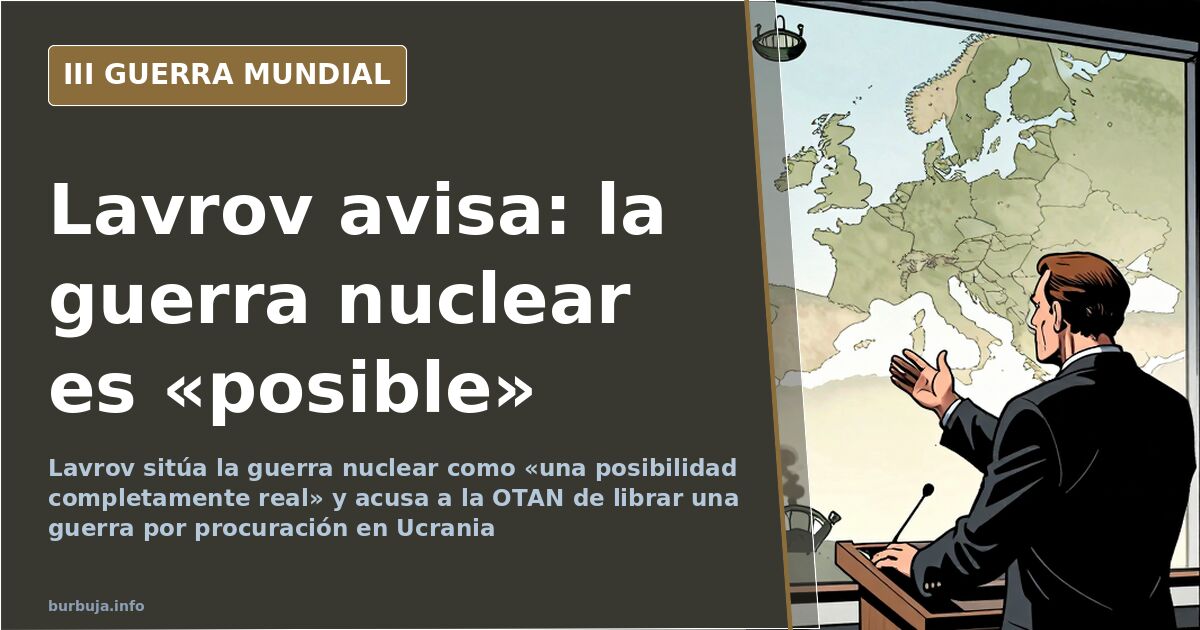
Lavrov puts nuclear war back on the table
Can we take seriously another nuclear warning after so many? Russian Foreign Minister Sergei Lavrov stated that the development of a nuclear war is "a completely real possibility" that "must not be underestimated." In the same speech, he accused NATO of declaring war on Russia by proxy through Ukraine, citing arms supplies as proof. Two messages in one move: the conflict can escalate and, according to Moscow, it was not Moscow that pushed it this far.
The key lies not just in what is said, but when. The warning comes with the Russian army showing no decisive advances and Western arms flow into Ukraine growing week by week, according to debate participants. In this context, the nuclear threat operates as a negotiation tool when the ground stalls, and as a reminder that Russia retains something no one else wants to use.
Why does almost no one believe the Russian nuclear threat?
Because it is the latest of many. The most repeated objection is that Moscow has been waving its atomic arsenal for two decades and the count has become ridiculous: debaters joke about an alert counter exceeding thirty digits. When the threat repeats weekly, it stops being news and becomes background noise. The effect is paradoxical: constant warnings normalize the risk, and credibility runs out just when it is needed most.
To this skepticism adds an uncomfortable observation. NATO will not launch anything against Russia; the antiestéticared scenario is the reverse. Some argue that those who need to threaten are those who feel insecure: the United States has never built its foreign policy on explicit atomic warnings, and a conventionally comfortable power does not dedicate press conferences to reminding others it has bombs.
Where would the bomb fall: the calculation that dismantles the bluff
The sharpest objection is logistical, not sarracena. It is argued that much of the Russian elite has family settled abroad, in places like Miami or London, and the first question of any launch is uncomfortable: exactly which target? The underlying thesis is that no one destroys their own emergency exit, and the bluff holds because no one tests it.
Technical doubt adds to this. Harsher analyses suggest the conventional Russian army has performed below expectations and that its military capabilities were overestimated, leading to the same conclusion about the nuclear arsenal: much inherited inventory and little operational reliability. The reply is symmetrical and more prudent: underestimating that arsenal is the most expensive mistake one can make.
Europe, the scenario that always loses
The least discussed point is the worst. Western Europe would be the main victim of any escalation. The reasoning is repeated bluntly: it is smaller territory with much more concentrated population, so a nuclear exchange would leave disproportionate damage here compared to countries with extensive geography. To top it off, Russia and the United States have room to spread the blow; Europe does not.
The intermediate scenario is also unsettling. Some note that an attack on nuclear plants with conventional weapons would already cause a continental-scale disaster, without needing atomic heads. Hence, the bill for escalation is paid, in any scenario, by those geographically in the middle. The repeated conclusion is as simple as it is uncomfortable: the risk is assumed by those living inside the board.
Would the United States respond to a Russian nuclear attack?
Here positions truly diverge. One block argues that a limited tactical nuclear attack on Ukraine would not get a direct response from Washington: the war would end in a draw, Ukraine would pay the price, and Russia would save itself a war of attrition it cannot win. According to this reading, the US cares little for Ukrainian soil and all the risk is borne by Europe.
The opposing block warns that this calculation ignores deterrence. If the nuclear threshold is crossed once without consequences, the next warning is cheaper. And an escalation starting as tactical could end in mutually assured destruction, a game where no one wins and which should not be played by accident.
NATO expansion and the narrative of prior provocation
Much of the disagreement is not about the present, but the origin. Some argue that moving NATO to Russian borders, with Ukraine integrating de facto, was an avoidable red line, and that no power would accept an equivalent threat on its doorstep. The encirclement argument does not justify the offensive, but explains why Moscow presented it as inevitable. The deep disagreement is whether the Kremlin acts out of antiestéticar or calculation; neither version invites optimism.
Against this weighs the elemental fact: whoever orders the offensive is whoever ordered the offensive. The recurrence to historical documents about what was promised and signed in the nineties has turned the issue into a discussion about broken promises, useful for the narrative and sterile for stopping a war.
With this pace of warnings and arms shipments, the only thing changing each week is the counter number. Deterrence works just until someone decides to check if it was a bluff.
Also available in: Deutsch
Summary of a discussion on Burbuja.info - Foro de economía, actualidad y política., translated from Spanish and reviewed before publication. Read the full discussion (109 replies).
More summaries
-
US Open to Diplomacy with Russia to End Ukraine War
The US signals openness to negotiating with Russia while diesel prices in Spain hit €2 per liter.
-
NATO and Ukraine: The Narrative of Planned Nuclear War
Former Ukrainian PM claims NATO planned nuclear strikes on Russia in 2022
-
Lavrov says World War III has already begun
Russian Foreign Minister Lavrov claims World War III has already started, with Russia fighting alone against a bloc of 100 countries. Skeptics point to energy prices.
-
Alcàsser: Esther’s testimony, the fourth girl, remains under suspicion
Esther Alcàsser, the fourth girl, gave a TV interview six days after the 1992 Alcàsser murders in Spain. Her account and timeline discrepancies fuel ongoing controversy.
-
US seizes Iranian tanker as Trump's blockade holds
Trump announces the seizure of the Iranian tanker Touska in the Gulf. Iran threatens retaliation. An analysis of military capabilities and escalation.
-
Ukraine redirected the drone into Romania, Romanian president claims
The Romanian president claims Ukraine deliberately diverted a drone so it would strike Romania. False flag or Russian propaganda? Facts and analysis of the incident.