
Bonaire parking and the dispute over victim counts
Spain's Bonaire parking lot was drained with no bodies found, but missing data on victims fuels concealment theories.
English · Original discussion in Spanish · Published
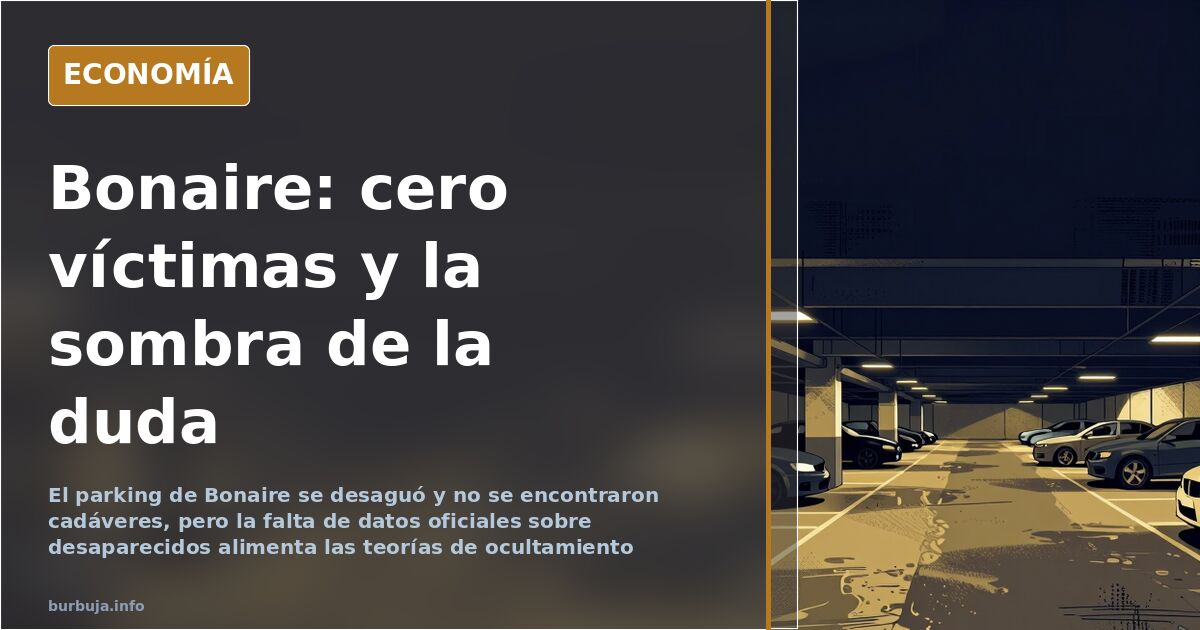
Bonaire parking and the dispute over figures
The car park of the Bonaire shopping centre in Aldaia became the focal point after the DANA storm devastated parts of Valencia province on October 29, 2024. For days, speculation about what lay beneath the water and mud—ranging from hundreds of trapped vehicles to an unknown number of fatalities—spread unchecked. When authorities finally accessed the interior and announced no bodies were found during the initial inspection, the reaction was not unanimous relief. It was the opposite: part of public opinion interpreted the announcement as the start of an orchestrated cover-up.
Why is the zero count at Bonaire parking questioned?
The timeline fueled all suspicions. In the first days, amid absolute chaos and no official narrative guiding information, figures for missing persons reached around 1,900. Later, as authorities took control of the area and restricted access, those numbers plummeted. For many analysts, this abrupt change does not reflect a data correction, but a strategy: what is not counted does not exist.
Some argue the parking lot was drained and inspected in record time, and that videos supposedly debunking the rumor—the one of a young man claiming the lot was nearly empty when evacuated, or people running—appeared on November 5, when the area had already been cleared. The lingering question is why these materials were not released between November 1 and 3, when speculation peaked. The answer given in certain circles is simple: because closing the wound was not convenient then.
Managing the missing: ten years to declare death
One repeated argument concerns the legal treatment of victims. In Spain, a missing person is not officially declared dead until ten years have passed since their disappearance. This administrative gap, which normally protects families, becomes a limbo hindering real counts in catastrophes of this magnitude. Without a body, there is no official victim. Without an official victim, the death toll remains artificially low.
The parallel with the pandemic is inevitable. During the health crisis, daily death updates dominated headlines. Once the emergency lost media interest, those same data vanished from front pages. Now, something similar happens with DANA victims: the number of deaths has disappeared from online headlines, leaving only political talk. Many conclude transparency is practiced only when convenient.
The political tug-of-war: negligence versus conspiracy
The debate quickly shifts to politics. On one hand, it is noted that emergency management fell to the Generalitat Valenciana (Valencian regional government), led by the PP (People's Party), while the Júcar Hydrographic Confederation depended on the central government. Internal emails from the CHJ, showing the Poyo ravine flow jumped from 29 to 1,686 cubic meters per second in hours, are cited as proof sufficient warning could have been issued earlier. The question remains: why wasn't it?
On the other hand, the theory of deliberate manipulation gains traction. It is argued the weakened central government has an interest in minimizing victim counts to avoid further wear. And the Generalitat, under PP control, lacks incentives to acknowledge catastrophic figures. The result would be an implicit pact of silence among administrations of different signs so the final count isn't absurd. A hypothesis lacking verifiable evidence, like others circulating.
Absence of images and information control
A striking detail is the near-total absence of photos or videos of deceased individuals in media. In other disasters, raw images eventually leak. Here, they don't. Those defending the cover-up theory attribute this to confidentiality clauses imposed on rescue and cleanup workers. The lack of images is interpreted as censorship, though it could also stem from respect for victims and families.
The debate on missing persons has become a minefield. Every published figure is questioned. Every silence, interpreted. Amidst this, certainty exists regarding grave negligence in hydrological alert management—a fact even skeptics of conspiracy theories do not doubt. Indignation over incompetence is widespread. What divides is how far manipulation extends.
Where analysis stalls
With available data, it is impossible to know how many truly died in Bonaire parking. Authorities claim none. Significant public opinion disbelieves them. Verification is impossible due to restricted access and outdated official missing person figures. Analysis stalls here: between reasonable suspicion and impossible proof. One thing is clear: disaster management left a trust wound likely taking years to heal, if ever.
Also available in: Deutsch
Summary of a discussion on Burbuja.info - Foro de economía, actualidad y política., translated from Spanish and reviewed before publication. Read the full discussion (105 replies).
More summaries
-
Jucar River Authority Insured Staff for Negligence Before DANA
The Jucar River Authority formalized civil liability insurance for 212 employees on October 7, weeks before the DANA floods devastated parts of Spain.
-
Spain's Júcar Hydrographic Confederation: Delays and Silence During Flood
Five alerts from the CHJ showed delays up to 30 minutes and a 2.5-hour gap as the Poyo stream flow surged.
-
Spain cracks down on Iker Jiménez's team after Valencia floods
Valencia floods spark conflict between Spanish government and media figures Gaitán, Jiménez, and Gisbert amid alleged retaliation.
-
Jon Echeverría, PP's lead candidate in Gipuzkoa, and the pensions row
Jon Echeverría, the PP's number one in Gipuzkoa, Spain, said people live well on a €1,000 pension with a paid-off home. The PP has dropped four tenths in…
-
Galicia sells off its industry: from Avícola Tratante to Aludec
Avícola Tratante, Aludec, Ochoa, Martínez Otero: foreign capital is buying up Galician companies; forum users point to the lack of generational succession
-
Vox and PSOE: the deal no one confirms but everyone talks about
A tweet claims Vox has a deal with Spain's PSOE without providing any evidence. The claim is stirring up a campaign in which, some say, Vox is rising and the PP fears being overtaken.